Big Law has plenty of competition for its best lawyers.
Some of the most ambitious lawyers want to work for clients in their legal departments.
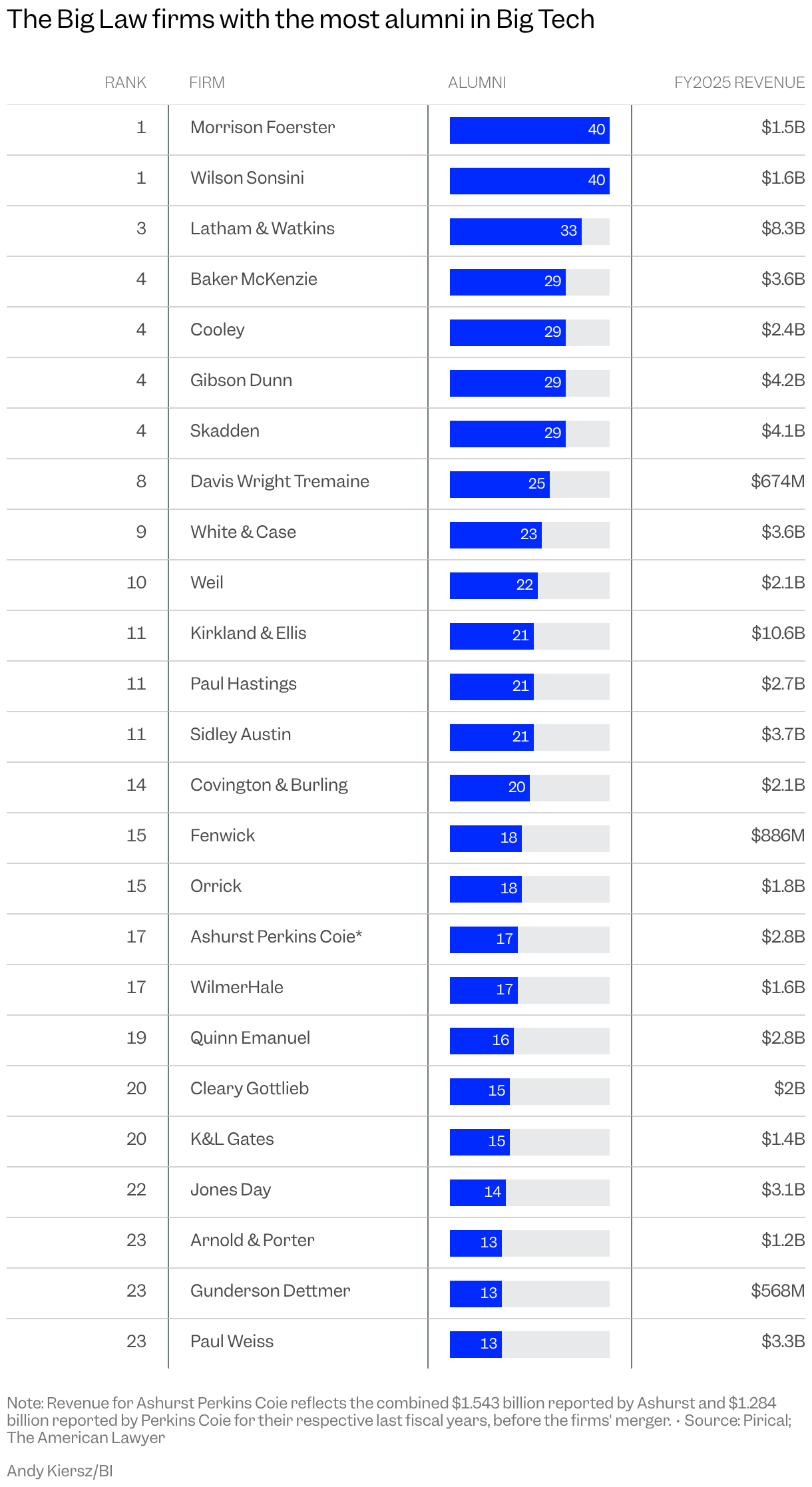
New Pirical data shows which law firms have the most alumni working in Big Tech.
Big Law has a hard time keeping its lawyers.
It's not just rival firms dangling basketball-player salaries, extra vacation, and branded merch to lure away top talent.
Big Tech is competing for those lawyers, too.
New data shared with Business Insider reveals which firms send the most lawyers to the biggest names in tech.
Pirical, a legal people-analytics company, tracked lawyers who previously worked at the 200 largest law firms by revenue in the United States and now hold legal roles at seven tech companies: Google, Meta, Microsoft, Nvidia, OpenAI, Anthropic, and SpaceX. Pirical filtered out summer associates and interns.
Morrison Foerster and Wilson Sonsini tied for the top spot, each with 40 alumni working in legal roles across the seven companies. Both firms regularly represent tech startups and the investors backing them.
Latham & Watkins followed with 33 former lawyers. Kirkland & Ellis, the industry's revenue leader, ranked 11th with 21 former lawyers working at those companies, tied with Paul Hastings and Sidley Austin.
Pirical's analysis may have missed lawyers whose job titles fell outside its search criteria, said Craig Savitzky, its insights and content editor. He said newer companies, particularly Anthropic, are also likely undercounted because their legal teams are growing faster than public profiles are updated.
Big Law-Big Tech pipeline
For attorneys hoping to land a coveted job at a tech giant, a stint at a white-shoe law firm can be a stepping stone. They can trade billable-hour quotas for a seat closer to the business, attractive pay, and just one client to keep happy instead of dozens.
That combination makes these roles "some of the most highly desirable and sought-after positions" for law firm associates, said Casey Sullivan, a recruiter with CMW Legal Search.
There's another draw, Sullivan said. The companies at the forefront of artificial intelligence are wrestling with some of the thorniest legal questions of the day, from intellectual property to regulation.
"That's where the most interesting work is for lawyers," he said.
Not all law firms are equally effective launch pads. Pirical's Savitzky noted that the firms near the top of the list have deep ties to the tech industry, if not the deepest pockets.
Cooley brought in $2.4 billion in revenue last fiscal year, placing it 29th on The American Lawyer's ranking of top law firms by revenue. But it tied fourth on Pirical's list, with 29 alumni working at the seven tech companies, including nine at Nvidia, a longtime client.
Davis Wright Tremaine, which has represented Microsoft in antitrust and employment lawsuits, has 13 alumni working in the software giant's legal department. Fenwick, which advised Wiz and Fitbit on their sales to Google, has 13 lawyers at the search giant.
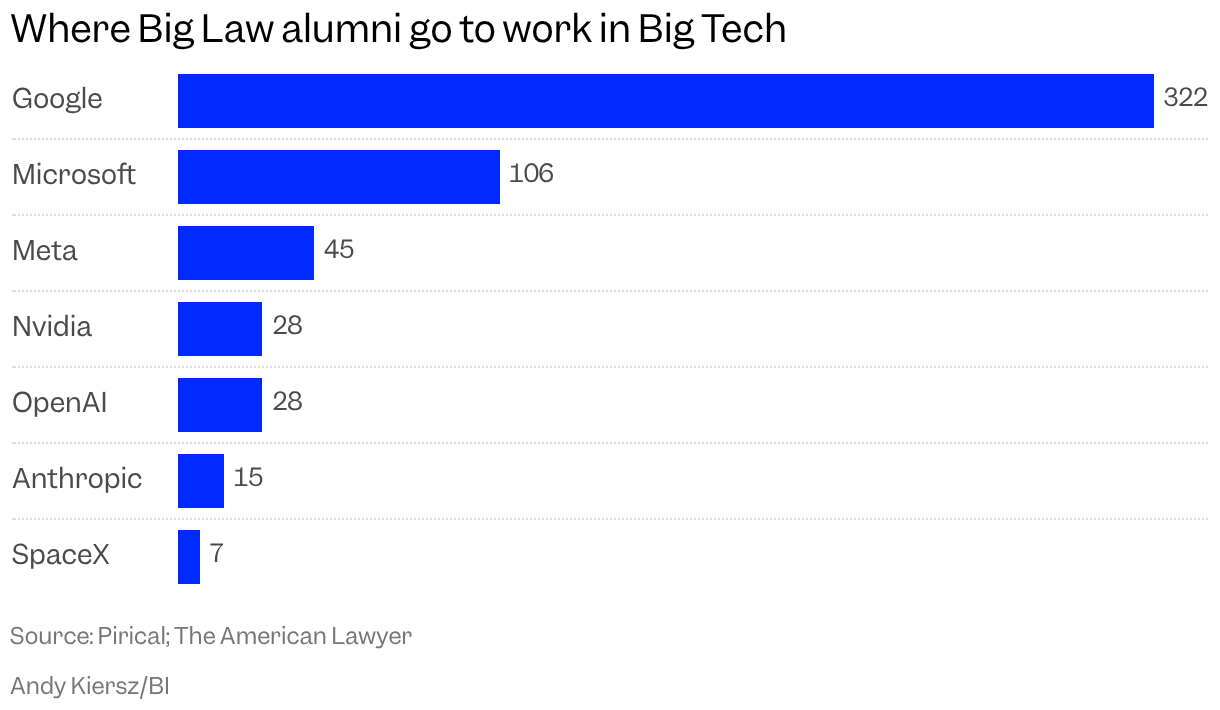
Business Insider also sliced the data another way, looking at which of the seven tech giants employ the most alumni from the top 25 firms on Pirical's list.
Big Law is effectively a feeder school for Google's legal team. The company employs 322 alumni of the top 25 law firms on Pirical's list, more than any other tech company studied.
That doesn't necessarily mean Google is the most desirable location for lawyers leaving Big Law. Savitzky said the numbers likely reflect the sheer size of Google's legal department and the decades it has had to recruit from top firms.
Bloomberg/Getty; Jeremy Strong/Sony Pictures; Finn Gomez/Getty; Tyler Le/BI
Writing villains is supposed to be hard. No grand, world-dominating plan ever really makes sense in a story. Soon after "The Dark Knight" came out, David Goyer, its writer, told me the Joker had been a real relief. "Blessedly, because of who the Joker is, we just said, 'fuck the plan. We don't have to do it. He's the Joker. He's the anti-plan,'" Goyer said. "Trying to take over the world is such an impossible, stupid idea — as if anyone could do it with a single act, you know?"
Yet now very real people seem to try just that, on the regular. Except if you believe Hollywood, they're not insane clowns. They're billionaire tech bros. It's starting to seem like every movie and TV bad guy is a douchebag who got rich making stuff that works on your phone. Mark Zuckerberg in "The Social Reckoning," Elon Musk in "Musk," Elizabeth Holmes in "You Can See Everything," Sam Altman in the upcoming "Artificial," Sam Bankman-Fried in "The Altruists." In these stories, at varying levels of fictionality, the evil villains' megalomaniacal plans mostly make sense. Some of them even got away with it. America is eagerly consuming stories about them. "You Can See Everything" grossed $15 million on opening in just 855 theaters, twice what its producers expected.
The more interesting question is why these founders are our demons, all of a sudden. Chalk it up to the reality of the "techlash," the society-wide revulsion to Big Tech's ubiquity and power. But if you really want to understand the extent to which everyone thinks Silicon Valley is so uncanny these days, you should be watching a CBS legal procedural called "Cupertino." It's a sharp look at tech and its discontents — but more than that, it clarifies how widely the techlash is spreading.
"Cupertino" comes from the TV-making couple Michelle and Robert King, best known for the "The Good Wife" and "The Good Fight." In their new show, a slick lawyer played by Mike Colter gets iced out of the tech company he cofounded at the same time as a more junior attorney also gets ousted. The two join their wrongful-termination lawsuits against the company, eke out a big settlement, and start a firm to represent "little guys" against Silicon Valley giants. In one plotline, a drone maker tries to blame a mid-level coder for one of its bots falling out of formation during a show and killing a man — it turns out the company had changed batteries to accommodate a prospective military contract. In another, a mysterious whistleblower client asks for help to force an Anthropic-like company to put guardrails around its most powerful AI. Then the whistleblower claims to in fact be the AI.
It's all in good fun. The actors are beautiful. They banter well. Colter wears the hell out of a suit. Busy Philipps plays a Mackenzie Scott-like benefactor of the new law firm — if Scott used her incredible wealth to become a hardcore partier.
A CBS show like "Cupertino" picks bad guys that millions of people can easily recognize as deserving of comeuppance. It picked the overlords of Silicon Valley.
But thematically, there's depth. That Colter is the only Black person for miles does not go unremarked. His new partner Olivia Siffre (pronounced "cypher"), played by Rachel Keller, is a devout, cross-wearing conservative from the Midwest, an alumna of Liberty University. Their closest allies don't come from the ranks of coders, marketing, or venture capital but are instead service workers, tradespeople, and the waitstaff from a nearby TGI Fridays. (Alas, a fiction — there are no TGI Fridayses in the Valley.)
So see that class rage for what it is. The fantasy here is that the middle-American proletariat gets to stick it to bespoke-suited, arrogant C-level types and unkempt, geniuser-than-thou sex pests. Because for the last few years, those people have had all the power. "They always have a friendly audience, an accommodating interviewer who won't ask them anything controversial. And then they get into territory where the price is much higher," Robert King said in a recent interview. "They reveal who they really are: robotic, inhuman nerds who never got laid in high school and are now kind of crazy with power, self-importance, and a sense of entitlement."
The point is, the "little guys" fighting this good fight seem like they're supposed to be proxies for the viewer. "Cupertino" is a CBS procedural, the genre of shows like "NCIS" and its offspring — things that no one watches, except for 10 million people every week. That's a lot. CBS typically has the largest primetime viewership of any network, and the oldest — like, people in their 70s. It's all well and good for young coastal sophisticates to post about Elizabeth Holmes' inability to grasp the Who's-on-First routine, but "Cupertino" is aimed at America's parents and grandparents. And apparently they are excited to see the people who make their phones portrayed as the wealthy engines of every inconvenience — sources of half a billion dollars to Republicans only, builders of data centers, creators of chatbots that drive kids to death by suicide, purveyors of screens that watch you back. "Cupertino" debuted to rapturous reviews and more than 3 million viewers, beating "Grey's Anatomy" in its time slot.
A show like "Cupertino" is meant to have a low barrier to entry; it picks bad guys that millions of people can easily recognize as deserving of comeuppance. It picked the overlords of Silicon Valley.
Not so long ago it would've seemed preposterous to give a scrawny, socially awkward, brainy little guy the job of Big Bad. They're the assistant, or the butt of a particular kind of joke, like the spectrum-y heroes of the wildly popular "Big Bang Theory" — Klingon-speaking, physics-doing, Green Lantern oath-knowing clods. Still, I can think of examples of "bad guy, subtype: tech nerd" going back to the early days of science fiction. Mad scientists like Dr. Frankenstein or Dr. Jekyll, or various HP Lovecraft antiheroes, probably count. So too might the arrogant cyberneticist in Robert Heinlein's "Waldo."
A rough analog in the mid 20th century might be the rogue industrialist. After all, James Bond villains have often been tech-bro adjacent. Karl Stromberg in "The Spy Who Loved Me" wants to build independent ocean settlements; he's basically a seasteader. Hugo Drax in "Moonraker" is a eugenics-obsessed CEO who wants to build space stations, which sounds familiar. Max Zorin, played by Christopher Walken in "A View to a Kill," is an "industrialist" and the product of Nazi genetic experiments. But his megalomaniacal plan is to use a California natural disaster to gain a monopoly on silicon computer chips. That's just Jensen Huang on any given Tuesday.
The weirdest new phenomenon here is how personal it all is. Evil technology oligopolies have been representatives of oppressive capitalism in Hollywood for decades — but they were faceless. The anonymity was part of the terror. Think of the company that orders Bruce Dern to destroy the last forest in his spaceship biodome in "Silent Running," the Umbrella Corporation in "Resident Evil," or Cyberdyne Systems, creator of Skynet in the Terminator movies.
More recently, film and television have started identifying not just faceless corporations but specific tech-coded people as their worst-of-the-worst. And not just any people, but people geofenced into Silicon Valley: "Glass Onion," "Don't Look Up," "Ex Machina," "Devs," "Super Pumped" (fictionalized Uber), "WeCrashed" (fictionalized WeWork), "The Playlist" (fictionalized Spotify), and "The Dropout" (fictionalized Theranos), "Mythic Quest" — the list goes on.
Actually, Cyberdyne's a good example of one important way these depictions have changed; in 1984's "The Terminator," Cyberdyne is a Los Angeles-area heavy-industry firm. In 2015, "Terminator Genisys" moved Cyberdyne to a gleaming tech campus explicitly modeled on the headquarters of Oracle. It's an inside joke, though not the ha-ha kind. The movie's producers included Megan and David Ellison, children of Oracle CEO Larry Ellison. David now owns the merged studios of Warner Bros. and Paramount, and he just got a billion-dollar investment from Elon Musk. The new company, Skydance, includes in its holdings … CBS.
Christopher Walken's Bond villain has a megalomaniacal plan is to use a California natural disaster to gain a monopoly on silicon computer chips. That's just Jensen Huang on any given Tuesday.
"A sequence of Hollywood contemporary science-fiction movies identifies Silicon Valley capitalists as a new type of villain," write Northumbria University film studies scholars Joe Street and Russ Hunter in a 2024 paper. These new movies critique tech, they say, using an approach "in the grand tradition of cinematic science fiction touchstones such as the Cold War alien invasion films that allegorized fears of Communism in 1950s America."
In other words, movies about time-travelling killer robots and dead-eyed billionaires aren't so different, after all. Horror is about shared anxieties. Old-school mad scientists posed a threat because they dared to do experiments that contravened the laws of nature; they were evil for love of the game. The Silicon Valley bad guys are worse, because they do it for profit. "When presented with an innovation," Street and Hunter write, "the prime movers in these corporations think not of moral or ethical concerns and crucially not of the material impact of what they are doing — but only of the innovation's potential for financial gain."
Is Hollywood's techlash actually on the rise? The schlemiels of "Silicon Valley" premiered in 2014. I have tech-bro-villain articles in my files going back to 2022 at least. And the business world has always been fodder for stories filtered through the anxieties of the time—what was Ebenezer Scrooge if not a capitalist oppressor?
Mapping the full arc of technology-associated villains would be, in the words of Ted Underwood, "hard to code." Underwood's an English and information science professor at the University of Illinois at Urbana-Champaign, researching ways to identify literary trends across time, in big canons. "In addition to tracing the history of villains, you'd have to think how often these social types appear as heroes," he says. For every Max Zorin there's a Tony Stark. Ethan Hunt's nobody without tech aces Luther and Benji. "Star Trek" doesn't trek without Scotty, or Chief O'Brien. Every movie heist is basically a hack. And let me just say unto you: "MacGyver." "One hypothesis would be that what we're feeling right now with evil tech bro villains is just that the counterbalancing examples have dropped out," Underwood says.
Clearly, though, tech billionaires and their hangers on have actively tried to make themselves into main characters. Some of them seem to think they're the only real consciousnesses in a simulation, a virtual world populated with non-player characters like you and me. At minimum they evince a belief that they possess a greater depth of perception and knowledge. As the architect and tech historian Fred Scharmen once wrote, "for this particular kind of person, wealthy and powerful or not, intelligence comes paired with a certain kind of malignance. The Evil Nerd is sharp, and also mean, their big brains are oriented towards anger and destructiveness."The Thiels, Altmans, Musks, and Karps of the world turn what had been nerdy weakness into nerdy strength. They go on friendly podcasts and show up in pictures taken with presidents. We don't have to imagine them delivering what the screenwriter John Rogers, creator of the anticapitalist TV show "Leverage," calls the Evil Speech of Evil. They monologue at tech conferences! These guys embody their ideologies; l'enterprise, c'est moi.
And what happens if that kind of behavior gets depicted, week in and week out, on a popular legal procedural TV show? Even if that show airs on a network owned by one of those "evil nerds"? Hard to say. Maybe it'll be enough to turn some people into the Joker.
Danielle Fewings before and after receiving Sculptra and cheek filler.
Courtesy of Danielle Fewings
Danielle Fewings, founder of Get Clear Beauty, has invested in cosmetic treatments since she was 27.
Fewings' journey with aesthetic procedures began with a breast reduction and includes Botox and filler.
Her $150,000 investment in herself has supported both personal confidence and professional success.
This as-told-to essay is based on a conversation with Danielle Fewings, a 40-year-old entrepreneur from New York City. The following has been edited for length and clarity.
I started my career in digital marketing and ran my own agency from 2020 until 2025, when I sold it. I'm now the founder of Get Clear Beauty, an aesthetic treatment marketplace, which I started in 2026.
I've always felt like there was something missing from my appearance, as if someone much more confident was buried beneath it all. I got my first procedure done in 2013 and have had many since.
I don't regret any of them.
I'm the most treatment‑forward person in almost every room I'm in
In my broader New York circle, routine maintenance is completely normal. People are getting Botox and lip filler, and a few have had breast augmentations. Most are dipping in rather than going all in.
I'm honestly the most treatment-forward person in almost every room I'm in. In any given conversation, I'm the one who's had the most work done, which is a little wild when I think about it.
For most of the people I know, the max is Botox. Routine maintenance is common around me, but no one I'm close to has done anywhere near as much as I have.
My first major decision was my breast reduction at 27
I wore a 32G and desperately wanted them smaller. I call this my gateway surgery because it was honestly a very easy recovery, so I had this ease as the template, which gave me the confidence to keep pursuing additional treatments.
It made me more willing to put myself out there, both in dating and especially in showing up online to create content for my business, which matters enormously when you're building something. It shifted how I approach relationships, too, both friendships and romantic ones.
When you feel confident inside and out, you see yourself as more valuable, recognize your worth, and become more selective about who you let into your life. As I've felt better about myself, I've been more intentional about the relationships I keep close, and I see a direct correlation between the two.
I've never made decisions due to outside pressure
My choices have always been personal. I've never done any of this for another person or because of outside pressure. It has always been about putting my best self forward, and if that takes some tweaks and some money, I'm willing to do it.
I'm a very confident person — I just haven't accepted every imperfection. My upper blepharoplasty is a good example: most people would say I didn't need it, and they would be right, because no one needs any of these things. I wanted it. My eyelids felt heavy, and I chose to change that.
I'm fully committed to antiaging and the maintenance it requires. I go to my quarterly Botox appointments and my annual lip filler appointments, and I'll be ready for a facelift when that time comes. The idea that aging gracefully means avoiding treatments is absurd; aging gracefully is doing whatever feels good to you as an individual.
The cost breakdown
Because my first breast surgery was a reduction, I paid $6,000 out of pocket, and my insurance covered the rest. I had a full-body makeover in the Dominican Republic, which included a tummy tuck, skin tightening, and two further breast surgeries after major weight loss, costing around $12,000. I've also had liposuction, scar revision, an upper blepharoplasty, Sculptra and filler, a Morpheus8 treatment on my legs, tattoo removal, lip blushing, microblading and shading, Invisalign, and teeth whitening. These procedures have cost about $50,000 in total.
The maintenance I keep up with regularly includes manicures and pedicures, which I have gotten every two weeks for the past 10 years; lash extensions, which I have gotten every three weeks for about 15 years; Botox; more filler; peels and lasers; tanning; and haircuts. The recurring maintenance has cost about $105,000 over time.
What struck me is that the one-time procedures come to about $50,000, but the quiet, recurring maintenance is over $100,000. The costs nobody tracks are the ones that add up the most. That is exactly why I built Get Clear Beauty.
Each procedure served a purpose
My whole philosophy has been doing high-maintenance things to stay low-maintenance. The lashes, manicures and pedicures, lip blushing, and microblading are all upkeep that let me feel put-together with minimal effort, and because of them, I barely wear makeup, so some of that cost is a trade-off.
The bigger procedures came from real changes in my body. My weight has gone up and down for years, and that has driven a lot of it. The Morpheus8 on my legs was for skin laxity, because I'm not ready for a leg lift and probably don't need one. I've had three breast surgeries total.
I'd never do CoolSculpting, and I'd never have a nose job. I don't think CoolSculpting is cost-effective, and I've grown to love my nose.
My appearance impacts confidence, and confidence impacts business
When you're on 15 Zooms a week and constantly recording content to win business, looking and feeling your best matters.
Appearance affects business outcomes, but for me, it works through confidence. When I feel good about how I'm showing up, I represent my company more powerfully and carry my knowledge into the room in a way that lands.
I love how I look. 10 years ago, I never thought looking this way was achievable, and it's the result of a GLP-1 medication, surgeries, and really taking my appearance by the horns. I'm in a genuinely happy place with it.
Bill Gates says AI will bring about an age of abundance in 20 years, but it'll be a rocky road.
He predicted robots will displace human workers and "build houses, grow food, do surgery."
Some jobs might be reserved for people, and work limits could preserve employment, Gates said.
Bill Gates says AI will create "true abundance," but the next two decades before it arrives will be "as tumultuous a period as there's been in human history."
"My big concern is this 20-year transition period, where they'll have winners and losers and a lot of disruption," the Microsoft cofounder and billionaire philanthropist said on the latest episode of the "Decoder" podcast.
Gates echoed widespread concerns about white-collar jobs, saying that telesales, telesupport, and accounting will disappear as AI will be able to do those "radically cheaper, radically faster, and even more accurately." As for blue-collar jobs, humanoid robots will take over those, he said.
"If we don't choose to massively slow down or stop, then we will have robots that can build houses, grow food, do surgery," Gates said. "And none of the things that human labor provides to the economy will be necessary for most goods and services."
He also underscored howjarring it will be for someone like him, whose vast resources have allowed him to lead the charge toward eliminating malaria and tackling other humanitarian crises.
"And when the AI says to me, 'No, I'm better than you, you go play pickleball and I'll get back to you, I'm gonna take care of this' — I mean, it's kind of humorous, but it's not humorous," he said.
Gates shared his long-held view that work is vital to giving people a sense of purpose, a way to earn an income, a reason to show up every day, an avenue to build relationships with colleagues, and a path to build things and solve problems.
He suggested that certain activities such as art, sports, cooking, and childcare could one day be reserved for humans, "even though the AI could do those things better."
Gates also highlighted that measures such as early retirement and caps on working hours could help maintain some level of human employment.
He envisioned some people saying, "Let's be like the Amish and let's only use AI for certain things," so they won't have to give up "helping each other or coming up with unique ideas."
Amazon founder Jeff Bezos and JPMorgan CEO Jamie Dimon have both proposed a shorter workweek as a less painful alternative to AI-driven unemployment.
Gates is one of several tech leaders to warn of job disruption on the road to an age of abundance.
Elon Musk has predicted a "bumpy" transition and proposed government checks for all as the best solution to AI-driven job losses. He's said that technology will drive production costs so low that everyone can have "whatever stuff they want," work will become "optional," and it's not worth saving for retirement in 10 or 20 years as money won't matter.
Similarly, Anthropic's Dario Amodei has said that AI promises to "raise the quality of life for everyone," but the "short-term shock will be unprecedented in size."
However, OpenAI's Sam Altman said in May that AI hasn't eliminated as many white-collar jobs as he expected, and he no longer anticipates a "jobs apocalypse."
Despite widespread worry about AI taking corporate jobs, and high-profile layoffs at major companies such as Amazon and Meta, national unemployment hasn't increased materially during the AI boom.
It's the only drug that can shrink oil glands, potentially clearing pimples for good. But it comes with serious risks — primarily: a high rate of birth defects if you take it and become pregnant. Other side effects include sun sensitivity, high cholesterol, mood changes, and joint pain.
Parents are scared to put their teens on it. Dermatologists often reserve it for stubborn acne, after other creams, cleansers, antibiotics, and pills have been exhausted. And strict pregnancy-prevention rules mean monthly check-ins, tests, and blood work.
But in recent years, some of the stigma around the retinoid drug, generically called isotretinoin, has started to fade, as people have gravitated to a smaller, more strategic "Hollywood dose" of Accutane. By taking small amounts of the drug, maybe just a few days per week, many patients find they can maintain a dewy, glass-like complexion on camera while avoiding painful side effects like ultra dry skin, and the initial acne breakout purge that comes with heftier prescriptions.
"I love the Accutane glow-up," Honeydew dermatology founder David Futoran, 29, said. For him, it includes hair that's less oily, and baby-soft cheeks.
Futoran is partly responsible for turning Accutane from a maligned prescription of last resort into a buzzy internet sensation. He's found new ways to streamline and digitize paperwork, turning most of the required monthly doctor's office visits and testing for the drug into something people can do at home. Honeydew is now growing 3x year over year, Futoran said, and interest in low-dose prescriptions is increasing.
Dermatologists are divided on the trend of microdosed Accutane. Yes, it is a very effective drug, and it can clear up most breakouts. But there are tradeoffs to taking an intermittent or low-dose approach, and some doctors say why bother dancing around side effects when you could get on and off the potent drug in months, and have clear skin for life?
Founder mode for skin
David Futoran started Honeydew because he was so frustrated by monthslong wait times for dermatology appointments.
Honeydew
Futoran founded Honeydew in 2022 after spending years on various antibiotics and multi-step cleansing and cream routines, with his acne constantly coming back.
His vision was to make prescription acne care faster and more accessible. He partnered with his longtime dermatologist, Dr. Joel Spitz, to build a telemedicine platform connecting patients with providers and treatments for acne, rosacea, eczema, and psoriasis.
Yet Futoran was still hesitant to take Accutane himself, partly because of the logistical headaches.
One morning, he said, he woke up with a large, painful cyst in the middle of his forehead. That was it, he said — he decided he was finally going on the low-dose form of Accutane his company had been prescribing.
Futoran says he reached a breaking point when he woke up with this painful cyst on his forehead.
David Futoran
"I should have done that from the start," he said. "My skin is way less irritated than it ever was on any of the topicals, and I just have peace because I know it works."
Accutane works because it shrinks oil glands by turning down sebum production. It triggers the death of some stem cells, which is great for clearing up overactive oil-producing glands, but very bad for developing fetuses.
In addition to making regulatory compliance digital, Honeydew offers specially formulated lip balms, cleansers, antihistamines and supplements like Omega-3 designed to replace lost oil.
Bringing a celebrity skin trick to the masses
Mikey Narine, a model and influencer, was prescribed Accutane through Honeydew. He says his confidence has skyrocketed, and his face is totally clear.
Mikey Narine
Celebrities including Chris Pine, Pete Davidson, Emma Stone, and Kendall Jenner have all been open about using this powerful oral retinoid to help clear up persistent acne. The shadow business of microdosing Accutane, though, using it as a glow up drug even for minor, isolated breakouts, happens more through a whisper system between doctors and patients.
26-year-old marketing manager and social media influencer Kennedy Faris started microdosing Accutane with Honeydew in the spring. About a decade ago, she watched her little brother suffer some of the rarer mental health side effects of Accutane, and she was worried about the possibility the drug could lead to depression.
"My brother's a very happy person, so it was really scary," Faris told Business Insider. "I was really hesitant about starting."
After struggling to get a prescription from an in-person dermatologist, Faris heard about Honeydew from a follower and partnered with the brand. She started on a low dose of 10 milligrams, working her way up to a standard 40 mg dose over the course of a few months.
After years of trying different skincare products, antibiotics, and medications, she feels like she's finally found a more permanent solution to cystic acne. There are drawbacks to being on the drug, she said, including sensitivity to alcohol, sunlight, and some nightmares. But the real benefit has been her renewed confidence, optimism, and joy, with friends noticing she's "more bubbly and happy," she said. "I was like, 'wow, I was kind of depressed.'"
Because the drug shrinks pores, Faris has also noticed her face and nose appear slimmer.
"Everyone talks about the fake nose job," she said.
Some patients recovering from real nose jobs even use the drug to lower surgery-related inflammation and shrink pores on the nose while their face heals. As testosterone therapy booms, more men are taking Accutane to deal with oilier skin. And increasingly, patients are lining up for low-dose Accutane for minor breakouts, just to be in the clear. People are gravitating to skin treatments that will give them the edge at work and on screen, Spitz said.
"Everyone's on Zoom or Google Meets or they're on TikTok or they're on Insta, and they want to look good," he added.
The potential drawbacks of microdosing
Microdosing can ease side effects, but the results may not last as long.
Honeydew
Some doctors worry that microdosing Accutane could lead to more health complications if people stay on the medication for years at a time.
"In my practice, I just basically put people on the standard dose and then they're done at five months, and then they feel much better, Dr. Ariel Ostad, a dermatologist in Manhattan who is not affiliated with Honeydew, said. "Patients, once they go on it, their skin clears up really quickly, and they're happy, and they realize it's not as bad as they thought."
A shorter treatment course means less time worrying about drug interactions, liver or heart health, pregnancy, sun sensitivity, or bone issues.
Futoran said traditional dosing can be "absolutely the right answer for some patients," and roughly 40% of Honeydew prescriptions are at standard dosages. Still, he cites studies showing patient satisfaction is higher with low-dose Accutane, and said Honeydew patients on smaller dosages have "materially better retention."
"The best clinical outcome is when patients complete their course, but faster is not always better," he said.
The design platformlaunched Canva Craft on Thursday, its first image-generation model, similar to those from Google, Meta, and OpenAI.
Users can access Craft through Canva’s Dream Lab, including with free accounts, though it is subject to AI usage limits. You’ll need to sign in to a Canva account to get started.
In the release announcement, Canva said the tool plans a design’s layout, proportions, and text before generating an image, an approach that aims to help it produce legible lettering and accurate details.
The company also said that the model was trained on human-designed Canva templates, including posters, menus, and presentations, rather than photographs.
To test how Canva performs, Business Insider created three image generation prompts with escalating difficulty levels — from designing a simple greeting card to creating a photorealistic image from scratch.
Here is how Canva's brand-new image generation tool stacked up against three of the most powerful models.
Canva did not respond to a request for comment.
Starting off with an illustration
Canva's response to a greeting card prompt (left), compared to ChatGPT (middle) and Gemini (right).
Business Insider
We started off simple with a prompt for a birthday card.
Create a cartoon "Happy Birthday" greeting card for a friend named Jessica who has pink hair, brown eyes, likes to wear paisley, and is turning 28 years old in November.
Surprisingly, Canva, the design platform, fell short in its design of the birthday card, from the awkward font to the outsize head of the cartoon character. It didn't even bother to include any paisley.
By comparison, ChatGPT and Muse understood the assignment.
ChatGPT guessed that the recipient's favorite color might be pink, while Muse thoughtfully wove in cozy fall elements for the November birthday girl.
Muse wove in cozy fall elements for the November birthday girl.
Screenshot/Business Insider
Meanwhile, Gemini took the request literally and produced an image of an actual card. Extra points!
Winner: Muse
Editing an image
The request and original image (left). Canva's results (right).
Screenshot/Business Insider
For the second task, I tested the AI models' ability to identify an element and place it in a brand-new setting.
Edit this image of me holding a necklace pendant. Take the red garnet pendant off my hand and make it look as if it is displayed in a vitrine in a jewelry showroom.
Canva did a great job of identifying the pendant and creating an atmospheric setting, but, like Gemini, it depicted the jewelry in a way that defied physics and common sense. It would be unrealistic for a pendant to float in the air or sit propped on a metal pole.
ChatGPT (left), Muse (middle), and Gemini (right).
Business Insider
ChatGPT and Muse once again outperformed other models in understanding how things typically look in reality. Muse, however, made some alterations to the pendant, which I didn't ask for.
Winner: ChatGPT
Creating a photorealistic image from scratch
Canva's depiction of a cat perched atop a gothic castle.
Made with Canva/Business Insider
With Halloween approaching, I asked for a realistic depiction of my favorite animal.
Generate a photorealistic image of a long-haired orange tabby cat in a Halloween costume with bat wings, perched on the edge of a gothic medieval castle under the full moon and a starless night sky.
Though the cat's fur looks a little too strandy and high-contrast in Canva's creation, no components are missing or malformed, and the image composition pretty much matches the quality of Muse and Gemini.
The clear winner for me in this round, however, would be ChatGPT.
Gemini (left), ChatGPT (middle), and Muse (right).
Business Insider
Not only is the cat's posture majestic, but the soft glow on his left side is extremely realistic, and the white balance is well done. There are also clouds softly cradling the moon, which could be a response to my request for a starless sky.
Winner: ChatGPT
Overall, it's evident that Canva still has a lot of room to grow compared to other models, especially if graphic design is its focus. For now, I'll stick to moving components around by hand.
Sundar Pichai says Google's researchers are using AI to help build the next AI models.
Hardik Chhabra/ The India Today Group via Getty Images
Sundar Pichai said Google was still in the early phases of recursively self-improving AI.
Researchers are working with AI agents to build better models, he said.
Sergey Brin recently said Google was "starting to get onto that RSI treadmill."
Google's AI models may be helping to build their successors, but CEO Sundar Pichai says the moment of fully self-improving AI is still a while away.
Speaking on an episode of the "Big Technology Podcast" this week, Pichai said that Google researchers were using AI agents to assist them when building models, but caveated that it was still early days.
"We are pretty far from the end state of RSI," said Pichai, referring to recursive self-improvement. "The right way to describe it is, you have RSI loops along with AI researchers in various aspects of model development. I would say you almost have agents helping AI researchers, in some automated way, work together to build these models."
Pichai added that he expected that continuum to keep making progress into next year.
Earlier this month, Google cofounder Sergey Brin said the company's Flash series of models, as well as Gemini 4, were demonstrating how AI was helping to build itself, and that Google was "starting to get onto that RSI treadmill."
"And now our researchers and the model work hand in hand to make the next version of the model," he said.
Brin has been increasingly involved in Google's Gemini efforts and has leveraged his power as cofounder to shift resources to projects he deems most effective, Business Insider previously reported. This has included pushing for more focus on RSI.
A report from the firm Gladstone AI, published earlier this month, said that most researchers interviewed from companies including Anthropic and DeepMind believed RSI will start within the next three to 12 months, and possibly sooner without government intervention.
In another moment on the "Big Technology Podcast," Pichai was asked about how much AI was being used to code internally. The company said in April that 75% of new code inside Google was generated by AI.
"That number in our world today is like meaningless in the sense that every part of code we now touch is influenced by AI deeply," Pichai said. With Gemini 4 Argon, he said, people were going to tackle harder problems. He also said Google was seeing a one-third decrease in code rollbacks, where software is reverted to a previous version because of a bug or system issue.
"And so I think people are writing code more productively, and better code with it," he said of AI tools.
Pichai also uses AI to track Google's model development and internal discussions, he told the "Sources" podcast this week.