
Tuesday, 30 September 2025

Monday, 29 September 2025
OpenAI's newest team is proof that there's a key shift happening in the AI talent wars
Florian Gaertner/Photothek via Getty Images
- OpenAI is launching a new "applied evals" team to help businesses using its developer product.
- The team will help create evaluations for complex tasks, like refund requests.
- It's seeking engineers with "real, deep, lived expertise."
Earlier this month, an OpenAI engineer announced he was hiring for a new team.
OpenAI is building a new team called "Applied Evals," which helps businesses refine complex processes using AI, like refund requests or migrating code. The team will also focus on voice AI and multi-step reasoning tasks, said Shyamal Anadkat, who is leading that team at OpenAI. Pay ranges from $255,000 to $325,000 for the role plus equity, the new listing said.
Evals refer to measuring the capabilities of AI models, which Anadkat called "the most critical part of actually building AI products."
This new team reflects a shift across the AI talent landscape.. The tech industry has long hired technical minds to build and train AI models, and now people with specific subject-matter expertise are being tapped to make these models useful, AI founders and executives told Business Insider.
Anadkat's post said his team will comprise engineers with "real, deep, lived expertise." He said it will start with generalists. He plans to bring in specialists from different fields, such as software engineers for code-related tasks and, perhaps eventually, humanities-focused workers if there is more demand for tasks like writing.
Anadkat told Business Insider the team will work with companies using OpenAI's developer platform to help them create their own evals for specific use cases.
"OpenAI started as a research lab, and then we built a product," he said. "Now the shift that, at least I hope we'll see, is how research and product can work very closely together and collaborate on some of this to basically define what good looks like."
Anadkat's team is starting small and will grow with demand. It's exclusively focused on business customers, operating separately from the teams working on OpenAI's consumer-facing businesses, like apps or consulting.
Applied Evals will work with OpenAI's sales and business teams to determine what projects to prioritize based on customer need and where its models are underperforming, Anadkat said.
The AI talent shift
The AI industry has long had engineers work on evals within companies, large and small, though they mostly evaluated if the AI model was working well or not.
Over time, they've shifted from "thumbs up or down" to being more focused on context and asking the right questions, said Michael Jacobides, a strategy and entrepreneurship professor at London Business School.
"There's probably a hundred people in the world that could lead a team to build these frontier models," said Justin Farris, vice president of product at Read AI, "but there's so much work that needs to be done to take those and make them useful."
AI is increasingly moving from generic to specific use cases, said Tanmai Gopal, CEO of PromptQL.
"For a lot of applied use cases, the ways of working out what good is and what bad is start to become quite nuanced," he said.
Have a tip? Contact this reporter via email at gweiss@businessinsider.com or Signal at @geoffweiss.25. Use a personal email address and a nonwork device; here's our guide to sharing information securely.
from Business Insider https://ift.tt/ePWsloa


Jensen Huang says Trump's H-1B change is 'a great start' — but the $100K price tag for new visas is too high
Leon Neal/Getty Images
- Nvidia CEO Jensen Huang said Trump's $100,000 H-1B visa fee is "a great start."
- But the new fee "probably sets the bar a little too high," he added.
- Huang said the US must remain mindful of how such policies affect global talent flows.
Jensen Huang said President Donald Trump's $100,000 H-1B visa fee could put the American dream further out of reach for immigrants.
The Nvidia CEO said on an episode of the "BG2 Pod" published Friday that the Trump administration's move to change America's H-1B visa program is "a great start," but added that the $100,000 fee "probably sets the bar a little too high."
The policy "at least eliminates illegal immigration" and abuse of the visa system, but the steep cost might mean more investment outside the US, Huang said.
He agreed with tech investor and podcaster Brad Gerstner that the fee also tilts the playing field toward Big Tech firms that can more easily afford to sponsor visas, leaving startups at a disadvantage.
Huang said the US must remain mindful of how such policies affect global talent flows, saying they could make "foreign students uncomfortable."
He pointed to Chinese researchers as one example, separating the ideas of the US competing with China as a country from American policies that affect Chinese people.
"We need to make sure that that slippery slope isn't crossed," he added.
Talent inflow is an early indicator of the country's future success. "Smart people's desire to come to America and smart students' desire to stay, those are what I would call KPIs," Huang said, referring to key performance indicators.
The Taiwan-born CEO has often described his own journey as a product of the American dream. America's immigration system is in a "difficult situation," and Trump has limited time to improve it, Huang said. Any move that addresses the country's ability to attract and keep top talent is a step in the right direction, the CEO said.
The H-1B visa change is a good start — but it shouldn't be the end, he added.
Nvidia is one of the largest tech employers of H-1B visa holders in the United States. At the end of fiscal year 2025, the company had 1,519 H-1B filings and 36,000 employees worldwide, a Business Insider analysis found in March.
An Nvidia spokesperson declined to comment.
Reactions to new H-1B $100K fee
Business leaders have been weighing in on President Donald Trump's new $100,000 fee on H-1B visas. The White House told Business Insider earlier this month that the fee would only apply to new applicants, not those renewing their H-1B visas.
The US issues roughly 85,000 new H-1B visas via a lottery system every year. The H-1B program is highly popular among US companies looking to hire foreign workers for in-demand roles such as tech and engineering
Huang said in a joint interview with OpenAI CEO Sam Altman last week that he was "glad to see President Trump making the moves he's making."
"We want all the brightest minds to come to the US, and remember immigration is the foundation of the American dream. And we represent the American dream," Huang said during an interview with CNBC. "Immigration is really important to our company and is really important to our nation's future."
Altman said the Trump administration's introduction of the fee was the right move.
"We need to get the smartest people in the country, and streamlining that process and also sort of aligning financial incentives seems good to me," Altman told CNBC during the joint interview.
from Business Insider https://ift.tt/gcoCab2
Sunday, 28 September 2025
John Studzinski is a legend of Wall Street and philanthropy. He shares 5 reasons young people should give back.
Riccardo Savi/Getty Images for Concordia Summit
- Wall Street veteran John Studzinski says giving can help young people succeed at work and in life.
- The Pimco vice chair said helping others can build relationships and provide perspective.
- Giving small sums or volunteering can have big impacts that quickly multiply, he said.
Many young people dream of making bank on Wall Street. But industry titan John Studzinski said it was generosity, not greed, that fueled his career success.
Studzinski, 69, held senior roles at Morgan Stanley, HSBC, and Blackstone over five decades and is now Pimco's vice chair.
He started giving at age six when he volunteered in a soup kitchen, ran a health hotline as a teenager, worked with Mother Teresa in New York during the AIDS crisis, and set up the Genesis Foundation in 2001 to nurture young artists, and the Arise Foundation in 2015 to combat modern slavery and human trafficking.
Studzinski, who published "A Talent For Giving" this month, shared five reasons young people should start giving and continue throughout their lives.
1. Giving helps you connect with others
Studzinski told Business Insider that giving has "enhanced" his career by helping him connect with people and expanding his professional network.
Engaging with a broader range of people means "people will be more engaged with you," and inclined to trust you, work with you, and share their contacts with you, Studzinski said.
He said he found, from his early years at Morgan Stanley, that clients and colleagues were more interested in him because he was a more "eccentric or eclectic or diversified character" than his peers.
Studzinski said that people have called him "out of the blue" and asked to meet him because of his giving, and spent the first half hour of their conversation discussing his philanthropic work.
2. You don't need millions to make an impact
Wealth isn't a barrier to giving, as the quality of your impact on others matters more than the quantity of people you help, Studzinski said.
"You can accomplish quite a lot with very little money," he said, as you can focus it on "changing the world one person at a time." That approach can have a "domino effect" as each individual you help could become a mentor, a guide, or a teacher to others, he said.
Cash-strapped youths can also use their "talent as a currency," he said, as they can apply their skills to solving social problems.
3. It helps you see the big picture
Making giving a habit teaches you "patience and the ability to listen and observe," which can help give you perspective when you make decisions, Studzinski said.
That's important in navigating a "very volatile" US economy that's being buffeted by uncertainty over AI, tariffs, and the Federal Reserve's independence, he added.
4. Your impact can multiply quickly
Postponing giving until old age means "depriving yourself of lots of great opportunities" to grow and develop, Studzinski said. If you give throughout your life, your giving can compound and multiply, he added.
He said that's why he still works in finance: because the more he earns, the more he can give away as part of his commitment to donate half of his income.
5. Giving can be a way to address what you're unhappy about in the world
Giving provides an avenue for young people to harness their talents to address what they're unhappy about in the world, Studzinski said.
It can also help to focus on someone else and realize "they're much worse off than I am," he said.
Studzinski added it could be a "very nurturing process" that's best viewed as a two-way street, Studzinski added.
He said ongoing engagement, rather than a one-off donation, can result in a "real partnership with a reciprocal set of benefits" that helps people better understand themselves and their strengths.
Studzinski added that helping someone, then seeing that person help someone else can give a "much more positive view not only about themselves but about the world."
from Business Insider https://ift.tt/c4dAGUa
Get used to an America with fewer jobs
Michael M. Santiago/Getty Images
- Trump ramped up immigration deportations this year.
- Hiring has slowed way down and US-born unemployment is on the rise.
- This summer's disappointingly low job growth may be a new normal.
We're learning what America looks like with fewer immigrants and fewer jobs.
The Trump administration has been cracking down on immigration over the past few months, ramping up deportations and travel bans. It recently announced a $100,000 fee for new H-1B visa program applicants, which could affect some major companies, like Amazon, that leverage the program.
Immigration policies could be exacerbating the defining feature of the frozen 2025 labor market: Workers haven't faced mass layoffs, but hiring has slowed to a crawl. A more slowly-growing labor force with lower levels of immigration will likely see a much lower level of job growth, but weak labor demand with weak supply means that unemployment may not spike. And even native-born workers have not yet seen a major boon to employment in that continuing slow market.
Dante DeAntonio, labor economist at Moody's Analytics, said there's "no doubt" immigration policy changes are affecting the job market.
"There was a clear downshift in labor force growth starting in the second half of 2024, and the labor force has flatlined so far in 2025," DeAntonio said. "The most immediate impact of this change is a likely shortage of available labor, particularly in industries that are more heavily reliant on foreign-born labor, such as agriculture, construction, and leisure/hospitality."
Abigail Jackson, a spokesperson for the White House, said President Donald Trump aims to grow the US economy and add job opportunities for Americans.
"There is no shortage of American minds and hands to grow our labor force, and President Trump's agenda to create jobs for American workers represents this Administration's commitment to capitalizing on that untapped potential while delivering on our mandate to enforce our immigration laws," Jackson said. "The Trump Administration is focused on protecting the American workforce, ending instances of labor exploitation or trafficking, and working with American employers to ensure they have the legal workforce they need to be successful."
Below are some of the ways immigration has affected the job market.
We may have to get used to fewer jobs
Declining immigration means a more slowly growing workforce, which could make this summer's disappointingly low job growth a new normal.
One measure used to assess the labor market's performance is the breakeven rate, or how much job growth is needed to keep unemployment steady as the labor force adds more new entrants from immigration and young people aging into their working years. A more slowly-growing workforce from lower levels of immigration would make that breakeven rate drop, and that could lead to lower job growth in the long run.
We won't know the full extent of how the likely decline in immigration has affected population growth for a while, so estimates for how many jobs the US needs to add each month to keep unemployment stable in the long run could vary widely.
Jed Kolko, a senior fellow at the Peterson Institute for International Economics, told Business Insider that if net immigration is zero, it would mean a breakeven rate close to August's job growth. However, he cautioned that we don't yet know the full extent of the immigration slowdown. A blog post from Kolko showed that the breakeven rate in early 2024 was much higher.
Other estimates for that breakeven rate are higher. A Morgan Stanley note in early September said that 70,000 jobs added a month by the end of the year is probably consistent with flat unemployment. That would mean recent growth is too low.
On the other end of the spectrum, David Kelly, the chief global strategist at JPMorgan Asset Management, told Business Insider the payroll growth needed to keep unemployment constant could be around zero.
"You've got very weak growth at this stage in the economy because we've got really no increase in the number of people available to work," Kelly said.
US-born unemployment has increased
Immigration changes don't necessarily mean a better job market for non-immigrant job seekers. The native-born unemployment rate has ticked up from January's rate.
"Some people expected that a slowdown in immigration would open up jobs for native-born workers," Kolko said.
People are having a hard time getting a job because companies aren't so eager to hire or lay people off as they deal with economic uncertainty. "Sending immigrant workers away is not going to insulate workers from the labor market impact of tariffs or a recession," said Chris Martin, the lead researcher at company-review and job-search platform Glassdoor.
Pay is one reason DeAntonio thinks immigration changes would take a while to see a positive effect on non-immigrant job seekers. He said that "non-immigrant labor is not a perfect substitute for immigrant labor because the types of jobs and occupations filled by immigrant labor are lower paying, on average, and many non-immigrants are unlikely to fill those positions unless pay rises substantially."
The recent H-1B changes could mean employers look to offshore work or check out other visas. "We will likely push to get employees O-1 visas instead now," one startup founder told Business Insider. A 2023 paper from Britta Glennon, an assistant professor of management at the University of Pennsylvania's Wharton School, found that US multinational companies that encounter H-1B visa restrictions tend to ramp up hiring in other countries, especially in China, India, and Canada.
Glennon told Business Insider that multinational companies are probably going to ramp up offshore strategies unless they really need talent in the US.
"If they're intensifying the offshoring, that's more jobs and investment going abroad, rather than the US," Glennon told Business Insider, adding that such a development would run counter to the intent of the policy changes to visa programs like H-1B. She added that not all employers, including startups and universities, have the resources or option to offshore.
The construction sector is having a hard time
Some sectors that rely more on immigration are not growing much. Construction employment has plateaued, for instance.
"Immigration policies are definitely impacting labor supply by both pushing out immigrant workers and slowing applications to work in the US," said Martin. "It's too early to know just how many, but we are likely talking hundreds of thousands fewer workers."
Kolko said in a recent analysis that employment growth has been flat in construction, home healthcare, and other industries that are more reliant on unauthorized-immigrant labor, with a three-month annualized increase of just 0.06% in August. Other private sectors together had an increase of 0.34%, which is cooler than the 2.2% at the start of the year, as the job market has softened.
Tim Paradis contributed to this story.
from Business Insider https://ift.tt/bSEyQHC
Student-loan forgiveness delays will soon become a bigger problem for borrowers
Bloomberg/Bloomberg via Getty Images
- The Department of Education is working through a backlog of income-driven repayment applications.
- Advocates are urging quick processing before borrowers face new taxes on student-loan forgiveness next year.
- Debt relief through income-based repayment plans is also delayed until the winter.
The clock is ticking for President Donald Trump's administration to work through a student-loan forgiveness backlog.
Since Trump took office, his Department of Education has been processing a slew of income-driven repayment applications and filings for debt forgiveness, known as buybacks, tied to extra payments for the Public Service Loan Forgiveness program, before changes to those plans go into effect next year.
The processing backlog began under former President Joe Biden due to legal challenges against his SAVE income-driven repayment plan. While processing resumed in early January, the Trump administration faced a lawsuit from advocates over accusations of unnecessary delays.
The Department of Education said in an August court filing that 1.3 million income-driven repayment plans are pending as of July 31, along with 72,730 PSLF requests for credit toward forgiveness coming from extra payments. The continued backlogs prompted the American Federation of Teachers to amend a previously filed complaint into a class action on September 17, and it urged the department to cancel the loans of borrowers who have met their payment threshold through their repayment plans or PSLF.
"At this rate, borrowers may have to wait years to receive the benefits that Congress directed should be provided to them," the filing said.
This is especially timely, the filing added, because loan forgiveness through income-driven repayment plans will once again be taxable beginning January 1, 2026. That's because a 2021 provision in the American Rescue Plan that made forgiveness tax-free is expiring. Borrowers seeking forgiveness under those plans could face thousands of dollars in tax bills, depending on the amount forgiven, if they don't get approved by the end of the year.
Millions of student-loan borrowers have been in relief limbo not only due to paperwork processing delays but also changes to repayment plans codified in Trump's "big beautiful" spending law. It means that borrowers could be facing more expensive monthly payments and new taxes on any relief next year while the administration moves forward with its plan to overhaul the student-loan repayment system.
AFT's complaint said that one plaintiff has paid her loans for over 25 years, and despite reaching the forgiveness threshold, the department has not processed her relief. She has continued to make $700 payments to avoid falling into delinquency, and she'll face a tax liability if her relief is not processed this year.
Here's what we know about pending changes for federal student-loan borrowers.
Where student-debt relief stands
Trump's Department of Education has made clear that its priority is ensuring borrowers focus on repayment, not loan forgiveness. In that vein, Trump's spending law overhauled the repayment system by eliminating existing repayment plans and replacing them with two options: a standard repayment plan and a new Repayment Assistance Plan, which allows for loan forgiveness after 30 years.
The law also axed former President Joe Biden's SAVE plan, which would have allowed for forgiveness after as few as 10 years of payments. The department restarted interest charges for the 8 million borrowers enrolled in SAVE on August 1, and it recommended that enrolled borrowers switch to a new repayment plan, like the income-based repayment plan.
However, income-based repayment is also facing processing delays. The department posted a notice over the summer stating that ongoing litigation with the SAVE plan was preventing it from processing IBR forgiveness. It said it's working to ensure IBR payment counts are accurate — a process that it now does not expect to complete until winter 2025.
Sen. Bernie Sanders led some of his colleagues in sending a letter to Linda McMahon, Trump's education secretary, about the IBR delays. They wrote that if the department does not act quickly to process relief, "borrowers who should receive forgiveness before the tax exemption expires could face significant tax bills on debt relief that should have been granted to them without penalty."
The uncertainty with relief and repayment has borrowers on edge. Justin Krull, a 42-year-old borrower enrolled in SAVE, previously told Business Insider that he wants to make his payments, but the changing policies are making that difficult.
"We want to take care of our responsibilities," he said. "We just want a system in place that we can rely on and be able to financially plan for our futures and endeavors that exist out there."
from Business Insider https://ift.tt/zTixSBe
Saturday, 27 September 2025
I spent 2 days at Axel Springer's AI summit. My takeaway was that Germany wants to fight like hell to stay in the AI arms race.
Dominik Tryba/Welt
- I flew 2,950 miles to Berlin for the Welt AI Summit — two days of discussions on the future of AI.
- OpenAI's Sam Altman, Palantir's Alex Karp, and the head of Germany's DOGE-like ministry spoke.
- My main takeaway was that Germany needs to scale back regulation so that new tech can flourish.
Welt
Welt
Jakob Hoff/Welt
Axel Springer
Welt
Jakob Hoff/Welt
Jakof Hoff/Welt
Jakob Hoff/Welt
Dominik Tryba/Welt
Jakob Hoff/Welt
Jakob Hoff/Welt
Jakob Hoff/Welt
Dominik Tryba/Welt
Jakob Hoff/Welt
Welt
Jakob Hoff/Welt
Jakob Hoff/Welt
Jakob Hoff/Welt
Welt
Jakob Hoff/Welt
Welt
Axel Springer
Jakob Hoff/Welt
from Business Insider https://ift.tt/T9qeLvx
Friday, 26 September 2025
AI vibe coding tools may be going from boom to bust, new data shows. Here's why.
Svante Gullichsen via Lovable
- Barclays analysts spotted significant traffic declines lately for vibe coding sites.
- Lovable is among the services seeing big drops, according to Barclays data.
- The slump happened after a period of hype earlier this year.
The AI-fueled vibe coding boom, in which anyone can create an app or website with a few text prompts, may already be losing steam.
New research from Barclays shows that traffic to some of the buzziest services, including Lovable and Vercel's v0, has slumped after peaking earlier this year.
Google Trends data analyzed by Barclays tells the same story: a summer surge followed by a slowdown.
Barclays Research, Google Trends
The drop-off raises tough questions for startups that flaunted exponential annual recurring revenue growth just months ago. Analysts wrote that much of that revenue comes from month-to-month subscribers who may churn as quickly as they signed up, putting the durability of those flashy numbers in doubt.
"This waning traffic begs the question on whether app/site vibecoding has peaked out already or has just had a bit of a lull before interest ramps up," Barclays analysts wrote in a recent note to investors.
While these young companies have disclosed surging ARR, they could have "questionable economics," the analysts wrote, noting that sales gains like this could come from short-term subscribers who might not stick around. (ARR is a common industry metric that extrapolates monthly revenue streams into an annualized figure.)
Barclays/Company Social Media/The Information/Vercel/Base44/Replit/Lovable/Bolt.
Back in August, I warned you about "inference whales" messing with the business models of vibe coding services. Heavy users racked up huge costs, forcing some leading startups to raise prices and make other changes to avoid big losses.
Raising prices can dent user growth, that's for sure. The Barclays note highlighted recent traffic declines at several top vibe coding sites:
- Lovable, which hit $100 million ARR in June, is down 40%.
- Vercel's v0 has seen visits plunge 64% since May, according to data Barclays shared with investors this week. (Vercel recently put security measures in place to prevent unauthorized bot access to v0 outputs, so this may have contributed to some traffic decline.)
- Bolt.new slipped 27% since June.
- Even Replit, one of the more resilient players, has cooled, with traffic slipping slightly.
Barclays Research, SimilarWeb
Eric Simons, CEO of Bolt.new, told me recently that vibe coding services are seeing higher customer churn and need to expand into stickier offerings.
Indeed, in August Bolt.new rolled out new features and an updated subscription aimed at keeping customers engaged for longer.
"This is the problem across all these companies right now. The churn rate for everyone is really high," Simons said. "You have to build a retentive business."
Don't write off vibe coding yet, though. The tools, which blur the line between drag-and-drop builders and full-on coding, are still in the experimental stage. They're most popular with AI-native early adopters, who use them to sketch out ideas but often hit a wall when the code gets messy. For mass-market users, that last 5% of polish remains a potential sticking point.
Barclays Research, Google Trends
Legacy players still see potential. Wix bet on vibe coding to expand its market with its recent acquisition of Base44, an AI-native site builder. Rivals like GoDaddy are also eyeing the field.
"It seems to us that 'everyday' consumers are still very much in the experimentation stage of AI chat interfaces such as ChatGPT, let alone having familiarity or experimenting with adjacent 'vibe coding' solutions," the Barclays analysts wrote.
Vibe coding might not topple traditional web tools anytime soon. It's not going away either. Expect it to stay part of the AI conversation well into 2026.
Sign up for BI's Tech Memo newsletter here. Reach out to me via email at abarr@businessinsider.com.
from Business Insider https://ift.tt/Zl9Bvts
Kimmel thanks Trump for his show's near-record viewership
Rich Polk/Variety via Getty Images
- Jimmy Kimmel thanked Trump for boosting his ratings after his show was reinstated by Disney.
- The Tuesday episode of "Jimmy Kimmel Live!" was the second-most-watched in the show's history.
- Kimmel's monologue in the comeback episode has been viewed more than 21 million times on YouTube.
Jimmy Kimmel thanked President Donald Trump for giving his show ratings a big leg up.
Kimmel returned to the air to shoot "Jimmy Kimmel Live!" on Tuesday after being suspended from the airwaves for a week. In a Thursday night episode of the show, he said the suspension helped juice viewership.
"Even though we're still being preempted in 60 American cities, on Tuesday, we had our second-highest-rated show in almost 23 years on the air," Kimmel said, to loud applause from the audience.
"Our monologue from Tuesday night has more than 21 million views just on YouTube alone," he said. "And I want to say, we couldn't have done it without you, Mr. President."
As of press time, Kimmel's monologue in his comeback episode, in which he slammed Trump and FCC chair Carr, has amassed 21.5 million views since it was uploaded on Tuesday.
Disney said in a press release on Tuesday that Kimmel's show reached 6.26 million viewers on broadcast, citing Nielsen ratings. Broadcast affiliate station owners Nexstar and Sinclair have chosen not to air the show on their stations, even after Disney reinstated it.
"In addition to linear ratings, the monologue has garnered more than 26 million views across YouTube and social platforms," Disney said in the press release.
Disney, which owns ABC, "indefinitely" suspended Kimmel's show on September 17 after Carr slammed Kimmel's comments about the killing of the conservative political activist Charlie Kirk.
However, the media giant brought the show back after facing massive backlash on the decision.
Big names in media, Hollywood, and politics have criticized the Trump administration and accused it of infringing on free speech rights.
In his monologue on Tuesday, Kimmel also mocked Trump, who has on several occasions said that Kimmel's show had no ratings.
"I do tonight," he said on Tuesday.
Representatives for Kimmel did not respond to a request for comment from Business Insider.
from Business Insider https://ift.tt/Kgwy4QB
Thursday, 25 September 2025
China urges its companies in the US to avoid the cutthroat competition that has sent prices down
Spencer Platt/Getty Images
- China's Commerce Minister has called on Chinese companies in the US to avoid price wars.
- Beijing is cracking down on cutthroat competition at home, which has fueled deflation.
- US-China trade tensions could worsen if Chinese firms engage in big price-cutting.
Chinese companies have been making inroads into the US economy, with brands like e-commerce giant Temu and Starbucks challenger Luckin Coffee breaking through with American consumers.
Beijing has taken notice — and it doesn't want its firms to repeat the bruising price wars they've waged at home.
On Tuesday, Commerce Minister Wang Wentao met with representatives from over 10 Chinese companies in New York and urged them to avoid cutthroat competition, according to a statement from the ministry. The firms spanned industries including finance, logistics, and e-commerce.
"Chinese companies in the United States have overcome difficulties and achieved significant results, which is a remarkable achievement," Wang said at the meeting.
He urged them to support one another in their expansion efforts but to "oppose the externalization of involution," referring to a term used in China to describe relentless, unsustainable competition.
Wang's comments come as US consumers have become increasingly familiar with budget-friendly Chinese upstarts like Luckin Coffee, Temu, and Miniso. Luckin's regular retail prices are comparable to Starbucks, but the newcomer offers significant promotional discounts.
At home, Beijing has pledged to rein in aggressive price cutting to stabilize an economy still reeling from a yearslong property crisis. In July, China's top leadership vowed to curb "low-price and disorderly competition among enterprises" at a high-level meeting chaired by Xi Jinping.
That pressure has been most visible in food delivery, where consumers have been flooded with rock-bottom offers — from 1 Chinese yuan bubble tea to full meals delivered in under 30 minutes. Analysts told Business Insider that such strategies can hook consumers but aren't sustainable in the long run.
Beyond profits
It's not just about business.
If Chinese firms export their price wars to the US, it could hurt their own profitability and reignite trade tensions with Washington.
Western governments have accused China of fueling overcapacity and flooding markets with cheap exports — a charge that Beijing has consistently pushed back against.
On Tuesday, Wang pointed to the global backdrop, warning that the trade landscape faces "severe challenges" from unilateralism and protectionism. He urged firms to "respond proactively" and pursue "diversified strategies and compliant operations."
He added that China and the US have reached a series of "important consensus" after multiple rounds of talks.
from Business Insider https://ift.tt/yA3sN8I
Wednesday, 24 September 2025
Trust is dead. Can the 'Chief Trust Officer' revive it?
Getty Images; Tyler Le/BI
Who do you trust? If you're like most Americans, you might not have a lot of faith in government, business, the media, or other Americans, as each has seen declines in trust over decades. Add data breaches, convincing AI deepfakes, and a lack of transparency around how tech works and business operates, and it's easy to see why America is in a full-blown trust crisis.
To try to repair the rift, some companies have added a new executive to the ever-bloating C-suite that has recently become home to chief experience officers, chief diversity officers, and chief medical officers. The latest addition: the chief trust officer. This small but growing cohort of tech experts is charged with working to protect data, answering questions around the efficacy and safety of AI, and building trust. The role comes with significant challenges for executives accustomed to leading with metrics, as trust is much more of a woolly, complex emotion than a metric.
Particularly thanks to AI, "it is becoming harder to measure what's real, what's fake, and the trust boundaries are becoming more nebulous," Lakshmi Hanspal, chief trust officer at the security company DigiCert, tells me. Cybersecurity is a defensive posture, and the chief information security officer (CISO), which has been a part of C-suites for 30 years, has often been a reactive role responsible for responding when there's a cybersecurity threat or problem. CTrOs, as they're commonly known, are meant to be more proactive. The CTrOs I spoke to for this story say a typical cybersecurity team and checking off compliance boxes is not always enough for a company to convince its customers it's trustworthy anymore. A CTrO moves cybersecurity out of backrooms and into the business side of the company — that means their work is part technical, part communicative, and part innovative. They are tasked with safeguarding data, keeping companies compliant with regulations, ensuring ethical and accurate uses of AI, and communicating all of this to customers with the goal of becoming more transparent and trustworthy. "In an AI world, proof beats promise, and the CTrO owns the proof," Hanspal says.
While businesses are more trusted than non-government organizations, the media, and government, according to a 2024 survey from public relations and marketing firm Edelman, overall trust is so low that they're all in a race to the bottom. Four in 10 people from across the globe who responded to Edelman's 2025 survey said they approve of "hostile activism," like online attacks, damaging property, making threats of violence, or purposefully spreading misinformation, to bring about change. The public and business executives both want to have a trustworthy relationship, but they have completely different views on the current status of trust. In a 2024 survey from accounting firm PwC, 95% of business executives say organizations have an obligation to build trust, and 93% say trust is good for the bottom line. The clash: 90% of executives said their companies yield high trust from customers, but only 30% of customers actually have high levels of trust in companies.
Trust is a thorny concept that's been entwined with the tech world since the 1990s. With more people plugging in their dial-up connections and the birth of user-generated content, being online meant more risk of scams, attacks, and misinformation, and companies had to focus on making their online experience palpable to people. At the same time, trust across institutions took a hit. More than half of American adults trusted the government following 9/11, according to an analysis from Pew Research Center, but that number quickly dropped and has stayed below 30% since 2007.
Then, the 2008 financial crisis usurped trust in business, and those suspicions were exacerbated into the 2010s as data breaches became common. Over the past decade, there's been pressure, especially for B2B companies, financial institutions, and the other organizations that handle sensitive data, to build trust back. The CTrO is coming as a reaction to that pressure. "We have to build this trust quickly so that we can continue to use these products, innovate, move quickly, differentiate our services, differentiate our companies, and just compete," says Chris Peake, chief trust officer at Gong, an AI revenue company. "It not only became just an important risk to think about protecting the company, it became very much almost a business necessity," says Vinay Patel, software developer Zendesk as the company's first chief trust and security officer, tells me. "Trust is really the pillar upon which we can build and grow our business."
The chief trust officer is still a niche role. A recent report from Forrester Research looked at 16 chief trust officers and found their average tenure in the role to be just over 2 years. But companies are steadily announcing they have hired those with backgrounds in cybersecurity roles. That's the profile Patel fits. He previously worked as a CISO, a role that also had its growth over the past few decades and is now commonplace. There's "going to be a natural evolution" for the chief trust officer or some similar title, too, he says. As AI disrupts the workplace, CTrOs are needed to articulate what AI systems are built to do, and that they're being built responsibility. "I can see that becoming more and more relevant," he tells me, as customers will demand companies "have someone internally focused on ensuring that our trust isn't eroded every single day."
For trust officers, AI is a two-pronged problem. There's nefarious actors using it for scams, but also skepticism that AI systems can be trusted to work ethically with sensitive data. The threat of deepfakes is one that sits outside of typical CISO work, which focuses on securing tech systems. The widespread adoption of ChatGPT and other generative AI tools like Midjourney, Dall-E, and video generators have made deepfakes easy and cheap over the past three years. Companies are facing not just cyber attacks to their infrastructure, but disinformation that can be spread about them online, and information attacks bolstered by AI, where people can impersonate company leadership. Ben Colman, CEO of deepfake detector company Reality Defender, says the CTrO or similar role can be someone who takes on conversations with regulators and publicly answers questions about security and safety. For some smaller companies, like Reality Defender, that means splitting up those functions across roles. But larger companies could increasingly hire a specific CTrO to wrangle them all. Colman says he views "anything to do to get people to take things like cybersecurity more seriously as a net positive."
Widespread adoption of AI tools by businesses that handle sensitive data is one way to gauge how well trust-building is going, but the starkest way to measure your trustworthiness is whether your customers stick with you or jump ship. Whether CTrOs do rebuild trust or add value for companies remains to be seen — it could end up another flashy exec title that is a temporary bandaid to the bigger issue.
At the very least, the CTrO could be a way for companies to better communicate their goals and the tech that they're using, which is a more people-first starting point for rebuilding trust. "We can't separate the people from the businesses," Peake says. "We're really talking human to human — do I trust the people at an organization and, and do I trust them with my data?" There's much work to be done to rebuild trust, Peake says, which, as the saying goes, is hard to earn and easy to lose. The CTrO's job will be to try to earn that back, piece by piece. When it comes to trust, "we throw the word around a lot, but I think of it as a human emotion," Peake says. "We know it because we feel it."
Amanda Hoover is a senior correspondent at Business Insider covering the tech industry. She writes about the biggest tech companies and trends.
from Business Insider https://ift.tt/zhVBI9p
I'm an international student worried about H-1B visa changes. Now, I'm hunting for tech jobs in Canada and abroad.
Courtesy of Yuran Zhang
- On Friday, President Donald Trump announced a $100,000 fee for H-1B visa hires.
- One college senior who is in the US on an international student visa is worried about how the rule will affect her career.
- Though she would like to stay in the US, she's now looking for tech roles abroad.
This as-told-to essay is based on a conversation with Yuran Zhang, a senior at the University of Illinois Urbana-Champaign on a student visa, after President Donald Trump announced a $100,000 fee on new H-1B visa hires at US companies. It has been edited for length and clarity.
President Donald Trump's changes to the H-1B visa are throwing my postgrad plans up in the air.
After completing the first two years of my undergraduate degree in China, I enrolled at the University of Illinois Urbana-Champaign in 2024 to complete my degree in data and information science on a student visa.
Since my student visa expires next year, my plan was to use my OPT, or Optional Practical Training — a temporary work authorization for international students — to stay in the US after graduation. It also has a 24-month extension, and I planned to use that time to enter the H-1B lottery to stay and work in the US.
I'm not sure if that's possible for me anymore. It's unclear how the visa changes will play out, but I'm worried that if I get an H-1B and eventually renew it inside the US, I might not be able to leave the country and visit my family in China. I don't want to risk there being travel restrictions where I wouldn't be able to see my family for extended periods of time.
The uncertainty surrounding international visas is definitely making me rethink where I want to pursue my data science career. I've always regarded the US as an immigrant country, and I thought it would be the most welcoming for students like myself who want to make a career in the US. My goal is still to land a job at an American tech company, but I'm also looking at jobs abroad, including in Canada, if the H-1B visa doesn't pan out.
The door is closing for immigrants
The US is supposed to be the greatest country in the world. It's big, there are many job opportunities, and competition is fierce. But Trump's latest H-1B changes mean that the door is closing on those opportunities.
To me, the new visa fee is a sign that immigrants aren't welcome in the US, and even if I'm able to get a visa and land a job here, I'm not sure if I would be happy if the administration doesn't want me to be here. Many of my peers are in a similar boat; I have friends studying computer science who wanted to further their careers in the US, but they're now looking at opportunities in places like Canada and Singapore.
I also knew where Trump stood on immigration, so this wasn't a total shock, but it seems like his policies are changing every day, which brings a heightened sense of confusion and insecurity. He's sending a message to the country that only the top-tier talent from other countries should be prioritized.
Amid all the uncertainty, landing a job in the US remains my goal if I'm able to find a job that offers sponsorship. If that doesn't happen, I'm considering furthering my studies and pursuing a master's degree, either in the US or in Canada. I would still advise other international students that now's the time to start looking for opportunities in other countries because we can't count on job security in the US.
from Business Insider https://ift.tt/Jgw73sS
Tuesday, 23 September 2025
Crypto millionaires are looking for golden visas, and some are already paying with bitcoin
Jonathan Raa/NurPhoto via Reuters Connect
- Crypto millionaires are looking to buy golden visas with their digital coins, a new report found.
- St. Kitts & Nevis, Panama, and the UAE now accept bitcoin for visas, according to Henley & Partners.
- Wealthy crypto holders prefer fast blockchain payments over costly, slow bank transfers.
The world now counts 241,700 crypto millionaires, a 40% surge in 12 months, as digital assets reshape how the wealthy move their money or even buy citizenships.
According to the Crypto Wealth Report 2025, produced by investment migration firm Henley & Partners, bitcoin millionaires jumped 70% in the past year to 145,100 as of June.
It comes as governments from the Caribbean to the Gulf are opening the door to crypto payments for residency and citizenship by investment programs — marking a turning point in how digital wealth plugs into global mobility.
"While the percentage of clients actually transacting in cryptocurrency remains relatively small due to current program limitations, we're seeing significant interest and inquiries about crypto payment options," Dominic Volek, group head of private clients at Henley & Partners, told Business Insider.
"We've gone from virtually zero crypto-related inquiries five years ago to fielding questions regularly, particularly from tech entrepreneurs and younger high-net-worth individuals," he added.
Crypto is starting to buy passports through property deals
Some of that demand is already filtering through real estate.
Several investment migration programs tie eligibility to property purchases, and developers in St. Kitts & Nevis, Panama, and the UAE now accept crypto as payment, creating what Volek calls "an indirect pathway for crypto holders to participate."
The timing, he added, is no coincidence.
"These programs only started accepting crypto in late 2023 and 2024, so there's years of pent-up demand finally finding an outlet," he said.
"When established programs like St. Kitts & Nevis, running since 1984, start accepting cryptocurrency, that signals institutional acceptance."
For many investors, the draw is simple: most of their wealth is in digital assets. Converting to traditional currency isn't just inconvenient — it can lead to taxes and racking up other fees.
"For someone with substantial digital wealth, a blockchain transaction that settles in minutes versus a three-day wire transfer — there's no comparison," Volek said.
Shutterstock/Sean Pavone
Risks remain — but governments are adapting
Still, risks remain. Regulators worry about compliance and money laundering, and crypto's volatility makes payments tricky.
Volek argued the irony is that blockchain often leaves a clearer audit trail than traditional banking.
"The compliance requirements for crypto are often stricter than traditional wealth," he said, noting that many applicants opt for stablecoins to avoid sudden swings.
Looking ahead, Volek expects crypto to remain a specialized payment method but predicts more programs will embrace it.
"Within five years, I expect maybe five or more programs will offer crypto options — not a majority, but enough to serve this market globally," he said.
The investment migration industry, he added, has always adapted to new wealth trends.
"Twenty years ago, it was all real estate, then financial portfolios, now digital assets," he said. "We're positioning ourselves to serve the quarter-million crypto millionaires who need sophisticated planning for their digital wealth."
from Business Insider https://ift.tt/SHPk8Mn
Monday, 22 September 2025
BYD and Tesla are duking it out in their next battleground: India
Vipin Kumar/Hindustan Times via Getty Images
- Tesla and BYD are both eyeing expansion in India, but both face major challenges.
- India imposes massive import taxes on foreign vehicles, and rocky relations with China have hampered BYD.
- Meanwhile, analysts and industry executives told BI that Tesla's launch in the country has fallen flat so far.
Tesla and BYD's global battle for EV dominance is heating up.
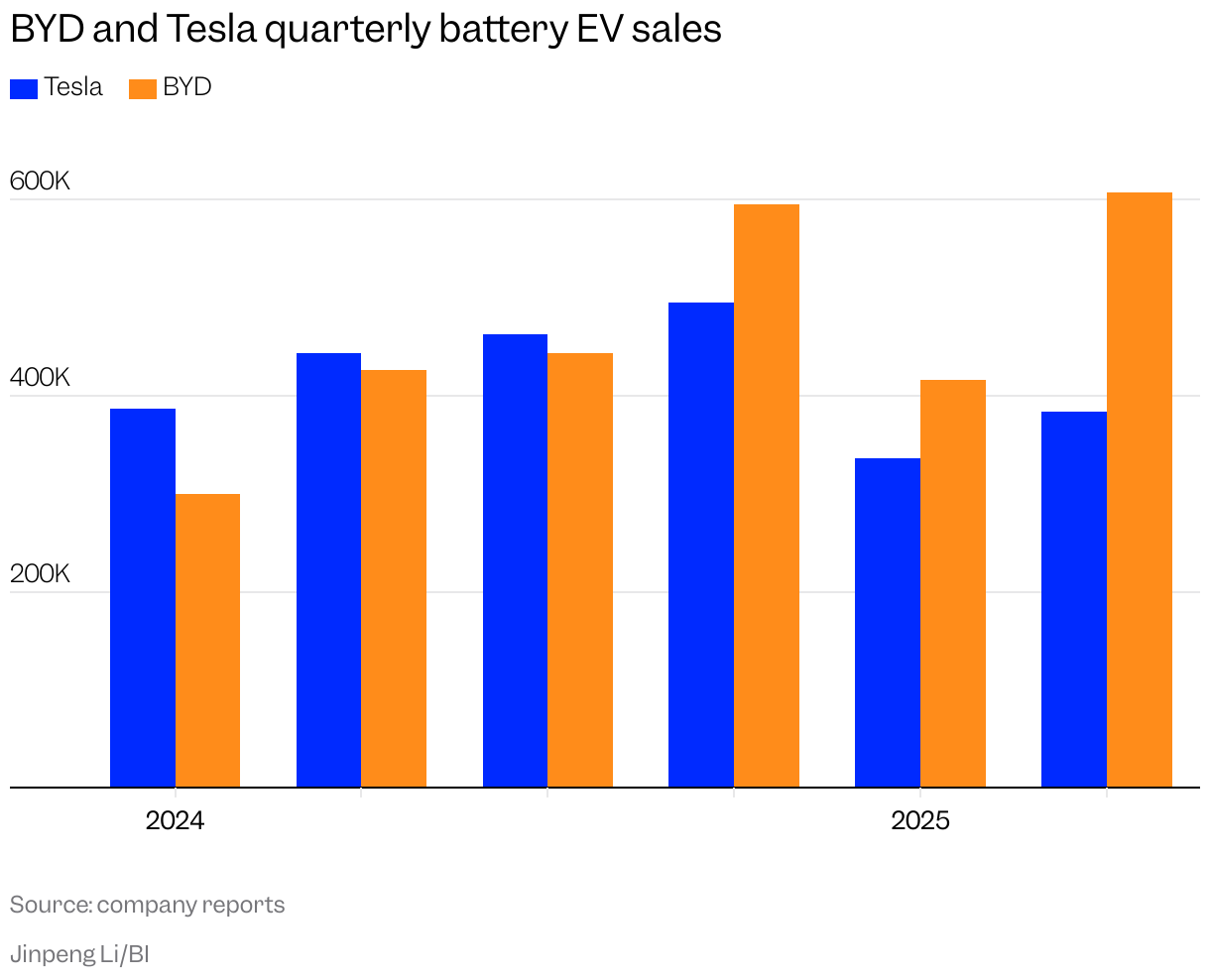
Chinese giant BYD is on track to surpass Elon Musk's automaker as the world's largest seller of battery electric cars this year, and is expanding rapidly overseas.
The Shenzhen-based company sold more EVs in Europe than Tesla for the first time in April, and has seen sales surge across the continent even as Tesla's have collapsed.
Now, the two companies have a new battleground: India.
Despite the world's third-largest car market proving largely inhospitable to Western and Chinese brands, both BYD and Tesla are pushing hard to crack it.
Becoming a success in a country where cars are massively outnumbered by motorcycles is far from simple, but the rewards could be huge.
Brajesh Chhibber, a partner at McKinsey and the co-lead of the consultancy's center for future mobility in India, told Business Insider that India's EV market is set to grow rapidly over the next few years.
He estimated that electric car sales in the country could rise to between two and three million a year by 2030, up from 100,000 in 2024 and nearly twice the size of the US market last year.
Tesla finally arrives
Tesla's arrival in India has been a long time coming.
The EV maker opened preorders nearly a decade ago, but only started selling its cars in India in July, a delay that left some customers waiting years to get their vehicles.
Tesla has opened two showrooms in Delhi and Mumbai so far, selling its Model Y SUV at an import tax-inflated price tag of around 6 million rupees ($70,000), almost twice the price of the entry-level Model Y in the US.
The Elon Musk-owned automaker has also ramped up hiring. In addition to customer service and support roles, Tesla is recruiting Autopilot testers in Mumbai and Delhi, suggesting the company eventually plans to bring its assisted driving tech to the country.
Puneet Gupta, India Automotive Market Director for S&P Global, told Business Insider that Tesla had entered the Indian market "half-heartedly," citing a lack of salespeople and showrooms.
"Tesla is an inspirational brand for many Indian consumers. But if a brand like Tesla is coming in with two outlets, it shows that you are not interested too much in the business," Gupta said.
PUNIT PARANJPE/AFP via Getty Images
India imposes a steep 70% import tax on foreign vehicles in an effort to get automakers to build factories in the country.
Plans for Tesla to set up a production plant have stalled repeatedly over the years, and in June, an Indian government minister said that the company was "not interested" in building cars in India.
Tesla's launch has had a tepid reception from India's automotive enthusiasts, Vilas Deshpande, cofounder and COO of Indian EV startup Vayve, told Business Insider.
"It would have been exciting to see them in the market six years ago. Now, I would say the response is probably 'meh,' not excitement," he said.
Deshpande said the high price point of the Indian Model Y pushed it into the premium market, automatically reducing the demand, and added that the lack of a supercharger network in India made Tesla's EVs a tough sell.
Tesla also faces stiff local competition in the form of local brands like Tata Motors and Mahindra, which dominate India's nascent EV market and don't have to worry about hefty import taxes.
"There's definitely pretty good local competition for Tesla. The Indian carmakers have the advantage of making in India, which is a huge cost advantage," Deshpande added.
Gupta said that Tesla would likely see increased demand should the company enter India "wholeheartedly," with manufacturing and a major retail presence.
"India is the third largest car market in the world, and you clearly can't ignore this market," he added.
BYD catches a break
BYD faces even steeper barriers to entry than Tesla. Frosty geopolitical relations between India and China have stymied the company's attempts to build a factory or partner with local manufacturers.
Until recently, some members of BYD India's senior leadership were unable to get a visa to enter the country, according to a Bloomberg report.
Despite this, the Tesla challenger has seen some success, launching its Atto 3 and Sealion 7 EVs in the country and selling its 10,000th vehicle in India in September.
BYD has bet heavily on overseas markets to drive growth, with sales in China flatlining in recent months amid a brutal price war.
Gupta said India had "tremendous potential" for BYD because of the Chinese brand's lineup of affordable vehicles, describing them as ideally suited to the Indian market.
"When it comes to BYD, people are still buying them, in spite of a massive import duty," he said.
"If the duty is reduced, then they can really rock the market because when it comes to Chinese players, they give you value, they give you features, they give you technology," Gupta added.
John Keeble/Getty Images
There are signs that the diplomatic walls that have hampered BYD's ambitions in India are beginning to come down.
After Indian Prime Minister Narendra Modi met with China's leader Xi Jinping at a summit in Beijing in August, Bloomberg reported that easing travel restrictions between the two countries would allow BYD India's senior leadership to visit the country for the first time.
Both BYD and Tesla will have to overcome India's history of becoming a graveyard for global carmakers. General Motors and Ford exited India in 2017 and 2021, respectively, after years of struggling sales.
Chhibber said that any global carmaker attempting to set up in India must be aware of the market's unique nature.
He warned that simply trying to replicate product lines and strategies that have worked elsewhere was a "recipe for disaster," adding that brands needed to be prepared to "play the game wholeheartedly" to win over customers.
"The market has seen many of these large players folding up and going away, and that puts a question mark on whether these global companies will stay here. So you have to demonstrate commitment," he added.
from Business Insider https://ift.tt/7BxaC4G
John Oliver says Jimmy Kimmel's suspension is a canary in a coal mine for free speech
The Late Show with Stephen Colbert/Youtube
- John Oliver said Jimmy Kimmel's show getting suspended was the latest blow to free speech in the US.
- The "Last Week Tonight" host said Kimmel was the "latest canary in the coal mine."
- Kimmel's show, "Jimmy Kimmel Live!" was pulled off the air over his comments on Charlie Kirk.
John Oliver warned that Jimmy Kimmel's show being pulled off the air was the latest warning sign that free speech is under attack in the US.
On an episode of his talk show "Last Week Tonight," aired late on Sunday, the British-American comedian said Kimmel was "by no means the first casualty in Trump's attacks on free speech."
"He's just the latest canary in the coal mine," Oliver said. "A mine that at this point now seems more dead canary than coal."
Kimmel's "Jimmy Kimmel Live!" was indefinitely suspended by Disney after Brendan Carr, the chairman of the Federal Communications Commission, criticized Kimmel's comments about the killing of conservative political activist Charlie Kirk.
Oliver devoted the majority of his 40-minute-long episode to talking about Kimmel's suspension.
He criticized Carr for walking back what the commissioner said in a 2023 statement about free speech being a check on government control, and the comedian slammed broadcasters Sinclair and Nexstar for what he characterized as bending to the FCC's will.
Oliver joined the ranks of comedy talk-show hosts who have weighed in on Kimmel's suspension.
On Thursday night, four of late night's best-known voices — Stephen Colbert, Jimmy Fallon, Seth Meyers, and Jon Stewart — criticized Disney's move and defended Kimmel.
Stewart gave a sarcastic monologue on the suspension. Meyers said it was a "big moment for our democracy." Colbert called it a "blatant assault on the freedom of speech." And Fallon said he hoped Kimmel would get his show back.
Oliver's segment on Kimmel was longer and more critical than those of the American talk show hosts. He said his show was less susceptible to FCC pressure because it was not on broadcast TV.
He ended the segment on Kimmel by urging media companies to stand up against "stupid, ridiculous demands."
A representative for Oliver did not respond to a request for comment from Business Insider.
from Business Insider https://ift.tt/UtlIxyh
Sunday, 21 September 2025
I created a group chat for 6 struggling job seekers. They shared how they're coping in a market that feels broken.
Rebecca Zisser/BI
The struggle to find work is real — and sometimes you need moral support.
Over the past year, I've spoken with dozens of fed-up American job seekers. As the number of open roles in the US dwindles from the record-highs reached in 2022, many have told me their searches are stressful, emotionally draining, and isolating.
They've also found it difficult to assess the flood of advice they come across, saying the market is shifting so quickly — due to factors that include tariffs and AI — that it's hard to know which tips will actually pay off. So I invited six of them to join a group chat to share what they're going through.
Between June and September, they opened up about how their search has affected them emotionally and financially, the strategies they've tried, and the obstacles they believe have stood in their way. Here are some of the highlights from our conversations, lightly edited for length and clarity.
Meet the Participants:
.
Scott Strohmyer, 60, Nebraska — Looking for full-time IT sales jobs since being laid off last year
Hilary Nordland, 53, Minnesota — Looking for full-time healthcare marketing jobs since being laid off in 2023
Chris Patterson, 55, Ohio — Looking for full-time sales jobs since being laid off last year
Brad, 27, Utah — Looking for full-time communications jobs since earning a bachelor's degree in communications last year. His last name has been excluded because he recently found full-time employment, but is still actively searching for a new role.
Heather Driscoll, 53, Colorado — Looking for full-time healthcare management jobs since being laid off last year
Juan Pelaez, 48, New Jersey — Looking for full-time marketing or project management jobs since being laid off in 2023
Why do you think your job search has been so challenging?
How has your job search affected your finances?
Has anything helped you manage stress during your job search?
How much of a pay cut compared to your previous job would you be willing to take for a full-time role?
Any updates on your job searches?
from Business Insider https://ift.tt/nhmbdUv
I'm a 65-year-old fitness trainer who stocks up on healthy foods at Costco. These are the 11 products I swear by.
I shop for kitchen staples at Costco. Janet Osborne I'm a 65-year-old personal trainer who stocks my kitchen with healthy foods fro...
-
The Bell V-280 Valor was selected as the Army's future long-range assault aircraft in 2022. Photo courtesy of Bell The US Army desi...
-
Big Tech is emerging a winner in the new H-1B system, while early-stage startups could lose out. Matthias Balk/nirat/Getty/Getty Images ...
-
Student-loan borrowers said they're worried about higher payments without the SAVE plan. Aaron Hawkins/Getty Images/iStockphoto Tru...


