Frederick Baba, a trader at Jane Street and former Goldman Sachs partner.
Courtesy of Goldman Sachs
Former Goldman partner Fred Baba shared the goodbye note he sent colleagues.
He left Goldman in 2023 to join Jane Street as a trader. He shared the note on LinkedIn.
His letter offered candid advice for senior leaders and young professionals alike.
When Frederick Baba left Goldman Sachs after nearly a decade, he didn't send the typical farewell note on his way out the door.
The former Goldman partner — who left the bank to join the secretive quant-trading firm Jane Street in late 2023 — published a surprisingly candid reflection on LinkedIn this week, revealing that colleagues once considered him "challenging to work with." He shared the goodbye note he originally sent to Goldman staff to mark two years since leaving the firm.
Baba — one of Business Insider's Rising Stars of Wall Street in 2020 — wrote that he believed colleagues had viewed him as difficult for years, and conceded they may have had a point.
He fixated on driving concrete results, he said — "I was obsessive about commercial outcomes, I had a lot of opinions about things" — and pushed his views so forcefully that he could come off as polarizing. "I focused more on winning arguments than getting people to come along with me," he continued.
At Goldman, Baba drew wider attention for a 2020 email he wrote about the experience of being Black following the killing of George Floyd by Minneapolis police. In late 2022, he reached the upper echelons of the firm when the then-managing director on the systematic market making team was promoted to the rank of partner. That authority came with unintended consequences.
"As I became more senior, I became effective at getting people to do as I say," he reminisced, "but I noticed a chilling effect on outside ideas, making it harder to know if I was actually right."
A central theme running through the letter was the idea that leaders should make disagreement easy and safe. As he put it: "Present your arguments gently, make it easy for people to disagree with you, and actively seek feedback and opposing viewpoints."
He encouraged current managers to do the same: "To the current leaders: Cascade information, give feedback, and teach them to drive. An early manager at GS would often say that he couldn't move up if there was no one else to do the job he was currently doing. The teams I've worked on have performed at the highest levels when the people leading them delegated and elevated effectively."
He urged newcomers to high finance to evaluate their careers over one-, three-, and five-year timeframes. And landing a promotion, he noted, rarely happens by chance. He said he checked in regularly with senior stakeholders, sought broad feedback, and made sure the results of his work aligned with their expectations.
Baba also quoted a line from a 2003 Jay-Z song, beginning with a recording by Biggie, saying: "The key to staying on top of things is to treat everything like it's your first project. Like it's your first day working as an intern."
He closed with reflections on the reputation he hoped to leave behind.
"We don't get to choose how people remember or speak about us," he wrote. "People often talk about leaving a legacy, but ultimately how we're remembered and spoken of is a separate thing to who we choose to be, how we show up, and how we treat others."
Gangal has struggled to find full-time work in the US.
Courtesy of Ashwini Gangal
In 2022, Ashwini Gangal decided to uproot her life in India and move to the US for love.
Her husband was in the US on an H-1B employment visa, allowing her to relocate on an H-4 visa.
Gangal felt like a "trailing spouse" and had to rebuild her professional identity in a new country.
My husband and I met on a dating app in 2021. He had moved to the US in 2009 and was in Mumbai, where I lived, to visit family.
His trip marked the start of our whirlwind intercontinental romance. In April 2022, after nearly a year of long-distance dating between the US and India, we got married in Mumbai, where I had spent all 36 years of my life. Nearly six months after the wedding, I moved from high-octane Mumbai to Sunnyvale, a sleepy suburb in San Francisco's Bay Area, leaving my job as the managing editor of an online business publication and bidding my friends and family goodbye. At the time, my husband worked in tech on an H-1B employment visa, which meant I could move to the US on an H-4 dependent spouse visa.
When I got to the US, the heady joy of marital bliss was soon eclipsed by a crisis of identity. While I was glad to have found the man of my dreams à la Bollywood, I felt bitter about being a "trailing spouse," moving to a new country for love, at the cost of professional stability. The busy editor who led a team of reporters in Mumbai quickly became an alter ego from a past life. Plus, I was incredibly lonely. It was only after roughly three years in the States that I began to think of Sunnyvale as home.
I felt like I was having a breakdown in slow motion
As a well-traveled Anglophone, I felt no culture shock when I arrived in America, with the exception of the "do-it-yourself" culture common to the Western world. I was a Bombay brat who always had house help to cook and clean for me. In the US, I tortured my gut bacteria with junk food for months before grudgingly learning my way around the kitchen.
In my head, I thought I'd only take a short break from work following my relocation. It took around six months after landing in the States to get my work authorization, known as the EAD, and then, I was all set to pick up my pen and notepad and return to work as a journalist.
But I found landing full-time workextremely difficult. Every day, I searched online job portals for journalism roles to apply to, but I was either ghosted or rejected every time.
Isolation made these rejections harder to handle. Friendless "visa brides," as I sometimes call immigrants of my ilk, have no one to share their burdens with.
Gangal has found the Bay Area isolating.
Courtesy of Ashwini Gangal
Although I did make friends over time, it was extremely difficult to connect with people initially, because loneliness is baked into suburban Californian life. In contrast to the throbbing metropolis of Mumbai, the Bay Area is quiet and boring, with vast distances between any two places of interest. It's not unusual to have to take multiple freeways to get to a grocery store or restaurant. Some roads don't even have footpaths for you to walk on. Public transport is a joke, so in these soulless suburbs, your car becomes a detachable extension of your body.
A few months into my life in the Bay, I knew I was experiencing something that went beyond homesickness. I cried frequently, sometimes breaking down in public places. I slept badly, worried constantly, and lost my confidence. It felt like I was having a breakdown in slow motion.
Gradually, I've gained more financial freedom
Learning how to drive, and getting my license in February 2023, was a big part of my emotional recovery. I'd always been afraid of driving, but now I've overcome it, I'm no longer dependent on my husband for transport. I have at long last befriended the asphalt.
One of my first long-distance drives was to a town called Turlock, nearly 100 miles from my place, where I did a live poetry reading.
Financially, I had to depend on my husband while I struggled to find work. But over the past three years, I've picked up some freelance writing assignments, which have granted me some financial freedom, and I've been able to lease my own car, a gorgeous black Tesla.
Gangal in her Tesla.
Courtesy of Ashwini Gangal
Writing has been the refuge that's helped me rebuild my identity
I'm not the first "visa wife," nor will I be the last. My story is the story of many women who've put oceans between themselves and their family, friends, and work, to move for love. My experience with immigration has taught me that when you move countries, your skills come with you, and if you believe in yourself, they can help you rebuild your professional identity.
I'm proud to have strengthened my identity as a writer during this difficult time. I've written news articles for local outlets, works of fiction and poetry, and non-fiction essays based on my experience as an immigrant. For me, "home" is a place where people know my name, and building up professional recognition in the US has given me a greater sense of belonging.
That said, even though I've picked up temporary work, like contract jobs and freelance gigs, full-time employment remains elusive. I'm still actively looking for jobs, but I've come to believe that the struggle has less to do with my own abilities than imperfect algorithms on job portals, a volatile job market, and a general skew in the Bay Area toward software and technological skills, which makes me feel less in demand as a writer.
I don't write code. I write stories. In "Alf layla wa Layla," an ancient West Asian collection of folk tales, popularly known as "The Arabian Nights," it takes princess Scheherazade a thousand nights to find the path to survival through storytelling.
I fancy myself a modern-day Scheherazade in Sunnyvale, and, having lived as a writer in Silicon Valley for over a thousand days now, I think I'll survive too.
Do you have a story to share about being on an H-4 or another dependent visa? Contact the editor, Charissa Cheong, atccheong@businessinsider.com
15-year-old Rodin Roohipour has gotten email advice from Mark Cuban and Paul Graham.
Rodin Roohipour
Rodin Roohipour is a 15-year-old interested in tech and venture capital. To learn about the industry, he cold emails leaders.
Mark Cuban, Paul Graham, and prominent VCs have given Roohipour advice.
Roohipour shared with Business Insider his tips for cold emailing, from subject to body.
This as-told-to essay is based on a conversation with Rodin Roohipour, a 15-year-old from Los Angeles. It's been edited for length and clarity. Business Insider verified the email correspondences mentioned.
I've wanted to start a company since I was 12.
When I was younger, at 8, I loved building things. I started coding very early. Then I turned 12, I did this entrepreneurship program, and I got really into it. I kept trying to build these companies, these little side projects, but nothing took off.
Eventually, I realized a really important thing you need to have is knowledge. I knew nothing about tech or venture capital. I decided to learn everything the best way I could, which is by talking to the most knowledgeable people.
When I emailed Alfred Lin, I had to follow up three times. I asked him what his issues were in venture capital.
I emailed Julia Lipton from Awesome People Ventures, and she responded three weeks after my follow-up and seemed happy to chat. She was the first big person I ever called with.
When I emailed Mark Cuban, I really had to personalize it. This guy gets like 500 emails a day. You have to stand out. I said: "I'm currently a high school student who uses Al a LOT and went to your bootcamp a while back." That captured his attention.
The most important thing is the ask
A lot of people are like, "Can you get on a meeting?" You need to go in with no expectations. You should just share your story and say, "One sentence of advice would help."
A lot of people hide the interesting parts about themselves because they think that it'll scare people off. In my first few emails, I talked like a salesman. It sounds super professional, but the problem with that is, it sounds like a sales pitch. It'll go to your promotions folder.
You need to use the extreme or unusual attributes around you.
I view an email as two parts: the subject and the body. The subject is what you're using to get someone to open it. You don't need to explain anything. You don't need to introduce yourself.
The subject line I've been using a lot is: "writing this email to you while in my high school math class." It's a bit generic, so if you're emailing someone like Mark Cuban, you would change it. But it works really well. (I don't actually write the emails in my math class. I just schedule them for the morning.)
It's a pattern break. If all your emails are like "I'm going to fix this" or "I'm going to do that," nobody cares. That subject line captures your eye. A 14-to-18-year-old? What's he doing in my inbox? Math class reinforces that.
The body of the email is where everything else happens. You present your real argument, why the person you're emailing is relevant, and why helping you makes sense for them.
A clever subject line can't save a bad email. You'll have 500 opens but two replies.
Paul Graham was one of the biggest emails I got. I told him, "I'm Rodin, 14 y/o and super interested in VC and startups. I'm building a product that is a trust platform for VCs / founders. I would love to chat with you about your story and some problems you face. Even 10 mins would mean a lot."
He gave me a blunt reply, but it was nice. He told me: "This is a mistake. You are much better off focusing on learning math and programming. Build your own LLM."
Even if these people don't give you big replies, it's important that you're in their network. It builds a slight connection.
Brian Niccol said he wanted Starbucks to feel like the coffee shop from "Friends."
Justin Sullivan/Getty Images
Starbucks CEO Brian Niccol said a fictional café guided his vision of what his stores should look like.
He said he described the coffee shop from "Friends" as being the ideal café experience.
Niccol has spent more than a year trying to revitalize the brand and turn it into a cozy third space.
Starbucks CEO Brian Niccol wants his cafés to feel like Central Perk from the TV show 'Friends.'
During an interview with The Wall Street Journal, released Monday, Niccol spoke about his "Back to Starbucks" plan, a yearlong process of turning around the brand after several quarters of declining sales amid a deteriorating customer experience.
He told Alan Murray, president of The WSJ Leadership Institute, that the name "Back to Starbucks" helped to give his baristas a "visual understanding" of the café experience he was trying to achieve.
"Because everybody remembers a 'Friends' episode, or that coffee house experience, by me saying 'Back to Starbucks,' that kind of hearkens that memory of what I would call the barista-customer connection that we're after," Niccol said.
The coffee shop from the 'Friends,' Central Perk, was a pivotal set piece throughout the sitcom's 10-season run. Almost every episode featured the café as the characters' favorite haunt.
The cast was often filmed sitting on Central Perk's mismatched sofas and chairs, ordering coffee and baked goods, and making small talk with the awkward manager, Gunther.
Niccol's comparison of Central Perk to Starbucks comes after he spent more than a year rebranding Starbucks, from what customers and employees said was a soulless conglomerate chain, to a warm and inviting third place. He took the top job in September 2024.
He simplified the menu, introduced more seating and tables in the cafés, offered free coffee and tea refills, brought back the condiment station and ceramic mugs, and encouraged baristas to write small notes on coffee cups to interact with their customers.
However, its sales have yet to see a strong recovery. It reported a 1% increase in its global comparable sales for the fourth quarter of this year, compared to the same period last year. Its stock price is down more than 6% since the start of the year.
Just like a long line of executives before them, leaders of some of the world's hottest firms are learning to hate an age-old enemy: short sellers.
Last month, Palantir CEO Alex Karp had a meltdown of sorts about the subject. When asked about short sellers, aka investors betting against the company's stock, Karp unloaded on the naysayers.
"They could pick on any company in the world. They have to pick on the one that actually helps people, that's actually made money for the average person, that is actually supporting our war fighters," Karp said on CNBC. (It should be noted that some would debate that characterization; Palantir is often criticized for its work with the US government on surveillance and immigration enforcement.)
"These people, they claim to be ethical," Karp continued, adding that "they're actually shorting one of the great businesses of the world."
Sam Altman, the founder of OpenAI, also recently expressed his discontent with those who are skeptical about his firm's valuation. While his company is private, Altman said he sometimes wishes it were public so that he could take it to short sellers.
"There are not many times I want to be a public company, but one of the rare times that it's appealing is when those people are writing these ridiculous, 'OpenAI is about to go out of business,'" Altman told the Bg2 Pod in October. "I would love to tell them they could just short the stock, and I would love to see them get burned on that."
And while he hasn't been as outspoken about short-sellers per se, Nvidia CEO Jensen Huang responded to AI bubble concerns during the firm's earnings call in November, saying "there's been a lot of talk about an AI bubble," and "from our vantage point, we see something very different."
These rising titans of the AI era are the latest business moguls to direct their ire at short sellers. The distaste for investors who put their money on the line to bet that a company's shares will decline is a decadeslong tradition. Tesla CEO Elon Musk has famously battled investors who have bet against the electric vehicle maker. GameStop CEO Ryan Cohen has called the practice "un-American." The pushback it's understandable: executives put a massive amount of work into building and running their companies, and when someone bets against them, it can feel personal.
However, CEOs like Karp need to understand that attracting the attention of shorts is part of the natural life cycle of a company and a healthy market mechanism that allows a range of views to compete. One could even argue that Karp should take pride in the fact that he's grown his company to a size that draws such fervent skeptics. In a sense, it's a badge of honor. He's made it to the big leagues.
Big enough to short
Investing in a company you believe in is straightforward: simply buy the stock. Betting against a company by shorting its stock, on the other hand, is a bit more complex. To do it, an investor borrows shares from their brokerage and agrees to return them by a specified date. The investor then sells the borrowed shares in the open market. When it's time to return the shares to the lender, the investor purchases the agreed-upon amount at the prevailing market price. If the price of the stock falls within that time, the short-seller can then buy back the shares at a lower price, earning a profit. If they got it wrong and the company's stock is higher, well, they've lost money. For example, if you think a company's stock is overvalued at $100 a share, you can borrow 10 shares from a broker for a total value of $1,000. You agree to give the shares back at the end of the month. On the day the deadline hits, if the stock has fallen to $50 a share, you buy up the amount you need to return and pocket a tidy $500 gain. But if that stock were to get hot instead, and rises to $300 a share, you're out $2,000 — a nasty hit. It goes without saying that short-selling can be extremely risky. While a long investor can lose all of their money, a short-seller can, in theory, lose infinite sums.
It's especially tricky to short small companies. Since there are fewer investors buying and selling their shares, even small amounts of buying can cause the price to rise dramatically. This can create problems for short sellers if they suddenly need to return the shares to their lender, a process known as covering their position. If the supply of shares is low and demand suddenly increases, it can drive the price of a stock through the roof, cutting the short seller even deeper. It's a phenomenon known as a short squeeze, and it's what famously happened to short sellers Gabe Plotkin and Andrew Left during the GameStop saga.
"Short sellers absolutely want to make sure they have plenty of liquidity, and so that's why it's so dangerous to short something that's pretty small," said Ryan Kelley, the chief investment officer at Hennessy Funds, which manages around $4 billion.
Derivatives markets, more complex financial products that allow for even more exotic bets on the direction of a stock, also become larger when a stock becomes more prominent, thereby providing the opportunity for more people to bet against a company. After all, to short a stock, you need an investor to lend shares to you.
"The reality is, as companies get bigger, the derivatives market in companies grows. And as the derivatives market grows, there's more folks that will be taking positions," said Maurits Pot, the founder of Tema ETFs, which manages around $1 billion after launching in 2023.
So, the fact that Palantir is drawing short-sellers is, in a way, a badge of honor for Karp. When you get as big as Palantir — which is up 1,720% since its IPO in October 2020 — short bets are going to happen. Sure, some of these increased bets are because there are more people who think the company is on the wrong path, but a lot of times, short interest can increase for more technical reasons — many of them to do with the size of the company. When a company grows, so does the variety of opinions on its stock performance. And that's OK.
Why the market needs short sellers
There are several reasons shorting is a necessary component of a robust market.
First, short-sellers act as a check, helping to call out companies for a range of bad behaviors, from corporate malfeasance to incompetent management. On the extreme end, short sellers have used research, data analysis, and information gathering to expose cases of serious fraud, accounting tricks, and blatant deception. For example, fraudulent behavior at the pharmaceutical company Valeant was exposed in 2015 when short-sellers sounded the alarm about the firm. On the more quotidian side, investors betting against a company have called out executives and management teams for taking a company in the wrong direction. Some individuals will do it publicly, sharing their thesis for why a stock is overvalued. But since the amount of short interest can be tracked, a rising number of quieter short bets can make investors and regulators more aware of the risks associated with a particular firm. In these instances, short sellers have a financial interest in seeing the stock go down, but they are also trying to serve the public interest.
"It's a possibility that people can be adamantly against the way you're running a business," Kelley said, "and it should be that they're able to actually put their money where their mouth is — in other words, short the stock and be vocal about it."
In other cases, short sellers may not think the company itself is doing anything egregious, but rather that other investors in the market are overreacting. Tesla's stock has often traded at nosebleed valuations due to its fanatical investor following, drawing short interest simply because it has traded above its fundamentals at times.
Of course, there are bad actors — some short sellers have been charged with taking a short position on a stock and then drumming up negative headlines about the company to send its share price tumbling, sometimes coordinating with other short sellers. In other words, not simply talking their book, but being disingenuous or lying. These more questionable motivations make short sellers an easy target, and are likely what raised Karp's rankles. But the notion that short-selling in and of itself is harmful is not fair, Pot said.
"The idea that you can't be shorting, I think that's — I wouldn't say it's anti-competitive — but it impedes the natural impulse of the market, which is that there are companies that are shorted for good reason," Pot said.
"Short selling is core to the market," Pot continued, "and I think as long as short selling doesn't become a coordinated, speculative attack, I think it's part of the regular functioning of capital markets."
In this same vein, short sellers can temper the euphoria in bubble periods. When the market is ripping and Wall Street strategists are loath to issue a downbeat, bearish forecast, it can be helpful to hear arguments for why a standout stock or a particularly hot market theme has gone too far. And because losses can be infinite for short sellers, putting their money where their mouth is tells you about their degree of conviction. It's essentially what Michael Burry — who gained fame shorting the housing market leading up to the 2008 crash — did a few weeks ago, when he questioned the assumed rate of depreciation on GPUs, arguing that they'll become obsolete in just a couple of years. With this argument now at the top of investors' minds, you might argue that stocks are more efficiently priced.
Another important role that short sellers play is providing liquidity in the market. While an investor would ordinarily hold their shares, lending them to a short-seller to auction off to the market allows these shares to continue circulating through the system. And when they eventually have to cover their positions and repurchase their shares, they provide exit liquidity to people looking to sell. Higher liquidity levels enable investors to enter and exit positions more quickly and at closer proximity to the market price.
Executives like Karp shouldn't take short-selling to heart. Instead, they should recognize its important market function, and wear it as a feather in their cap — a sign that their company is maturing into adulthood.
William Edwardsis a senior investing reporter at Business Insider primarily covering the US stock market and the broader economy.
Mark J. Terrill/AP Photo; Ethan Miller/Getty Images; The Ring Magazine via Getty Images; The Ring Magazine via Getty Images; Rebecca Zisser/BI
It was a typical scene for anyone familiar with the luxe life that Floyd Mayweather flaunts on social media: the 48-year-old former boxing champion sitting in the cabin of a private jet, counting a heap of $100 bills and talking about the envy that gets directed at him.
"Continue to hate," Mayweather said in the September video as he piled the stacks of cash into a clear plastic bag. "You know, people only talk about winners. I'm a winner. So, continue to talk."
"Money Mayweather," as he calls himself, was indeed a winner in the ring, ending his pro career in 2017 with a 50-0 record. He scored more than a billion bucks in boxing paydays, making him the 10th highest-paid athlete of all time, according to the sports business outlet Sportico.
"I'm financially set, and I want to let everybody know this," he said in 2021. "Every property that I have is paid for. My jet is paid for. All my cars is paid for. I own billion-dollar buildings."
Everything is no longer paid for: Mayweather took out millions in mortgages on his homes last year, a Business Insider review shows. He has also faced a string of lawsuits and liens that say he owes money for a Mercedes Maybach G-Wagon, jet fuel, and garbage collection at his Las Vegas mansion.
At the same time, he has trumpeted a major entry into big league commercial real estate.
Starting in the fall of 2024, Mayweather talked up a spending blitz on commercial property in New York through his newly formed real estate firm — splashy moves that earned him a featured spot at a prominent real estate conference with a session titled "Real Estate Knockout: The Floyd Mayweather strategy."
That big talk doesn't always end in big deals, Business Insider found.
Mayweather's social media last year promoted an article that reported he had made a deal to invest $100 million in a portfolio of Manhattan luxury high-rise apartment towers owned by Go Partners. People with knowledge of the investment said that Mayweather put in a "nominal" sum late last year but did not invest further and his initial equity in the deal was later absorbed by Go Partners, leaving him with no stake. The portfolio of buildings was eventually spun off into a publicly traded entity.
In February, Mayweather also said he bought a portfolio of rent-regulated apartment buildings in Upper Manhattan for $402 million, declaring that "all the buildings belong to me, I don't have no partners." Business Insider previously reported there were no property records showing an outright or majority sale.
Floyd Mayweather, boxing legend and businessman, attends his exclusive red carpet birthday bash at Gabriel South Beach on February 24, 2022 in Miami Beach, Florida.
Jason Koerner/Getty Images for CGI Merchant Group
Meanwhile, in the last 18 months, two of Mayweather's commercial properties have been foreclosed, and he is at risk of losing a Las Vegas building that houses his strip club Girl Collection over $52,000 in back property taxes and penalties. Mayweather has been accused in lawsuits of failing to pay for millions of dollars of luxury items, including watches and high-end jewelry, allegations he has disputed.
Mayweather has been pursued by creditors over Air Mayweather, the Gulfstream jet that's been one of the symbols of his megawealth. In December, FAA records showed he had sold the plane — and he's sold his mansions in Beverly Hills and Miami to two of his real-estate partners.
Business Insider reviewed hundreds of pages of public records and interviewed dozens of current and former friends and business associates about Mayweather's finances and his team, which includes a convicted felon who has been named in several lawsuits against the boxer.
"He doesn't seem to have the guardrails that were in place," Mark Tratos, a Las Vegas attorney who represented Mayweather during his professional fighting career in various business and legal matters, told Business Insider.
"When you've got professionals that are doing the thing for you, you're a little better protected. When you're out there on your own, your protection is dropped."
Mayweather's lawyer, Bobby Samini, said Mayweather is not "experiencing financial strain," and "works with a team of seasoned professionals."
"Floyd Mayweather rose from poverty and hardship to become one of the greatest champions in boxing history, transforming his talent and discipline into an undefeated legacy and a highly successful business empire," Samini said in a statement. "Creating unfounded narratives misrepresents the truth and minimizes the achievements of an individual who has risen from adversity to become one of the most successful athletes and entrepreneurs of his generation."
Mayweather has said that he embarked on the road to mega-wealth in 2007, a decade into his professional fighting career, when he bought himself out of his contract with a promoter and founded his own company, Mayweather Promotions.
The arrangement allowed him to cut out middlemen and negotiate larger shares of the proceeds from pay-per-view, ticket, and food-and-beverage sales. He ditched his original nickname, "Pretty Boy Floyd," and christened himself "Money Mayweather."
Oscar De La Hoya (L) fights with Floyd Mayweather during their WBC Super Welterweight World Championship, in Las Vegas, Nevada, 05 May 2007.
GABRIEL BOUYS/AFP via Getty Images
In the ring, his defensive technique and lightning counterpunching made him a winner, even if it deprived fans of the drama of a ferocious knockout. He embraced the role of a villain audiences wanted to see bloodied, which enhanced his bankability.
"There can't be two good guys," he said in the lead-up to his 2007 fight against Oscar De La Hoya. "I chose to be the bad guy."
Showing off his enormous payouts and playboy lifestyle were part of the provocation.
"He understood the dynamics of entertaining," said Derrick Poindexter, a boxing promoter. "People tuned in just to see him get his ass whooped."
2007 fight Floyd Mayweather against Oscar De La Hoya.
Ethan Miller/Getty Images
As the earnings flowed in, Mayweather kept his fortune where he could see it — bricks of cash, high-end cars, and real estate in Los Angeles, Miami, and his home base of Las Vegas that he owned debt-free.
"He liked the tangible element of having cash in his hand and watching it come and go," said David Levi, who worked closely with Mayweather from 2010 until his last professional fight.
Dave Hall, Mayweather's accountant in the early 2000s, said Mayweather spent heavily without setting aside enough to pay his taxes.
In 2017, Mayweather paid the IRS $22.2 million in back taxes, records show. In 2023, Mayweather settled with the IRS to pay $5.5 million in back taxes and another $1.1 million in penalties, according to a settlement filed in US Tax Court.
Al Haymon was Mayweather's boxing manager from the 2000s until Mayweather's retirement.
TOM UHLMAN/The New York Times/Redux
The core group around Mayweather began to break up once he left the ring. He parted ways with Al Haymon, Mayweather's legendary boxing manager from the late 2000s until Mayweather's retirement, and Leonard Ellerbe, the longtime CEO of Mayweather Promotions. His uncle and longtime trainer, Roger Mayweather, died in 2020, and Mayweather has said his father, Floyd Sr. — also a former professional boxer— suffers from dementia.
A more recent key figure in Mayweather's life is Jona Rechnitz, the scion of a well-connected Los Angeles family who gained notoriety for his role as a government informant following his 2016 guilty plea in a sweeping New York City corruption case.
Rechnitz testified in federal court that he delivered a Ferragamo handbag stuffed with $60,000 in cash to a powerful union boss in exchange for a $20 million investment in a hedge fund, which then lost $19 million of it. He's scheduled to be re-sentenced in January.
Jona Rechnitz and Floyd Mayweather
Allen Berezovsky/Getty Images
After the scandal, Rechnitz returned to LA and reinvented himself as a jeweler to the stars, including Kim Kardashian and Shaquille O'Neal. Multiple jewelers and other creditors hit Rechnitz and his jewelry business with lawsuits that accused him of failing to repay loans or pay for jewelry. Most of those cases were settled. Three ended in judgments against Rechnitz, including one for $17.7 million awarded by an LA court in 2023. Rechnitz is appealing the decision.
Rechnitz's relationship with Mayweather, who was a jewelry client, flourished, and Mayweather has credited him as an architect of his post-boxing success. "When your career is over, you got to make smart decisions," Mayweather said during an appearance on Fox News in February. "But a close friend of mine, Jona Rechnitz — great guy, great person — helped me a lot."
World champion boxer Floyd Mayweather Jr. travels in New York at the beginning of the Mayweather and Canelo fight card promotion road trip, as seen in a jewelry store in Fifth Avenue. 2013
Benjamin Lowy/Getty Images Sport
The two frequently travel together, including a trip to Israel after the October 7 attacks where they were pictured with Prime Minister Benjamin Netanyahu. Closer to home, they attend NBA games, and Rechnitz is often seen sporting baseball caps with the "TMT" logo of "The Money Team," Mayweather's apparel brand, and the nickname for his posse of friends, bodyguards, and close associates.
By Mayweather's account, his foray into commercial property investing began more than a decade ago, when he met two New York City real estate executives courtside at a Knicks game.
In a meeting the next day, one of the executives, Jeff Sutton, enchanted the boxer by explaining that while he earned staggering sums during his fights, real estate generates profits as its investors sleep.
Since late last year, there have been headlines about much bigger deals, including the Go Partners venture.
World champion boxer Floyd Mayweather Jr. travels in New York 2013
Benjamin Lowy/Getty Images
Last December, he said that he had purchased a building in New York's Diamond District, for a reported $20 million, as a gift to his then 3-year-old grandson. Property records show that a company tied to jeweler Avi Davidov bought the building in June 2025 from its longtime owners. Davidov declined to comment.
In the months leading up to the real estate announcements, he began freeing up a big chunk of cash against his personal real-estate portfolio and his jet, which he has since sold.
In early 2024, Rechnitz introduced Mayweather to Don Hankey, a billionaire specialty lender based in Los Angeles. Hankey, who rose to prominence in the lending business by providing car loans to buyers with poor credit, is best known for posting a $175 million bond for President Donald Trump.
Over the next year, Mayweather borrowed $54 million from Hankey at a roughly 9% interest rate, to "fund other ventures," his lawyer told Business Insider. He used as collateral 14 residential homes, his Las Vegas strip club, and his jet, according to Hankey and Business Insider's review of public loan documents.
Don R. Hankey, chairman &CEO of Hankey Group
Ringo Chiu/ Reuters
In loan documents, and according to Hankey's description of the deal, a portion of the debt was cross-collateralized, meaning it was taken against a collection of Mayweather's assets, rather than as smaller loans tied to individual properties. That structure is inherently more risky since, in the event of a default, borrowers can lose multiple properties at once, rather than one asset at a time, experts say.
Hankey said that working with Mayweather gave him some insights into the boxer's finances. Mayweather's wealth, Hankey said, for instance, appeared largely anchored in the value of his personal homes. When Hankey searched Mayweather's credit history, "not much showed up," he said.
"I think some people buy stocks, some buy bonds and put their money in a bank, and I think he put his money in houses," Hankey said. "Before he came to us, I don't think he tried to borrow very much."
Samini, Mayweather's lawyer, said that Mayweather had been an "ideal client" for Hankey. "Like many other sophisticated businesspeople, he borrowed against the substantial equity in his portfolio to fund other ventures," Samini said of Mayweather.
While Mayweather was drawing millions against his real estate portfolio, bills were piling up elsewhere.
In February, a Las Vegas commercial building that Mayweather bought for $3.6 million in 2024 was sold at auction to its previous owner.
This summer, two condos that Mayweather owns at Trump Las Vegas Residences were seized by Clark County for unpaid property taxes — then returned to Mayweather after he made a $21,000 payment. Last month, a $568.63 lien was put on Mayweather's Las Vegas mansion for unpaid trash collection.
A Texas aviation supplier sued Mayweather companies in June over what it said were $137,000 in unpaid bills, and FAA records show that a lien was placed on the aircraft in July for another $358,000 for maintenance work. That same month, AJ Ramey, Mayweather's former pilot, complained on social media that the boxer "trashed my reputation and relationships by never paying his jet debts."
Mayweather has since settled the maintenance bill, and that lien was removed in August. Mayweather did not respond to the jet fuel lawsuit. In October, a default judgment was awarded in favor of the fuel company.
The FAA has not released specific details about the sale of the jet, such as the name of the buyer or the price.
Ramey said that he is still owed money for his work as Mayweather's pilot.
"Floyd Mayweather harped on loyalty, hard work, determination, doing business the right way," Ramey said. "To be betrayed and watch that dwindle and have someone that had such a profound impact on you in a good way turn around and burn you like that, I still am working through it."
Samini denied that Ramey is owed money or that he was betrayed.
In 2023, a Los Angeles court awarded a Nigerian media company a $2.4 million judgment on a claim that Mayweather was paid $210,000 for appearances in Africa that he never made. Mayweather has denied the allegation, and his appeal was denied. The judgment has not been paid and has swelled to almost $3 million with default interest, according to an attorney for the Nigerian firm.
Floyd Mayweather tips a valet from his car in front of a casino on August 10, 2013, in Las Vegas.
Benjamin Lowy/Getty Images
Rechnitz is a recurring character in some of the lawsuits brought against Mayweather in recent years. In 2024, for example, Leonard Sulaymanov, a high-end jeweler in Miami, filed a lawsuit accusing Mayweather of stiffing him on a $3.9 million bill for various jewelry and watches, including a Patek Philip 5980 and two Richard Mille 35-02s. Sulaymanov said in the lawsuit that Rechnitz, though not named as a defendant, set up the meetings where the jewelry was shown. Mayweather never filed a response and the case was settled out of court.
In September, a Las Vegas car dealer sued Mayweather, accusing him of leaving his lot with a $1.2 million Mercedes Maybach G-Wagon and never paying for it. Rechnitz asked for more time, the lawsuit said, and Mayweather ultimately signed a legal document promising to settle the bill. Mayweather then sued the dealer for fraud, alleging that he'd been sold a bad car. Both cases are still pending.
Business Insider found three cases where Mayweather and Rechnitz have together been accused of fraud or misrepresentation, including for promoting a cryptocurrency in an alleged pump-and-dump scheme and allegedly defrauding an investor through a ticket resale operation. In each of those lawsuits, Rechnitz was identified as the person allegedly facilitating the deals on Mayweather's behalf. Rechnitz and Mayweather have denied wrongdoing.
In the third case, Miami entrepreneur Jayson Winer sued Rechnitz, Mayweather, and Ayal Frist, the CEO of Mayweather's property investment company, accusing them of hawking access to celebrities, including Elon Musk, and failing to deliver.
Winer creates NFT art — digital creations stored on a blockchain — and hoped Musk could promote an online auction. "I know everyone. And have access bc of Floyd," Rechnitz allegedly wrote in a text to Winer. In a call, Rechnitz reiterated that Mayweather had a personal relationship with Musk, whom he had trained ahead of a rumored fight with Meta CEO Mark Zuckerberg, the lawsuit said.
Former world welterweight king Floyd Mayweather speaks on stage during the crypto-currency conference Bitcoin 2021 Convention at the Mana Convention Center in Miami, Florida, on June 4, 2021.
MARCO BELLO/AFP via Getty Images
Winer, who said he paid $20,000 and handed over two high-end watches to Mayweather's security guard, sued Rechnitz and Frist in January and added Mayweather to the suit in August.
Rechnitz and Frist have responded that they held up their end of the deal but Winer's "banal" and "uncreative" art failed to catch on with buyers. Mayweather asked a judge in November to drop him from the suit. Samini said that Mayweather denies all of Winer's claims and notes that, in April, a judge issued a temporary restraining order prohibiting Winer from making direct contact with Rechnitz and Frist.
Meanwhile, news of Mayweather's lavish spending irked John Berman, a businessman who sold Mayweather an LA warehouse for $4.5 million in late 2022.
Berman said he provided Mayweather with a loan to finance the purchase and that Mayweather defaulted on a December 2024 deadline to pay off that debt.
A month later, in January, Berman said he received a call from Rechnitz, who tried to persuade him to refund Mayweather's $1.5 million down payment on the property.
Berman said he considered cutting Mayweather a break — until he received a call from his own attorney. The lawyer had heard about Mayweather's purchase of an expensive car, which made Rechnitz's plea seem absurd.
"Foreclose on the building now," Berman's attorney told him.
"That was the nail in the coffin," Berman said.
Berman initiated a foreclosure and seized the building in August, wiping out Mayweather's ownership and investment, records show.
Real estate isn't Mayweather's only business interest. His One of One supplements brand, which he launched in February, is now carried at GNC and Dick's Sporting Goods. On his Instagram, Mayweather advertises partnerships with Agua Plus Premium Alkaline Water and Betify, a sports betting platform.
He has loaned his name to a personal injury law firm, which hosted a gala with him in November. He's also endorsed several cryptocurrency coins; one deal resulted in a $600,000 settlement with the Securities and Exchange Commission in 2018, and another sparked an investor lawsuit.
Mayweather Boxing and Fitness, a retail gym chain modeled on Mayweather's fitness routines, was sold in August. As Business Insider previously reported, more than half of Mayweather Boxing and Fitness studios, which once boasted more than 70 locations, have shut down, and a group of four franchisees have sued Mayweather and company executives for allegedly making false and misleading statements about the business — allegations Mayweather denied.
His bigger post-retirement paychecks have come from a string of multimillion-dollar exhibition fights, including against Logan Paul and John Gotti III. In September, it was announced that next year, he will fight former heavyweight champion Mike Tyson, 59, in an exhibition matchup.
Money Mayweather's take was totally on brand.
"I fear NO man but GOD!" he wrote on Instagram. "Let's get it!! 💰"
Note: Floyd Mayweather filed a defamation lawsuit against Business Insider in connection with a previous story about Mayweather's real estate investments. The case is pending, and BI stands by its reporting.
Daniel Geigeris a senior real estate correspondent for Business Insider.
Ellen Thomasis a senior reporter on Business Insider's technology desk.
Nearly 30% of Japan's population is 65 or older, and many still work.
Francesco Riccardo Iacomino/Getty Images
Japan has adapted to an aging workforce with government support and job programs.
Nearly 30% of Japan's population is 65 or older, with many working in low-wage jobs.
Experts say the US can learn from Japan's policies on older workers, as well as shortcomings.
While traversing the narrow, winding roads outside the Japanese town of Fujikawaguchiko, I stopped by a farm with a view of Mount Fuji, where a few locals were picking fruit. Most were older, and one was walking with a cane as she bent down to put berries into a bag.
At an udon shop, drivers and construction workers — some of whom looked to be in their 60s — were slurping noodles. The server said she knew people who have owned nearby restaurants and shops for decades.
After settling back at Shinjuku Station in Tokyo, I noticed that the older workers I had encountered in the city worked as crossing guards, cleaners, gift shop owners, taxi drivers, or wholesale workers. Only a handful of the older Tokyoites I observed were wearing the white-collar uniform of suits and ties.
When I visited Japan in early December, I had just finished the capstone story of my 80 Over 80 series, the most in-depth look at America's older workers that I know of in modern press or academia. In the months prior, I interviewed nearly 200 Americans working past 80 in dozens of professions. I discovered that nearly 550,000 Americans in this demographic work, according to Census data, and the number is expected to continue increasing as the US workforce ages and the cost of living rises. In interviews, dozens of American researchers said government benefits fall short for millions of older Americans each year, adding that the US could look to countries like Japan for inspiration.
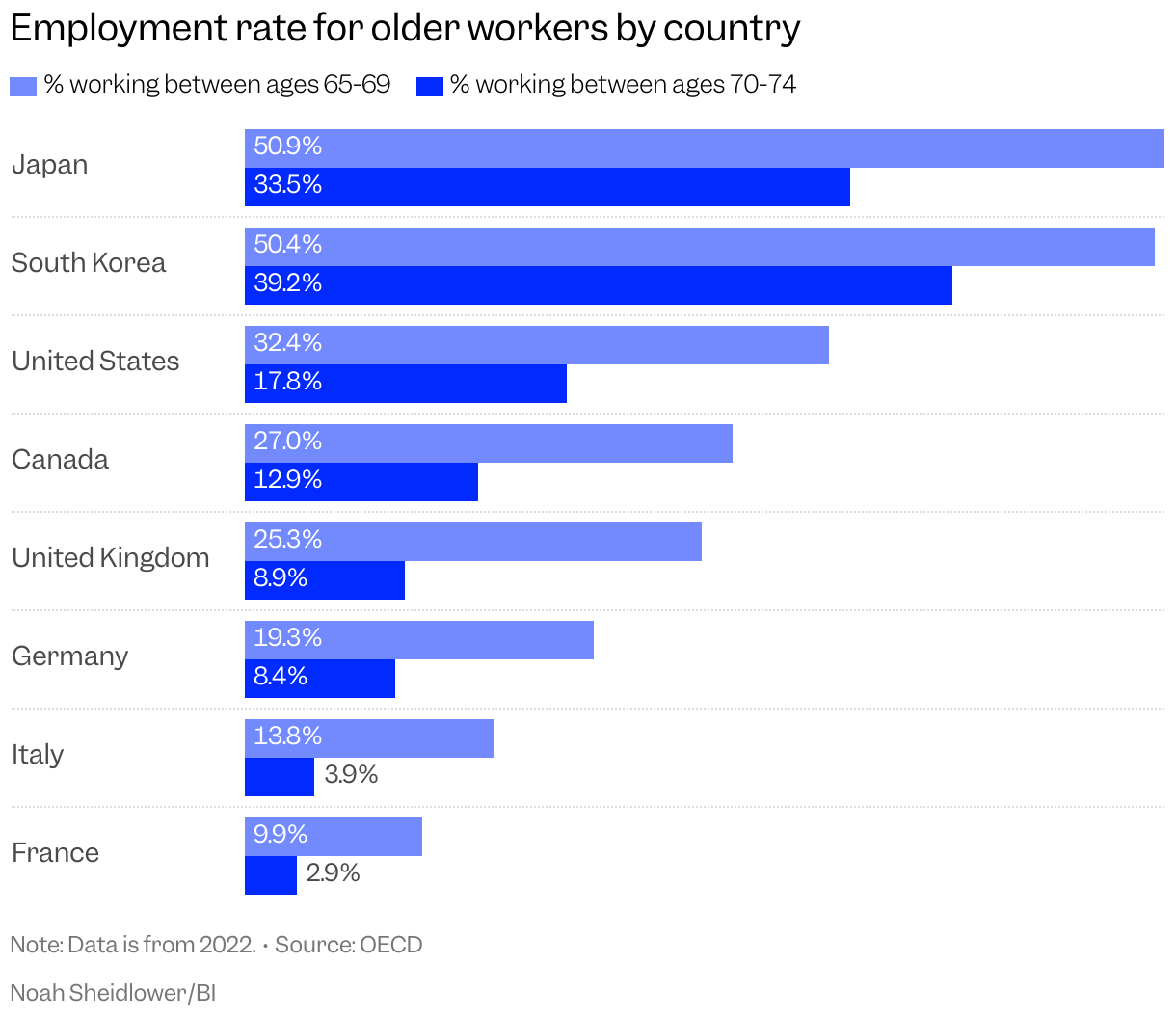
Japan, like many of its neighbors, has experienced rapid aging over the last few decades. Nearly 30% of Japan's population is 65 and older, the highest of any country, according to government data. About one in four in this demographic works, meaning that about one in seven Japanese workers is 65 and older.
Comparatively, this demographic comprises about 18% of the US population, and roughly one in five works. The US has not aged as rapidly as East Asia, although increased longevity and lower birth rates have propelled aging enough that by 2030, the Census Bureau projects there will be more Americans 65 and older than under 18.
Japan has adapted in many ways to its hyper-aging population. Its government has actively supported older worker employment, especially among older women. Seven researchers studying aging workforces in Japan and South Korea told Business Insider that keeping older workers employed at higher levels has helped both countries mitigate economic disaster and severe labor shortages.
The Japanese case is much different from the US, though, some researchers said. While the US will continue to experience lower growth rates, the workforce is unlikely to decline as much due to aging, assuming that comparatively higher fertility rates and immigration levels hold steady or rise. The desire to hire younger people is often stronger in the US than in Japan, though the US also has a younger population. The US also lacks a comprehensive healthcare system like Japan's, with worse general health metrics.
Researchers agreed Japan still has a long way to go in supporting its aging workers and preparing mid-career workers for a stable retirement. For the US, Japan may offer a different glimpse into what an older workforce can look like.
Working longer with more protections
Japan is often the first country many think about when discussing aging. It boasts the world's highest number of centenarians per capita and advocates for active lifestyles, healthier diets, and reliable healthcare.
Many older Japanese people work in manufacturing and retail, with an increasing number in service roles, construction, and medical-related services. America's oldest workers also frequently worked in these professions, particularly construction and education, according to Business Insider's analysis of Census Bureau data.
Japan has mandated that companies provide more employment opportunities for workers aged 65 and above through its Act on Stabilization of Employment of Elderly Persons. Legislation has encouraged companies to offer work opportunities until the age of 70, while former Prime Minister Fumio Kishida committed one trillion yen over five years for reskilling efforts.
Japan's government has installed resources for older workers.
Noah Sheidlower/ BI
Japan also has Silver Human Resource Centers, which provide part-time work and skills training for older people, as well as the government's Lifetime Employment Support Office.
The World Economic Forum notes that 80% of Japanese workers hope to continue working in some capacity after retirement. Some companies have implemented policies that enable workers to extend their retirement age and offer promotions and salary increases beyond 60. Japan's Ministry of Health, Labour and Welfare provides employers with subsidies if they can convert older contract workers to permanent jobs.
Jacob Funk Kierkegaard, a nonresident senior fellow with the Peterson Institute for International Economics, argued in a paper from April that Japan has alleviated many potentially disastrous economic outcomes of hyper-aging. Kierkegaard told Business Insider that despite Japan's unique socioeconomic and aging circumstances, the country may be a model for its neighbors, as it raised female employment levels, expanded immigration pathways, and became more integrated with foreign economies.
"In many ways, the Japanese labor market was always much more receptive to the idea of employing workers at high ages because they tend to be healthy and motivated and do the type of service-sector jobs that you could do at a high age," Kierkegaard said.
Battling the effects of aging
Japan isn't without its challenges, though.
"Even if Japan has done better than any other country, it doesn't mean that older workers in Japan have the same labor force participation or earnings potential as does prime-age workers," Kierkegaard said.
Many older Japanese workers are employed in low-wage jobs, as many companies remain reluctant to hire older workers for higher-paid positions. Much like in the US, many Japanese companies assume older workers require more training and costs. Japan's hierarchical workplace structure also means it's often harder for an older worker to climb the ranks.
Population aging contributes to critical labor shortages, according to Haruki Seitani, an economist at the International Monetary Fund and coauthor of a working paper on aging and AI in Japan. His research found that as Japan's labor force ages, productivity growth at work falls.
Many older Japanese workers earn money out of necessity, said Yasuo Takao, a political scientist at Curtin University in Australia. Government survey data shows that over half of older Japanese workers were predominantly motivated by money, compared to under 16% who worked to feel fulfilled.
Japan has struggled to expand employment among its older population, he said. Many companies are incentivized to "retire" their older workers, then rehire them at lower pay, which Takao said discourages them from "remaining fully engaged."
Many older Japanese workers hold lower-paying roles.
Noah Sheidlower/ BI
"Japan's wage structure is harsh for older workers because it is built on an aging seniority system that inflates wages in mid-career and then resets them sharply at retirement age to control labour costs," Takao said.
Takao said that older Japanese work at rising rates because labor shortages sometimes force firms to retain workers. Each year, more people leave the workforce than enter, and the working-age population has declined by over 10 million since 1995. Projections put the labor shortage at upwards of 6.4 million by 2030, and many companies have opted to automate tasks or give employees more work instead of hiring older workers.
Pension reforms have also made work more imperative for some older workers. Japan has a two-tier mandatory public pension system that relies on contributions, which is "highly sensitive to population aging," Takao said.
Older Japanese workers tend to put in fewer hours compared to their younger peers, although this may be partly due to cuts in pension benefits that apply if they exceed a specific threshold.
"If Japan can transition from quantity-driven senior employment to quality-driven, skill-aligned senior employment, it stands to gain a powerful long-term demographic dividend: higher productivity, lower fiscal strain, stronger innovation capacity and a healthier, more engaged older population," Takao said. "In this sense, treating older workers as a source of economic strength, not a cost to be managed, may be one of Japan's most important growth strategies in the decades ahead."
What the US can learn
Japan's approach to managing its aging workforce — and its shortcomings — can offer some valuable insights into what the US can do.
Takao said the US can avoid the "Japan trap" of older workers needing to work by acting earlier to expand phased-retirement opportunities and protect older workers' earnings. Takao added that the US should invest earlier in training and job redesign so that older workers can secure jobs that match their skill sets.
Japan is in some ways a cautionary tale for the US economy.
Noah Sheidlower/ BI
About 40% of female Japanese workers of all ages hold part-time jobs, compared to about a quarter of US female workers, and this rate increases with age. The US can learn from this discrepancy by providing more assistance to women who want to hold steady employment during their parenting and caregiving years.
When it comes to AI, Japan may be a cautionary tale. Japan has a relatively low exposure to AI, as determined by usage rate, compared to the US and China. Seitani said that AI could help aging-related labor shortages in occupations like transportation services, construction, and clerical work. Long-term, this could mean older workers may be less pressured to stay on the job or may have more flexible hours.
Additionally, the research suggests limited mobility between jobs with high and low AI exposure among Japanese occupations. The US can do more to promote technological education for older workers to improve their work outcomes.
Kierkegaard said many countries may have to adjust their lower retirement ages and more robust safety nets as they age, so older residents aren't as reliant on the social safety net, which might crumble if the demand exceeds the available resources.
"Ultimately, Japan's experience shows that aging societies require more than labor-supply fixes. They demand a broader redesign of pensions, work norms, care systems and urban infrastructure," Takao said. "The United States still has time to adapt, but the window for proactive reform is narrowing."
As a result, companies nationwide are scrambling to determine their next steps, rewriting travel guidance for foreign workers, and lining up backup staffing plans, including shifting some work overseas, according to five immigration attorneys who spoke with Business Insider.
"Unpredictability is one of the number one enemies for business," said Rohit Srinivasa, an immigration attorney based in Los Angeles who works with startups and medium-sized tech companies.
First came a $100,000 fee on new applications in September. Then came social media vetting requirements that left visa holders stranded abroad during the holidays. Now, a wage-based lottery system will favor the highest-paid applicants by giving them more chances in the annual H-1B lottery.
Immigration lawyers say the constant policy shifts have companies tightening sponsorship guidelines, re-budgeting for higher costs, and gaming out contingency plans for a program that keeps changing shape.
A cautious approach to H-1B visas
Companies are taking a more calculated approach to who they sponsor for work visas and how they do so, attorneys told Business Insider.
Divij Kishore, an immigration attorney at New York-based Flagship Law, which represents clients across various sectors, including tech, healthcare, and energy, told Business Insider that he has seen a 40% to 50% drop in H-1B sponsorship inquiries compared to previous years.
Typically, by this time of the year, clients reach out with lists of employees they'd like to sponsor for the spring lottery, Kishore said.
"This year, that's not been the case because employers are just not sure what the costs are," Kishore said.
On the other hand, K. Edward Raleigh, a partner at immigration firm Fragomen, which represents some of Silicon Valley's largest tech companies, including Apple and Nvidia, told Business Insider that he hasn't seen a material slowdown in H-1B filings overall, as most are renewals for existing workers.
Still, companies are "tightening up their sponsorship guidelines" and "proceeding with caution, understanding that various things could trigger the fee," he said.
This recalculation is occurring despite the $100,000 fee having a narrow scope. It applies to new visa petitions for workers living abroad and does not apply to the vast majority of cases, such as foreign students already in the US switching from an academic visa to a work visa or existing H-1B holders changing employers.
"One of the main attributes of this administration is that they keep people guessing," said Ted Chiappari, who leads the immigration practice at law firm Duane Morris. "Just because things are one way on Monday doesn't mean they're going to be the same way on Tuesday, and they won't switch back to things on Wednesday."
Fewer H-1B visas have been issued to Indian IT consulting firms, according to data from the National Foundation for American Policy, an Arlington-based nonprofit research organization focused on immigration and international trade.
Instead, for the first time in the program's history, Amazon, Meta, Microsoft, and Google occupied the top four spots for H-1B approvals in fiscal year 2025, a shift that began before the recent policy upheaval. The trend suggests companies were already reassessing tech hiring strategies before the recent policy changes.
Despite the turmoil, Srinivasa believes the H-1B will endure, saying the program is "so baked in" to the US economy, he said, that it's undergoing overhaul rather than replacement.
Some sectors saw more impact than others. Universities and nonprofit healthcare organizations that have historically recruited professors and medical workers from abroad have largely stopped filing petitions subject to the fee, Chiappari said. Unlike for-profit companies, these institutions can hire H-1B workers throughout the year without going through the annual lottery.
"That pipeline is now dried up," Chiappari said.
Companies look into alternative visas
Rather than abandoning H-1B sponsorship, companies are exploring alternative pathways and backup strategies.
Srinivasa said interest in O-1 visas for workers with "extraordinary ability" has surged, though not everyone qualifies. To qualify, applicants typically need to demonstrate a track record of impact and achievements in their field as evidenced by patents, awards, membership in select associations, and media coverage about them.
Some founders from countries with US trade treaties are turning to E-2 investor visas, which also provide work authorization for spouses. Others are using the EB-1C path, where companies send managers abroad for a year before bringing them back to the US.
Companies are also increasingly establishing international offices and using L-1 visas to transfer employees to the US, or opting for services like Deel and Rippling that serve as the official employer, handling immigration paperwork on behalf of client companies.
Big Tech, as well as Wall Street firms such as JPMorgan and Goldman Sachs, have been expanding their operations in Indian cities like Bengaluru and Hyderabad.
Kishore said some clients are preemptively reaching out to offshore providers to ramp up staffing capacity in case they are unable to bring workers to the US as planned.
"If they can't spend that same hundred dollars within the US next year, they will spend a hundred dollars outside the US," he added.
The 2026 H-1B lottery changes
Starting with the 2026 lottery, visa applications will be weighted based on salary level. Workers offered the highest wages will get four entries in the lottery, while those at the lowest tier get just one. The administration says this will ensure visas are awarded to the most skilled workers.
Raleigh said companies are already thinking about how this will affect their recruitment strategy, "without the exact terms of how those rules are going to work."
The change will likely benefit large tech companies that can afford to place workers in top salary bands, while creating challenges for smaller companies, nonprofits, and early-stage startups.
"Often the best startup founders forgo being paid a living wage because they're so dedicated to the mission," said Sophie Alcorn, a Bay Area immigration attorney who focuses on startups and entrepreneurs. "Those same startups may be the ones that have the most difficulty in getting the right people through this future system."
Kishore said that a higher salary doesn't always mean more skill. A first-year associate at a major law firm might make $225,000, while an equally qualified associate at a smaller firm makes significantly less. Under the new system, the big-firm lawyer would have much better lottery chances, he said.
Some attorneys are advising clients not to artificially inflate salaries to game the system. Chiappari said the spread between wage levels is typically $20,000 to $30,000 — far less than the $100,000 fee — and companies aren't rushing to increase compensation anyway.
Immigration attorneys previously thought that the $100,000 fee might improve the chances for foreign students already studying in the US by increasing their chances if fewer companies enter candidates in the lottery. Now, the wage-based lottery means that it might not happen.
"That logic's been turned on its head," said Kishore, adding that students, who typically enter the workforce at lower salaries, will get fewer chances at the lottery.
Companies update their policies
Beyond policy changes, companies are also recalibrating their compliance strategies to avoid triggering fees or violating new rules.
Raleigh said that ensuring workers maintain valid immigration status has become even more critical, as any lapse could force someone to leave the country and return on a new H-1B visa, potentially triggering the $10,000 fee.
Companies are updating their HR policies, including guidance on social media presence for foreign hires, in response to new vetting requirements, Srinivasa said. Some are advising employees to avoid international travel altogether, even when technically permitted.
Chiappari said he still gets constant questions from worried H-1B holders about whether it's safe to travel internationally.
"Even if I write a three-page affidavit explaining how they're not going to have any trouble coming back to the United States, they're just not going to believe it, and they're staying here," Chiappari said. "They're just not traveling."
The human cost is real: postponed weddings, skipped vacations, and delayed work travel.
"Employers," Kishore said, "need to be prepared and agile for what's coming in the next few months."
Davon Moseley, the influencer behind the Royale Eats social media channels, turned his side hustle into a full-time job.
Davon Moseley
Davon Moseley turned his online side hustle and love of food into a full-time content creation job.
Moseley expanded from his Royale Eats page to write a cookbook and start a production studio.
He told Business Insider how he has diversified his income streams to build a sustainable career.
This as-told-to essay is based on a conversation with Davon Moseley, the content creator andfood influencerbehind Royale Eats. It has been edited for length and clarity.
While I was in graduate school pursuing my master's degree, I began posting photos and videos of the meals I was cooking. I didn't think much of it at first — I certainly didn't have a road map or business plan — but people started responding in a way I didn't expect.
As more people followed my page, I decided to release my first real product: an eBook. I had no idea how it would perform, but it turned out to be a huge success. That was when I realized this could be more than just a hobby. It could be a real business.
Today, with millions of followers across platforms, Royale Eats is my full-time job. What started as a creative outlet has become a sustainable business that supports not only me but also the small team I've built.
I work with a management team and a few contractors — videographers, photographers, and graphic designers. Right now, everyone is contract-based, but I'm working to bring everything in-house and build a full-time team on payroll. Collaboration is important to me; everyone brings something unique to the table, and that helps elevate the brand as a whole.
How I make my money
Like most content creators, my income comes from multiple streams. Here's how it breaks down:
Brand collaborations — about 30%
I partner with different brands to create sponsored content or consult on food-related campaigns.
Direct sales — about 30%
This includes eBook sales, other digital products, and my first cookbook.
Ad revenue — about 10%
I earn money through ads on my website and blog.
Investments — about 10%
I invest in brands that align with my values and interests.
Social media platform revenue — about 20%
This comes from monetized content on platforms like Instagram and YouTube.
I'm proud that the business generates enough income for me to live comfortably, especially compared to what I'd earn in a traditional corporate role. But more than that, I get to do something I genuinely love every day.
Building something bigger than myself
This year, I launched First Bite Studios, my own production company. We already released our first show, "Borders," which just wrapped its first season on YouTube. My goal is to eventually bring it to television — but for now, I'm focused on growing the audience and building quality content.
Many of my followers are novice cooks: individuals who are just beginning to learn their way around the kitchen. I found that they connected most with my slower-paced, instructional style. I tried making fast-paced, entertainment-style videos for a while, but my audience didn't respond to them the same way. They wanted to learn — not just watch. And that's where I've found my niche.
I always tell people: stay curious and be a student. You can't afford to have an ego in this business. The moment you think you know everything is the moment you stop growing.
My debut cookbook came out on November 4, and it was a major learning project to bring it to life. Now, I'm focused on expanding my production company and continuing to create new shows and collaborations. I want Royale Eats to be a brand that not only teaches people to cook but also inspires them to connect with food, family, and creativity.
I've learned that growth occurs when you stay true to your vision, remain humble, and continue learning. That mindset has taken me from a simple side hustle to a full-time business in less than three years — and I'm just getting started.
Daters are using AI to slide into the DMs and craft Hinge profiles.
Three singles told Business Insider that they had used ChatGPT for pick-up lines, dating app bios, and texting advice.
A crop of startups are fighting for these AI-powered daters, while dating apps like Tinder and Hinge experiment.
When Rebecca Koltun met a man in the VIP section of a club in Tampa, she didn't ask her friends for advice. She asked ChatGPT.
Should she text him first?
"Chat told me no," said Koltun, a 26-year-old from St. Petersburg, Florida, who works for a ballet nonprofit. "It said that this is a guy in a VIP section. He's used to girls' attention. The best thing to do is leave him alone and wait for him."
A week later, the man texted Koltun. "So chat's advice worked," she told Business Insider.
Koltun is one of the millions of daters using AI as a coach, therapist, and friend. Dating app swipers use chatbots to refine their profiles. DM sliders use AI to generate their pick-up lines. Anxious blind daters use the tech to ask whether they should text the following morning.
26-year-old Rebecca Koltun asked ChatGPT whether she should wait for a man to text.
Rebecca Koltun
Angling for space on daters' homescreens is a growing, mostly bootstrapped startup space. Apps like Rizz and YourMove, once viral hits, are now establishing stable user bases and say they're profitable. Dating app heavyweights, such as Match Group and Bumble, are engaging in talks with these apps, per the startup founders, and developing their own competitive products.
How much should we entrust our dating to AI? TikTok is fullofdaters convinced that they're Hinge matches are using ChatGPT. There's a whole "South Park" bit about it, and even a new word: "chatfishing." (While catfishes use fake photos or life stories, chatfishes use AI-altered voices.)
Founders and singles alike say that seeking AI's help is the future of dating, whether we like it or not.
Welcome to the era of the AI wingman.
Goodbye, dating coach. Hello, AI.
Chase Dennis, an 18-year-old student from Wyoming, uses ChatGPT to slide into DMs. He asks the chatbot for jokes or rhymes, he said, but then edits its output to stay in his own words.
Do the pickup lines go over well? "It depends on the girl," Dennis said. "Most of them do. Sometimes they just think I'm a cornball."
Dennis said he often tells the recipients that his pickup lines were AI-generated — and that they mostly found it funny. "I've been nervous to tell them because they might think I'm unoriginal, but honestly, I think I'm pretty iconic," he said.
18-year-old Chase Dennis writes witty pickup lines with ChatGPT.
Chase Dennis
Daters like Dennis are being courted by three cohorts of businesses: startups, dating apps, and LLM makers.
Leading the startup pack is Rizz, founded by Roman Khaves in 2022. The app offers witty replies and compatibility scores based on dating app chat screenshots. Khaves branded it as an AI dating assistant when the space was still in its infancy. "Now, there are hundreds of them," he said.
Rizz has been downloaded by 13 million users since its founding, Khaves said, and has 400,000 monthly active users. The app was profitable from the outset, even before venture capital became interested, he added. Now, when the VCs knock on his door, Khaves said he turns them down.
Rizz promises to get users "more dates" through AI suggestions.
Screenshot via Rizz
Racing behind Rizz are companies like YourMove and Roast, founded in 2022 and 2024, respectively. YourMove has "well over" 1 million downloads, per its founder, Dmitri Mirakyan. (Mirakyan no longer manages YourMove as he pursues another startup.) Roast has "millions" of free users, said its cofounder, Benoit Baylin, and close to 100,000 paying users.
Then there are smaller apps that have grown their audiences. There's Wingman (4,700 paying customers), FireTexts (10,000 installs a month), and Amori, one of the few VC-backed startups in the space (10,000 registered users).
These startups are mostly oriented around dating apps and DM slides, though they can also be used for flirty messages far beyond a first date.
Who's using these apps? It's hard to say, though FireTexts founder Alex Vilenchik has noticed a divide.
"I don't know a single female user besides my girlfriend," he said.
The dating apps make their move
As these helpers grow, the big dating apps are threatening to make them obsolete
Dating apps are increasingly incorporating AI advisors. Tinder has an AI photo selector; Hinge offers advice on opening lines. Grindr is piloting its own Wingman product, and Chief Product Officer AJ Balance said that feedback has been positive.
Hinge includes AI-generated advice on drafting an opening line.
Hinge
The space is ripe for an acquisition, though none of the founders seems to be biting. Rizz's Khaves said that Match Group's CTO approached him in 2023, but talks ended when Khaves wasn't interested in an acquihire.
YourMove's Mirakyan said that he's had talks with multiple major dating app companies. Roast's Baylin said he talked to Bumble and Match Group — and is unimpressed with the latter's current efforts. Match Group declined to confirm any past potential acquisition conversations; Bumble did not respond to a request for comment.
"When we see the Tinder photo selection, it's really far behind in terms of tech," Baylin said. "If you take 20 selfies of yourself, those 20 are going to pop up as the potential photo options."
(I tested the photo selector for myself — while it didn't pick only selfies, it did pick entirely solo shots, breaking the classic dating app rule that you want at least some group shots to prove you have friends.)
Other founders seemed skeptical about the major dating apps' entrance into the space. Wingman founder Rob Mariani and FireText's Vilenchik both suggested that the companies were too politically correct to be helpful.
"Are they able to make their AI say, 'Well, dude, have you considered losing weight?'" Mariani said. "That's a very impolite thing to say. I don't know if they have it in them to do that."
Then there are the AI pioneers themselves. The makers of foundation models and the chatbots they power pose another threat to the AI wingman startups. ChatGPT can generate suggestions for dating app messages or provide feedback for profiles. OpenAI will soon allow erotica for adults, per its CEO Sam Altman, opening up even more opportunities.
The startup founders must convince daters to seek out a specialized product — and even pay a subscription fee — rather than turning to a traditional chatbot or a built-in AI tool on their go-to dating app.
Am I being chatfished?
Then the thornier question remains: Do singles want to bring AI into their dating lives in the first place?
The Kinsey Institute at Indiana University conducts an annual survey of 5,000 daters in partnership with Match Group. This year, 26% of respondents said that they were using AI while dating. That figure jumped to 38% for active daters.
Kinsey Institute research scientist Amanda Gesselman said she heard anecdotally that some daters felt like they were chatting with bots. 33% of respondents said that using AI to generate an entire conversation was a dealbreaker. The daters were more receptive to an AI-generated opening line, she said.
The biggest sore spot was AI-altered photos, with 40% calling it a dealbreaker.
There's still some hesitancy from the dating apps, too. While Tinder invests in its AI photo selector, it's still holding back from fully artificial conversations. Claire Watanabe, Tinder's senior director of product, wrote in an email to Business Insider that Tinder should "never feel like a sea of chatbot-generated content."
"Internally, we've even joked about removing the paste function or adding an em dash detector to flag suspiciously 'AI-ish' writing," Watanabe wrote. "It's half-serious, but the intent is real."
36-year-old Daksha Franklin asked ChatGPT to describe her dream man.
LAURA_HUERTAS/Laura Huertas
Despite all the efforts, it's still unclear whether AI wingmen are a fad or the future. Daksha Franklin, a 36-year-old clinical hypnotherapist from Los Angeles, asked ChatGPT to spruce up her dating profile — and wasn't thrilled with the results.
"I just didn't like it, so I went with my own words," she said.
Franklin isn't an AI pessimist, though. She also asked ChatGPT to describe her dream man so she could narrow down her preferences.