Vaughn Ridley/Sportsfile for Collision via Getty Images
Elad Gil is urging AI startups to consider selling soon due to the potential for changing market dynamics.
Gil is Silicon Valley's top solo VC, with billions at his disposal.
He sees parallels between the AI boom and the 1995-2001 internet boom.
Elad Gil, Silicon Valley's top solo venture capitalist, has a stark message for AI founders: sell your company soon, while conditions are still favorable.
"Founders running successful AI companies should all take a cold, hard look at exiting in the next 12-18 months, which may be a value-maximizing moment for outcomes," Gil wrote in a blog post this week.
Gil's perspective carries weight. He's raised more than $2 billion for a personal war chest to invest in AI startups. Gil, a serial founder who sold a startup to Twitter (now X), has backed several notable players in the space, such as Harvey, Mistral, Pika, and Perplexity. He was also an early investor in Anduril, Airbnb, and Stripe.
Investors have raised the alarm of an AI bubble since last year. But Gil's warning reflects both optimism about AI's growth and caution about how quickly the tech landscape can change.
Gil's reasoning draws on history. During the internet boom of 1995 to 2001, roughly 2,000 companies went public, but only a dozen or two dozen survived long-term. He thinks a similar pattern could emerge with today's AI boom.
Right now, demand for AI is surging. Many startups are seeing rising revenue and appear durable. But Gil warned this momentum may not last. As competition intensifies and the market matures, weaker or less differentiated companies could struggle to maintain their position.
"In the AI era, most companies, including those that are ramping revenue today, will see the market, competition, and adoption, turn on them," Gil wrote.
For founders, that creates a narrow window. Selling or merging while valuations remain high could maximize returns before conditions shift.
"While the tide is rising, many companies will seem to be unstoppable and durable — whether they are or not in the long run remains to be seen," he warned.
That said, he does not believe all AI startups face the same fate. A small group, such as major model developers like OpenAI and Anthropic, are likely to become foundational players.
"A handful of companies should absolutely not exit (eg. OpenAI, Anthropic) but many should if they can while everything is on the upswing," Gil wrote.
Tim Cook's China strategy has powered the company's rise and now shapes its biggest risks.
Bloomberg/Getty Images
Tim Cook left his mark on the tech world, but one of the most important parts of his legacy lies in China.
Cook turned China into the backbone of Apple's global business.
Here's how Cook made China central to Apple's growth, turning risks into rewards.
One of Tim Cook's defining legacies is clear: He made China the backbone of Apple's global business.
Apple announced on Monday that John Ternus, its senior vice president of hardware engineering and long seen as Cook's likely successor, will take over as chief executive. Cook will remain as executive chairman.
Cook's bet on China as the engine of Apple's rise helped shape one of the world's most valuable companies. It also bound Apple's fortunes to a market that is as much a source of risk as it is of growth.
Here's how Cook made China core to Apple.
Cook scaled China into Apple's factory floor
VCG/VCG via Getty Images
When Cook joined Apple in 1998, the company was clawing its way back from the brink. In 1997, cofounder Steve Jobs said Apple was about 90 days from bankruptcy.
Cook was brought in to fix operations, and he made a radical call: shifting production to China. A network of manufacturers in that country was not only cheaper, but faster and easier to scale.
A key moment of this shift came when Cook met Terry Gou around 2000. Gou's company, Foxconn, would go on to become Apple's key manufacturing partner — assembling early iPods after their 2001 debut and later playing a crucial role in producing the iPhone when it launched in 2007.
At that time, China was also pushing to move up the value chain, encouraging factories to produce more advanced electronics instead of low-cost goods like toys and garments.
The decision to manufacture in China proved to be a payoff. By the time the iPhone era took off, Apple could launch products globally at a scale and speed competitors struggled to match.
He expanded Apple's business inside China
credit should read CFOTO/Future Publishing via Getty Images
Cook has been credited with making China an important consumer market for Apple.
In 2001, Apple officially entered China with a Shanghai-based trading company. By the early 2010s, it was rapidly expanding its retail footprint, opening stores in major cities.
One of the biggest breakthroughs came in 2013, when Apple struck a deal with China Mobile, then the world's largest carrier by subscribers. The partnership gave the iPhone access to hundreds of millions of potential customers and marked a turning point for Apple's presence in the country.
"We see this as bringing the world's best smartphone to the very largest and now the fastest network in China," Cook said in an interview with CNBC in 2014.
Cook also broadened Apple's reach beyond major cities through carrier partnerships and reseller networks, helping it tap a wider customer base as local rivals gained ground.
The company's China business has also grown over the past decade, from about $59 billion, or about 25% of revenue in 2015, to about $64 billion in 2025, cementing it as one of the company's biggest markets.
Apple topped China's smartphone market last year, holding about 22% share.
Cook managed a delicate balance between the US and China
Apple CEO Tim Cook and other tech executives visited Tokyo this month with President Donald J. Trump to promote Japanese investment in the US.
Andrew Harnik/Getty Images
For Apple to succeed in China, Cook had to walk a political tightrope between Washington and Beijing.
In the US, Cook lobbied officials to emphasize the potential harm tariffs would cause to American consumers and businesses, framing Apple's success as integral to US economic interests.
In 2019, he engaged President Donald Trump on the impact of tariffs on Chinese imports and competition from the South Korean company Samsung Electronics. Trump later said Cook had made a "good case" that tariffs would put Apple at a disadvantage against competitors.
US trade regulators then approved 10 out of 15 tariff exemption requests, easing pressure on Apple's China-based supply chain. In 2025, Apple's smartphones and other electronics were also spared from tariffs.
At the same time, Cook worked to maintain strong ties in China, even as US-China tensions escalated during the 2018 trade war.
He regularly met Chinese regulators and senior officials, and attended high-level forums such as the China Development Forum to reinforce Apple's position in the country.
He invested heavily in China's ecosystem
Ted S. Warren-Pool/Getty Images
Cook didn't just rely on China to build Apple's products — he invested in the ecosystem to make that possible.
In 2016, Apple invested $1 billion in Didi Chuxing, then the country's dominant ride-hailing platform.
Cook said the deal would help the company better understand China, its second-biggest market. The firm said Apple's investment was the largest ever investment in its history.
"We'll learn a lot about the business and the Chinese market beyond what we currently know," Cook said in 2016.
Over the years, Apple has poured significant resources into China. In 2021, Tim Cook signed an agreement with Chinese officials worth about $275 billion, aimed at easing regulatory pressure on the company's operations.
The deal included commitments to invest in retail expansion, research and development centers, and renewable energy projects, according to a report by The Information.
In 2025, Cook told China's industry minister that Apple would keep investing in the country. Cook also unveiled plans for a $101 million new energy fund during a visit to China in March 2025.
Carrie Charles is the CEO of Broadstaff, a recruiting and staffing agency.
Carrie Charles
Carrie Charles, CEO of Broadstaff, highlights data centers as a growth area for tech workers.
Data center technician jobs are increasing, offering hands-on work with evolving technology.
Demand for skilled electricians in data centers could lead to high salaries and large opportunities.
A talent CEO says all the recently laid-off tech workers wading through corporate America's sluggish job market should look to one growing area: data centers.
Carrie Charles is the CEO and cofounder of Broadstaff, a staffing and recruiting firm that works with companies like Oracle and Verizon. She says that with Big Tech's AI infrastructure buildout underway across the country, Broadstaff's business is booming.
Aside from all the construction workers needed to build data centers, Charles says she constantly fields staffing inquiries for skilled electricians and technicians to install and maintain the physical hardware inside the facilities.
"Our phone has never rang so much in our 10 years as a staffing company," Charles said. "The space is on fire right now — it's wild."
Charles sees a disconnect between the demand for data center talent and the thousands of laid-off desk workers struggling to find a new 9-to-5 office job.
Data center job listings increased by 64% between 2023 and 2025, Deloitte found. Industry leaders also say job openings outpace recruitment. A survey from industry organization Uptime Institute found that 54% of data center executives reported talent acquisition as their main hurdle.
"Young people — people in their 40s — getting laid off is all over the media, and it's this massive shock," Charles said. "But there's a massive opportunity over here."
Data centers offer a limited number of permanent jobs per facility. Still, Charles said the market is expanding as more large data centers pop up across the country.
Employment at data centers in the US increased by over 60% from 2016 to 2023, according to the US Census Bureau.
Working as a data center technician could be a good fit for someone who likes being hands-on but isn't ready to fully let go of the corporate world.
"It's almost like a white-collar trade job," Charles said. "It's a technical role, but you're not sitting all day long."
Data center technician jobs are growing
A data center technician does on-site tech support and hardware maintenance. The job can be physically demanding, Charles said, and sometimes it involves moving between sites if you work for a company with multiple data centers in a region.
As data center technology evolves rapidly, more companies are launching their own training programs for entry-level workers.
For instance, the Uptime Institute offers a data center certification program that takes five days to complete.
"It all comes down to positioning," Charles said. "You're bringing skills like operations, troubleshooting, reliability, or even customer experience."
Advanced technicians can make $80,000 to $100,000
Technicians are "not going to immediately start making six figures," and entry-level data center technicians can make between $45,000 and $65,000 a year, Charles said.
While having a background in IT or completing certification programs can be helpful in landing a job, employers mostly look for a "can-do" and "no task too small" mindset in entry-level employees, she added.
"You might be working from 7:00 p.m to 7:00 a.m.," Charles said. "They want to make sure you're the kind of person who will do the job and stay in the role."
Technicians can move up relatively quickly to more advanced technician or facilities management roles.
"With a few basic certifications and a willingness to work shifts, you can ramp quickly," Charles said. "In most cases, you are back to that $80,000 to $100,000 a year range within 18 to 24 months."
Specialized electricians can make $200,000 to $300,000
If you have a higher risk tolerance, Charles recommends becoming a licensed electrician and seeking out apprenticeships with data center specialists. For instance, Broadstaff works with Wachter, a national electrical contractor that works with large data centers and offers apprenticeship programs.
Although becoming a licensed electrician can require four to five years of trade school and multiple apprenticeships, it's a path that can yield a larger payout in the long run.
Senior electricians can easily make over six figures, Charles said, and those with specialized knowledge of data center technology, such as liquid cooling and fiber cabling, can make between $200,000 and $300,000 a year.
Electricians are expected to be in high demand over the next decade. The US Bureau of Labor Statistics projects 81,000 job openings for electricians annually through 2034. BLS says the job outlook for electricians is growing "much faster" than most other occupations.
Gen Z is already on board with blue-collar trade work. Charles says it's time for everyone else to catch up and start viewing blue-collar jobs as viable careers.
Going to law school in your 30s or 40s is a similar commitment to becoming certified as an electrician, Charles said. Both require years of training from the ground up and come with short-term financial setbacks — and high long-term salary potential.
"It's hard, and there's an element of risk," Charles said. "But the opportunities are massive. You have to take a step back to take a step forward."
China's humanoid robot half-marathon produced a record-breaking run.
Still, falls and mishaps during the race drew attention and laughs.
A robot was carried off on a stretcher, while another had engineers in pursuit.
China once again staged a half-marathon for humanoid robots. It delivered a record — and plenty of chaos.
A robot from Chinese smartphone and gadget maker Honor clocked 50 minutes and 26 seconds at the event in Beijing on Sunday, according to a WeChat post by the Beijing Economic-Technological Development Area.
That time beats the current human half-marathon world record set by Uganda's Jacob Kiplimo, who finished in 57 minutes and 20 seconds last month.
Honor's robot's performance is a leap forward from the inaugural race last year, when the fastest robot took 2 hours, 40 minutes, and 42 seconds to finish. Participation also surged from about 20 teams to more than 100 this year.
The race wasn't just about speed — it delivered plenty of comic moments. Clips circulating on social media captured the messier side of the half-marathon.
In a video posted on Instagram on Sunday, one robot stumbled at the starting line, crashing face-first and breaking apart on impact. Its limbs were scattered across the track.
Staff rushed in with a stretcher, gathering the pieces in a scene that resembled a first-aid effort.
"Helpppp why did they run over and put it on a stretcher im CRYING," one user wrote in a comment on the Instagram post.
Another Instagram video showed the Honor robot veering into a barricade late in the race. It recovered and kept going to the finish line, while engineers jogged behind, clutching control devices. It made for a good laugh.
"Dudes were really trying to keep up with that thing," a user commented on the post.
On X, compilations of robots falling and malfunctioning during the marathon went viral. In one video posted by @SilviusBerthold, robots were seen crashing into barricades, collapsing mid-run, and twitching on the track.
China has been racing to develop and deploy humanoid robots, even experimenting with integrating AI agents such as OpenClaw.
In a January earnings call, Tesla CEO Elon Musk said that the biggest rivals to Optimus would likely come from China.
Still, mishaps involving Chinese robots have continued to make headlines. In February, a humanoid robot from XPeng flopped face-first during a public showcase. XPeng CEO He Xiaopeng likened the moment to "children learning to walk."
In another incident earlier this year, a humanoid robot developed by Unitree kicked an engineer in the groin during a test.
Ride AI, an autonomous vehicle hype conference, centered on the AV industry trying to commercialize.
Lloyd Lee/BI
Ride AI, an autonomous vehicle hype conference, was hosted in San Francisco, a hub for robotaxis.
The AV industry's focus has shifted away from building the technology to building a viable business.
Company leaders told Business Insider the question now centers on how to economically scale.
The AV hype conference has moved away from the hype.
On a Wednesday morning at SFJAZZ Center in San Francisco, Ride AI held its second conference, focused on all things autonomous vehicles, with more than 300 attendees. This year's theme: "It's time to market."
There was a lot of talk around the business, infrastructure, and operations side that goes into deploying an autonomous service — the "unsexy" side of the industry, as Chris Lichtmannecker, Mobileye's director of autonomous mobility, told me.
We're past talking about the technology — although there was one panel on AI "upgrading" AVs — and more on how the industry can make a viable business case out of it all. And with any talk of go-to-market opportunities, the JPMorgans and the McKinseys of the world follow.
"It seemed to me that they came here to see who to invest in," Sophia Tung, one of the Ride AI organizers and moderators, told me of the outsize presence of bankers and consultants. Another attendee told me that McKinsey showed up just to see which slides to include in their presentations.
To see where the conversation has gone since Ride AI in 2025 is striking, given that most people have yet to step inside a self-driving car. In the US today, there's only one company that could be considered a serious, daily alternative to a human-driven or human-supervised ride-hailing service: Waymo.
A line of robotaxis and aspiring self-driving cars were parked outside Ride AI.
Lloyd Lee/BI
Nowhere else in the world are you going to see a Waymo, Tesla, Wayve, Uber robotaxi, and a personal robocar from Tensor parked along the same street. At least not for now.
Ro Gupta, CEO of Toyota's growth fund Woven Capital, told me that simply being able to tell someone that they can travel to San Francisco and try a real robotaxi is meaningful progress.
"It's that famous quote of: 'The future is here, it's just not evenly distributed.'" Gupta said. "If a family member asks me about it, I say, 'Just forget what I tell you. Go to San Francisco, Phoenix, or Miami and experience it for yourself.' We weren't able to say that until very recently."
Company leaders also told me the industry has matured — at least more so than during the pre-2023 hype cycle. At the time, people insisted that robotaxis were around the corner. Instead, companies overpromised timelines and saw serious safety incidents, including when an Uber test vehicle killed a pedestrian.
Lior Ron, chief operating officer of Waabi, said the industry previously overpromised and underdelivered, but now has a better grasp on how to build a business with self-driving technology.
"We saw a lot of very smart engineers, roboticists, just throwing themselves at the technical challenge without really thinking through and understanding the end markets," Ron said, later adding that the next five years are going to center on the question of scaling.
Kaity Fischer, who worked at three different robotaxi ventures before joining Wayve in 2021 as its director of business development and partnerships, said that a decade ago, she saw an industry that insisted on handling every part of the robotaxi ecosystem itself, from the technology to the operations, which is incredibly capital-intensive.
Uber partnered with Lucid Motors and Nuro to launch a commercial robotaxi service in San Francisco by late 2026.
Lloyd Lee/BI
In 2026, it seems like a week won't go by without a robotaxi player announcing a partnership with a major ride-hailing company.
"Now we're to the point of seeing there is a commercialization opportunity," Fischer said.
Opportunity is the keyword here. Robotaxis are not yet a profitable business.
The past few years have weeded out companies from legacy automakers like General Motors' Cruise and Ford's Argo AI. Apple shut down its self-driving EV program. And Uber divested its in-house autonomous vehicle division, opting for the partnership route. The survivors are making real headway with real-world miles driven without a human driver.
The must-read story in the $5 trillion hedge fund industry used to be about who made the biggest trade or launched the biggest fund. Now it's about who made the biggest hire or got the biggest guaranteed payout.
As the increasingly institutional space has veered away from star funds run by a single genius to sprawling investment platforms with dozens of investing teams, the industry has grappled with a shortage of talent.
It's now such a finite resource that top portfolio managers are commanding deals that resemble those of professional athletes, and top managers accustomed to poaching their choice of talent by paying top dollar are now developing more talent in-house to cut expenses.
Business Insider has closely covered the evolution of hedge funds. See our stories below on the state of play, how the industry is changing, and who the new stars are.
The state of play
The numbers are staggering, with guaranteed nine-figure payouts and years-long non-compete clauses, but the anecdotes of what it's like inside the biggest funds are just as startling.
Firms dangle the prospect of relocating to tax havens like Puerto Rico and Dubai to entice top traders. Recruiters are being pushed into ethical gray areas to determine the truth about potential hires. While white-collar career ladders are collapsing in other industries, hedge funds are accutally building them.
How it's changing the industry
Whenever this much money is flowing, there's bound to be ripple effects. Within hedge funds, this means the introduction of both new industry players and new roles within the largest firms.
As with any gold rush, people are picking up an ax in the hopes of carving out a little piece for themselves. It's up to the powers-that-be of the industry to decide what's real and what's fool's gold.
The competition for the top PM talent scouts
One subset of the industry that has been thrust into the spotlight during the talent shortage is the group of individuals who find top PMs.
Recruiters and business development professionals at the industry's biggest managers have seen their own worth soar in recent years. With a steady flow of fresh capital into hedge funds, this cohort is likely to remain in demand for years to come.
When you buy through our links, Business Insider may earn an affiliate commission. Learn more
Zhao Xintong will attempt to defend his title at the World Snooker Championship.
George Wood/Getty Images
The World Snooker Championship returns to the famous Crucible Theatre in Sheffield, England, for the 50th time as 32 of the world's best players compete to be crowned the world champion. In this guide, we'll explain where to watch World Snooker Championship 2026 live streams, with information on free channels and platforms.
And there's great news for snooker fans in the UK, as every frame will be shown absolutely free thanks to the BBC and its iPlayer streaming website and app. Elsewhere, the entire tournament will be available on the dedicated WST Play platform, including in the US, Canada, and Australia.
This time 12 months ago, Zhao Xintong walked out of the Crucible having made history as the first ever player from China to win the World Championship. He was superb throughout, but really stamped his authority on things by destroying seven-time champ Ronnie O'Sullivan in the semis. After that, his comfortable final win over Mark Williams and a check to the sum of £500,000 (around $675,000) seemed a mere formality.
In order to go back-to-back, however, he'll have to defy the so-called 'Crucible Curse' — no first-time winner of the World Snooker Championship has been able to retain the title in the five decades that the tournament has been held at the venue. And there are plenty of worthy opponents waiting to stop him, such as O'Sullivan, Williams, world No. 1 Judd Trump, and in-form 2010 champion Neil Robertson. Not to mention the record 10 other Chinese entries, with Wuhan Open winner Xiao Guodong the highest ranked among them.
Where to watch World Snooker Championship for free in the UK
As ever, the free-to-air BBC has extensive live coverage of the 2026 World Snooker Championship. In addition to televised action across its BBC One, Two, and Four channels, the broadcaster will show every single shot and pot on its free online BBC iPlayer platform and BBC Sport website. As well as smartphones and laptops, iPlayer is available to stream on pretty much every streaming device you can think of.
For an alternative commentary and analysis, UK snooker fans can also watch on TNT Sports — available with certain Sky, Virgin Media, and EE TV plans, or through an HBO Max subscription costing from $26 a month.
How to watch World Snooker Championship from anywhere
Watching the 2026 World Snooker Championship for free in the UK is easy. But try accessing BBC iPlayer when abroad and you'll discover that you can't due to geo-blocking. Thankfully, you can get around this annoyance with a VPN (or virtual private network), which will let you set your smartphone, laptop, or streaming device so that it thinks it's back in the UK.
NordVPN is currently the very best VPN you can get. It offers rapid server speeds, an easy-to-use interface, and is superb at unblocking your domestic services when traveling overseas. You can discover more in our dedicated NordVPN review or, if you're ready to sign up now, take advantage of the fact that you can cancel within the first 30 days and get a full refund thanks to the provider's money-back guarantee.
Where to watch World Snooker Championship in the US
Unlike in the UK, you have to pay to watch this tournament in the US. It is being shown on the dedicated WST Play streaming platform. Prices are in GBP, with the monthly pass costing £7. That means you can watch every match of the 2026 World Snooker Championship for less than $10.
Where to watch World Snooker Championship in Canada
Just like south of the border, there are no domestic options for watching the 2026 World Snooker Championship in Canada. That means you'll need to subscribe to WST Play. The £7 a month fee works out to around CA$13.
Note: The use of VPNs is illegal in certain countries and using VPNs to access region-locked streaming content might constitute a breach of the terms of use for certain services. Business Insider does not endorse or condone the illegal use of VPNs.
When Massiel Lugo's parents moved to Jackson Heights, Queens, from the Dominican Republic nearly 50 years ago, the working-class neighborhood was an affordable place to raise a family.
Now that Lugo is in her early 30s and raising her own two kids in the same neighborhood, that's increasingly not the case. Though she took over her aunt's lease and the landlord hasn't raised the rent to market rate, Lugo's approximately $1,700 a month rent still adds up to more than 30% of her income, the threshold at which housing experts generally define housing as unaffordable.
Rents all around her have soared — data from StreetEasy indicates median rent in Jackson Heights rose about 26% between 2020 and 2025 — pushing more households into the rent-burdened category. Lugo worries she'll never be able to afford to move.
"At the end of the day, it's home, but it has changed so much," Lugo said.
A growing share of New Yorkers are struggling to afford life in one of the most expensive cities in the world — and the rising cost of housing is a big part of that. Once-affordable neighborhoods from Sunset Park, Brooklyn, to Jackson Heights, have been gentrified by higher-income newcomers fleeing costlier areas, prompting the question: Who can afford the concrete jungle anymore?
Where NYC rents are sky high
New York City's new mayor, Zohran Mamdani, was elected on a pledge to make the city affordable for working-class New Yorkers again, including by freezing rents on the city's nearly one million rent-stabilized apartments and fast-tracking housing construction on city-owned land.
"As many working people know, it is increasingly impossible to find an affordable home in New York City, to build a dignified life without making hundreds of thousands of dollars a year," Mamdani said during a press conference.
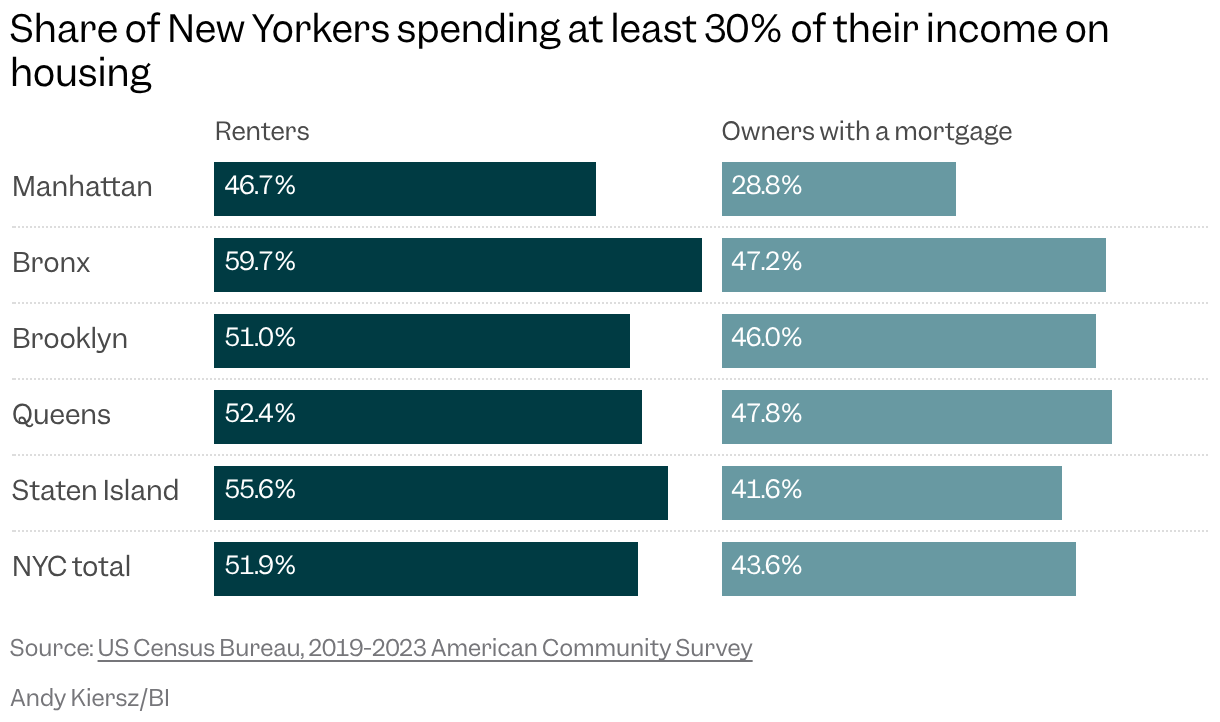
More than half of New York City's tenants are rent-burdened, and nearly 30% of renters fork over more than half their income on housing each month, comparable to the share of cost-burdened renters in the country as a whole. The vast majority of rent-burdened New Yorkers make far less than the median income, but a substantial share of middle- and higher-income renters and homeowners are cost-burdened, too.
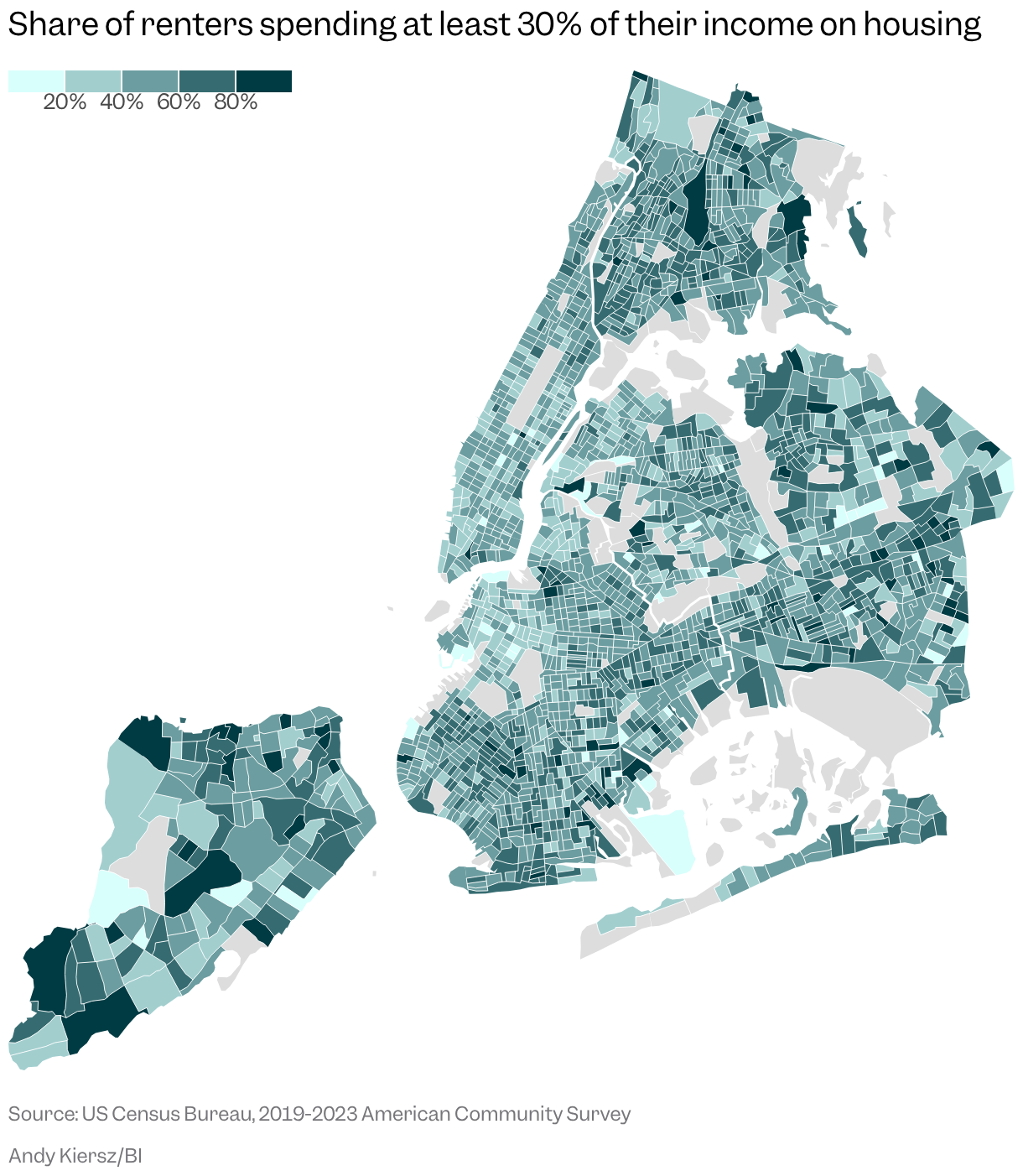
Analyzing data from the Census Bureau's 2019-2023 American Community Survey, we found that most New York City neighborhoods have a significant population of both renters and homeowners who are cost-burdened, with that share concentrated in the outer boroughs. Few parts of the city are in the clear.
"A high-income household that's paying 40% of income toward housing probably can still afford medication and afford food," said Emily Goldstein, director of organizing and advocacy at Association for Neighborhood and Housing Development, a coalition of housing groups.
Homebuilding isn't keeping up with the city
For decades, New York City has not built enough new homes, creating a severe shortage that's driven up rents and home prices. Between 2011 and 2023, the city added 895,000 new jobs, but only about 350,000 new homes. The city's housing vacancy rate fell to 1.4% in 2023 — the lowest since 1968 — and far below the widely considered healthy vacancy rate of 5 to 8%.
The housing that's been built in recent years is dominated by higher-end one- and two-bedroom apartments designed for higher earners. While the median renter household in the city makes about $70,000, the median rent citywide is about $4,400 per month, or $52,800 a year — significantly above the recommended 30% of income max spend on housing.
New Yorkers who made the city's average wage of around $88,600 in 2023 could afford less than 5% of rentals on the market that year, according to Streeteasy. Essential workers making typical wages could afford less than 1% of rentals.
Family-sized apartments with two or three bedrooms are especially hard to come by. The cost crisis is pushing many out of the city, particularly families with young children and lower-income Black and Hispanic residents, according to a 2024 study by the Fiscal Policy Institute, a left-leaning think tank. New Yorkers who manage to find larger apartments tend to hang onto them — more than 40% of apartments with three or more bedrooms have been occupied by the same tenants for more than a decade.
Mamdani has made big promises on housing affordability, some of which would require state approval, including freezing rents on rent-stabilized apartments, which have gone up between 2.75% and 3.25% for one-year leases over the last couple years. His campaign also promised that the city government would build 200,000 permanently affordable housing units over 10 years.
Those moves are not without their critics — landlords who own rent-stabilized units are worried about keeping up with their own bills, and building new housing is notoriously difficult in a city where many stakeholders have veto points.
"There's no question that the majority of New Yorkers are struggling with housing costs, and that, especially in the last election, we saw a really clear mandate that voters want the government to do everything in their power to address the cost of living and affordability," said Annemarie Gray, the executive director of Open New York, a nonprofit group that supports housing development, who's also advised Mamdani's team.
Gray said the city needs to add about 500,000 new homes — market-rate and affordable — over the next decade to bring down housing costs. In late 2024, the city enacted a sweeping zoning reform package, known as "City of Yes," designed to pave the way for 80,000 new homes across the city over 15 years. Gray called the potential impact of those reforms "a drop in the bucket."
"There are not nearly enough types of housing of different sizes, of different scales, that are meeting different income levels," Gray said.
The real estate industry is pushing for more subsidies for new housing, continued zoning reforms, and fewer regulations that slow down construction. The Real Estate Board of New York, an industry lobbying and advocacy group, released a report in December that concluded it takes, on average, 3.4 years to build a new apartment building or four years if it's in Manhattan.
"We must strengthen existing financing tools to promote new construction, expand development opportunities through zoning, and streamline the permitting process," said Basha Gerhards, REBNY's executive vice president of public policy.
When affordable housing isn't really affordable
Much of the subsidized affordable housing that's been built in recent years — largely by private developers with government incentives — isn't affordable enough for many lower-income, rent-burdened New Yorkers.
Freezing rents for stabilized units, which are disproportionately home to lower-income New Yorkers, would prevent some New Yorkers from being forced out of their homes because they can't afford rent, advocates say. "At an individual level, freezing rents is actually an eviction prevention approach," Goldstein said.
Lugo wouldn't directly benefit from a rent freeze since her apartment isn't rent-stabilized. She dreams of moving to Bayside, a wealthier, more suburban part of Queens, but housing and transportation costs out there would be even higher. She doesn't think she can find a better deal on any similarly sized apartment in a comparable neighborhood in the city.
For now, she's sticking it out. "I know I am very fortunate with the apartment that I have," she said.
Deloitte introduced a new firmwide talent architecture in January.
Artur Widak/NurPhoto via Getty Images
Deloitte US will cut benefits for some workers, according to internal documents seen by Business Insider.
Parental leave, PTO, and pension plan payments have been pared back for some internal-facing staff.
The changes are part of a wider overhaul in which the firm has also created new job titles.
Deloitte plans to pare back several core benefits for some of its employees, according to internal documents and a meeting recording seen by Business Insider.
Parental leave, annual PTO, a pension plan, and IVF funding have been reduced or cut for a group of employees who fall under the "Center" talent model, which broadly refers to employees in internal support roles, such as admin, IT support, and finance.
The changes are slated to come into effect on January 1, 2027, according to a document sent to the Center talent model in March.
It is unclear exactly how many employees will be impacted. The Big Four consulting and accounting firm employs about 181,000 people in the US.
The benefit shake-up is part of a wider talent restructuring that Deloitte announced internally in January, and that was first reported by Business Insider. As part of the changes, the firm told employees they would be getting new job titles and created a new class of leader. It also created four new segments within the business: Center, Core, Project, and Domain.
"Deloitte US is modernizing its talent architecture to provide a more tailored experience reflective of our professionals' broad range of skills and the work they do serving our clients," a Deloitte spokesperson told Business Insider.
"Benefits are regularly updated and will be tailored for a small subset of professionals to better align with the marketplace," the spokesperson said.
Companies are reducing costs
Deloitte isn't alone in tightening up workplace policies.
Workers face a difficult corporate outlook in 2026, as the shaky job market has shifted power back to employers. Faced with AI disruption and economic uncertainty, many companies are raising performance expectations and reining in perks.
Deloitte's US head count has grown over the past three years, alongside rising revenue, which reached $35.7 billion for the year ending May 31, 2025 — up 8% compared to the previous financial year.
Like its industry peers, however, Deloitte is facing challenges across both its core business lines — accounting and consulting — largely driven by AI disruption. Major consulting firms are evolving their offerings to drive AI-related business, while redesigning their internal operations and workforces to fit the future landscape.
Deloitte's government business was also hit last year amid the Trump administration's DOGE-related crackdown on consulting contracts.
"We are hearing from a number of clients that they are considering actions to reduce cost, given the ongoing uncertainty in the global economy," Ravin Jesuthasan, a future-of-work expert and the global leader of Mercer's transformation services business, told Business Insider.
They're taking a hard look at the different components of their overall labor cost, and "benefits and perks that are not fully utilized by the workforce are typically top of the list," he said.
Most of the cuts he's seen across the market have focused on tightening travel budgets and scaling back "nice to have" perks, Jesuthasan said.
A harder-edged management culture has taken hold in the corporate world, with strict RTO mandates, mass layoffs, and higher performance expectations placed on workers across the business landscape.
Alphabet CEO Sundar Pichai. The company has restricted work travel and cut perks in recent years.
Bloomberg/Getty Images
In recent years, Google and Meta have tried to cut costs by dropping perks and restricting work travel, and Amazon has reduced the number of shares it gives employees as part of their compensation.
"Companies have been getting tougher across the board," both by way of layoffs and ramping up workloads, said Peter Cappelli, professor of management and director of the Center for Human Resources at the Wharton Business School.
"Cuts and squeezing do not seem to be because businesses are in trouble. It seems more like with the job market slack, they feel they can," he added.
What's changing at Deloitte?
From January, all employees in the Center talent model will receive up to eight weeks of paid family leave and 18 to 25 days of PTO, depending on their seniority and tenure, the internal document shows.
They will stop earning additional accruals under Deloitte's pension plan after December 31st, the document said.
The changes also impact the part of Deloitte's Enterprise Solutions team that falls under the Center talent model, documents show.
Paid family leave, including parental leave, will be cut in half from 16 weeks to eight for employees in this group. They will also lose a $50,000 adoption and surrogacy reimbursement, which covers IVF treatment, starting in January.
PTO allowances for this group will decrease by 5-10 days for most employees, depending on seniority and start date. For example, an Enterprise Solutions employee who joined a decade ago will see their PTO drop from 30 days to 20 days in January, the documents show.
PTO for junior-level employees in this group will remain unchanged at either 20 or 18 days, depending on whether they joined before or after 2017.
In addition to PTO, the firm will continue to offer 15 companywide "disconnect days" and holidays, according to the documents.
Employees will retain benefits like medical and dental coverage, well-being subsidy, bereavement leave, and tuition assistance, according to a recording of a February meeting led by Lora Rothe, Deloitte's chief people officer for Enterprise Solutions, seen by Business Insider.
Enterprise Solutions employees will still be eligible for Deloitte's 401(k) savings plan, Rothe said.
One Deloitte worker who has been at the firm for over 10 years and falls into the Center talent model told Business Insider their benefits used to be "amazing" but said the changes felt like a "huge regression."
Do you work at Deloitte? Contact this reporter via email atpthompson@businessinsider.comor Signal at Polly_Thompson.89. Use a personal email address, a nonwork WiFi network, and a nonwork device; here's our guide tosharing information securely.
Blackberry Soul Fine Catering has catered events for the staff of Google, former Vice President Kamala Harris, Stephen and Ayesha Curry, and the Golden State Warriors.
Blackberry Soul Fine Catering
Chef Rene Johnson built a million-dollar soul food empire catering to Bay Area power players.
Using her grandmother's recipes, Blackberry Soul has fed big names like Sergey Brin and Steph Curry.
Now, Johnson coaches entrepreneurs on how to scale their businesses as she did.
This as-told-to essay is based on a conversation with Chef Rene Johnson, the founder of Blackberry Soul Fine Catering and entrepreneur behind Link and Thrive, a mentorship program for business owners. It has been edited for length and clarity.
I didn't even like food as a kid.
What I loved was being with my grandmother, who always made everything from scratch, and the way our family gathered around her food. That's where it started for me — not with cooking, but with connection.
I was her first granddaughter, and I always say she channeled me the most. I cook like her, think like her, have a business mindset like her. Everything I make — the peach cobbler, the red beans and rice, the biscuits — all come from her.
Before I rebuilt my career around her food, I was in the mortgage industry.
I had gotten a job in telephone sales and took to it naturally. When my clients closed on a home, I would gift them a homemade dessert: peach cobbler, pound cake, or banana pudding. That was my way of celebrating them.
When the mortgage industry crashed, I had to figure out what to do with my life. That's when I turned to cooking.
Nobody would have thought that I — a teenage mom without a college degree or formal culinary training — would build a business like this.
My kids were the ones who told me, "Mom, do something with your food." I lived in Georgia for a while and started dropping off meals at barber shops and around the neighborhood, but I couldn't quite get my footing there.
When I came back home to the Bay Area, everything changed. That's when I learned that it's not only about what you do, but also about who you do it with. I tapped into my community, and Blackberry Soul took off.
A broader mindset was key to my growth
At first, I thought I was building a small business, but I knew I had to shift that idea in my head.
I started telling people, "This is not a small business. This is my company." That changed everything: how I showed up, how I hired, how I thought about growing.
A wedding was my first big event. After that, I did a fundraiser for a political event with almost no budget, but everyone important was in the room. They tasted my soul food, and I became the preferred caterer for their events.
At first, I did everything myself, but I was holding on too tightly, trying to control everything. One of my biggest lessons, something I should have done sooner, was learning to let go.
When I finally did build a real crew, that's when the business blew up. As I let other people take over tasks like answering phones or doing the shopping, we grew so much faster than I could have ever imagined.
These days, if I show up to help with an event, sometimes my team will say, "You're not on the schedule. You can go home."
That's when you know you've built something real — when the business can run itself.
Now, Blackberry Soul feeds everyone from our community to major political and business leaders.
We've served thousands of people at once. I've fed 2,500 people at Google, including its cofounder Sergey Brin. I've cooked for Gavin Newsom, Kamala Harris, and so many others, but it's important to me that we treat every client the same.
Whether we're catering for executives or people in my community, I want them to have the same experience — that same "pop" when they take the first bite. So we cook everything from scratch and don't cut corners.
From solo operator to mentor
These days, my passion has grown bigger than food. I still love cooking, but helping other entrepreneurs is my real focus.
I learned everything the hard way. Nobody taught me how to run a business, how to scale, or build a team. I didn't even know I needed PR in the early days.
After I started really growing, people began coming up to me all the time asking for mentorship.
That's why I created Link and Thrive, my coaching program to teach people how to build their own businesses. Rather than being in the kitchen, I now spend most of my days paying it forward.
I always say: You might know how to make a great hamburger, but do you know how to run a hamburger stand?
That's what we focus on — the day-to-day reality of being an entrepreneur. Building your team, creating customer experiences, and navigating the peaks and valleys.
My goal is to pass along the lessons I learned and show people that success is not just about the work. It's about how you show up, connect, and grow.
Kurdish officials displayed the remnants of a Shahed drone (foreground) they recovered from an Iranian attack.
Ibra Naber/Business Insider
Iran attacked the Kurdish region in northern Iraq over 400 times during its war with the US and Israel.
Officials displayed weapons recovered from these strikes.
They included a new drone jet that's twice as fast as the Shahed drones that are Iran's signature.
Three men unloaded the remains of a monstrous weapon from a white van in Erbil, Iraq last week. Here, in the cordoned-off yard of the Asayish — the security forces of the auton›omous Kurdistan Region in northern Iraq — explosive ordnance disposal specialists examined every Iranian projectile used in this war. "Zolfaghar," one of the Kurds said, tapping the pitch-black metal. "This missile struck near a mosque on the outskirts of the city just a few hours ago."
The Zolfaghar is a large ballistic missile that carries a warhead weighing up to 1,100 pounds. The missile is only one part of the extensive arsenal with which Iran has attacked the Gulf states and the Middle East in recent weeks. In an exclusive presentation for Business Insider, the Asayish unit displayed some of the drones and missiles that have struck Kurdistan since late February, killing 17 people in the region.
These remnants are a gallery of the many weapons Iran has used to kill and terrify people across the region: triangular Shahed long-range drones, hulking ballistic missiles, and a new jet-powered drone that's more difficult to shoot down.
"With the help of Russia, China and North Korea, Iran has succeeded over recent decades in building up an impressive arsenal of effective, technologically sophisticated long-range weapons," the influential Austrian colonel and military analyst Markus Reisner said.
Authorities in the Kurdish region of Iraq have recovered drones and missiles from the many Iranian attacks there during Iran's war with the US and Israel.
Ibra Naber/Business Insider
Tehran's ability to continue carrying out 60 to 90 drone attacks a day — combined with missile strikes — even into the sixth week of the war prolonged the conflict and increased pressure on global energy markets. The American-Israeli alliance struck more than 13,000 targets in Iran, including more than 2,000 command and control targets, but was unable to decisively break its military capabilities, before the US and Iran agreed to a two-week ceasefire on April 7. According to US intelligence assessments reported by CNN, around half of Iran's missile launchers are still intact; in addition, the country continues to possess thousands of long-range kamikaze drones.
The destructive power of Iranian weapons has been demonstrated in this war, Reisner said: "Drones are being deployed in a saturating combination with cruise missiles and rockets. When these weapons systems are combined with targeted satellite reconnaissance from Russia and China, they also develop a troubling degree of precision."
In the yard, Kurdish security forces lined up various pieces of debris. In the center: Iran's most frequently used weapon — Shahed long-range drones, with a range of up to 1,200 miles. Russia uses these lumbering weapons, which have a recognizable delta-wing shape, extensively against Ukraine, usually in improved variants. "We identified three kinds of Iranian Shahed drones," said Halmat, a member of the Kurdish bomb-analysis team. The most frequently used Shahed-136 had more of a lead-colored, metallic surface; others were lighter or black. Their components, however, were very similar.
Officials recovered a new jet-powered drone (at left) designed with sharp angles to reduce its radar signature.
Ibra Naber/Business Insider
Iran also used other models from its roughly dozen combat drones against Kurdistan, including the Meraj-532, a medium-range attack drone used by the Revolutionary Guards. "And that over there," Halmat said, "is a new Iranian drone, the Hadid-110."
It is a jet-powered attack that can race past many air defenses and slam into targets at over twice the speed of most Shaheds. The drone is launched with a rocket booster that accelerates it before the jet engine takes over for sustained flight. Its design similarly reflects the growing sophistication of Iran's designs: A triangular wing configuration combined with sharply angled surfaces intended to hide it from radar. One of these drone jets slammed into a home in a neighborhood outside Erbil, the EOD specialists said.
Smaller combat drones with a shorter range have also appeared in the Iran war. Videos released in March by Iranian-backed militias show small piloted drones hitting hangars and a helicopter near a US base in Iraq. Even advanced air defenses struggled to defeat threats this small and numerous.
The bulky remains of the Kheibar ballistic missile lay at the back of the yard. "They also used it to strike civilian areas here in the region," said Pishtiwan, who is part of the engineering team of the Asayish security forces. He pointed to the markings left on the 10-meter-long missile. "This happened on March 19 in the Mala Omer area, outside the city. We found it at 12:55 p.m."
Kurdish EOD specialists recovered fragments from an Iranian Kheibar ballistic missile that struck the region.
Ibra Naber/Business Insider
In total, Iran attacked the Erbil region alone with more than 400 drones and ballistic missiles, Halmat said: "And we have defused and collected more than 200 bombs."
Pishtiwan explained that after every explosion in the region, one of their specialized units is dispatched to assess the damage and identify the weapon. The risk of being caught in a so-called double-tap attack — a second strike hitting the same target just minutes later — is very real. "But it is our duty to protect our people. We are ready to sacrifice our lives for this country."
According to military expert Reisner, Iran's weapons have also inflicted considerable damage on the United States and Israel. "Iranian strikes in Israel and in the middle of American bases made that abundantly clear in recent weeks."
The past weeks have also delivered a painful lesson in the Kurdistan Region: not even the United States — the most advanced military in the world — can fully protect its bases and diplomatic facilities in a modern drone war.
The Erbil region has been struck over 400 times by Iranian drones and missiles, authorities there said.
Ibra Naber/Business Insider
During the attacks on Erbil, Iran and its allied militias targeted both the US military installation at the airport and the US consulate, which opened in late 2025 at a cost of nearly $800 million. Kurdish security forces shared videos with Business Insider showing damage from impacts on the consulate grounds, though the destruction does not appear to have been extensive. The French military was hit harder. A drone strike killed a French soldier in March in a town near Erbil, which President Emmanuel Macron confirmed was the country's first military death in the Middle East war.
Kurdish security forces said they are almost entirely dependent on Western air defenses. A Patriot system fought off Iranian ballistic missiles over the last few weeks. Drone defenses were numerous. The C-RAM gun system fired bursts, including glowing tracer rounds, at incoming drones. And US fighter jets like the F-16 Fighting Falcon regularly took off to hunt drones, as seen in videos from Kurdistan. According to media reports, the Raytheon Coyote drone was also used to destroy several drones in flight.
Kurdish security officials say that, according to their information, no Ukrainian drone specialists were stationed in Kurdistan for air defense. Kyiv had deployed more than 200 drone experts during the conflict with Iran, primarily to Gulf states, to provide support.
According to Reisner, Iran's waves of attacks are also a final warning for Europe. "The range of Iranian missiles extends to the periphery of Europe. The US missile defense system stationed in Europe — the European Phased Adaptive Approach, or EPAA — and national procurement initiatives such as Germany's introduction of the Israeli 'Arrow' system are therefore of great importance."
Ibrahim Naber is a foreign correspondent who has reported from Ukraine since 2022. In October 2025, he and his team were injured in a Russian Lancet drone strike in Dnipro. In 2025, he received the George Weidenfeld Prize for his coverage of global conflicts and crisis zones. He wrote his dissertation at King's College London on the psychology of modern drone warfare.
The Axel Springer Global Reporters Network harnesses the resources of the company's newsrooms to publish ambitious scoops, investigations, interviews, opinion pieces and analysis. It allows journalists — including those from POLITICO, Business Insider, WELT, BILD, Onet and Fakt — to collaborate on major stories for an international audience of hundreds of millions across platforms: online, print, TV and audio.
Anthropic cofounder Jack Clark joked that Anthropic is making it a great time to be a philsophy major.
Bloomberg/Getty Images
Anthropic cofounder Jack Clark says his literature degree proved to be a great match for working in AI.
He said the best majors will involve "synthesis across a whole variety of subjects."
Clark pointed out that Anthropic employs philosophers.
Anthropic cofounder Jack Clark says you shouldn't write off liberal arts majors.
After all, Clark, a former journalist who studied literature at the University of East Anglia, is one of them.
"What turned out to be useful is that I got to learn a lot about history and a lot about the kind of stories that we tell ourselves about the future," Clark said on Monday during Semafor's World Economy Summit. "That's turned out to be like, extremely relevant for AI in a way that I think people wouldn't have predicted."
Clark said that the best areas of study are those that have a lot of overlap.
"I think that majors which are going to become more important are ones which involve like synthesis across a whole variety of subjects and analytical thinking about that," he said.
The best skill, Clark said, is learning how to ask the right question.
"The really important thing is knowing the right questions to ask and having intuitions about what would be interesting, colliders, different insights from many different disciplines," he said.
After repeated pressing, Clark said that "rote programming" is something he would avoid. That's on brand with his Anthropic colleagues, including Boris Cherny, the creator of Claude Code, who has said the title of software engineer will start to be phased out this year.
"Some people need to know those fundamentals, but we do see that technology move up the stack," Clark said.
Overall, though, Clark said that majors that may seem mismatched to the age of AI will actually be fairly worthwhile. He pointed out that Anthropic employs philosophers.
"When was the last time you heard that a philosophy degree was like a great job prospect?" he said.
Cloudflare's data shows that AI companies consume more web value than they return.
Anthropic's crawl-to-refer ratio is 8,800 to 1, highlighting ethical concerns.
AI chatbots reduce web traffic, upending the web's grand bargain.
Cloudflare's latest data offers one of the clearest snapshots yet of how AI companies consume the web, and how little they give back.
The company, which powers roughly 20% of the internet, tracks how AI bots crawl websites versus how often those platforms send users back through referrals. The resulting "crawl-to-refer" ratio is a simple yet telling metric: how much value is extracted compared to returned.
The early April 2026 figures are stark. Anthropic is the worst by a wide margin, with a ratio of 8,800 to 1. That means its bots crawl webpages 8,800 times for every referral sent.
OpenAI follows at 993 to 1. Microsoft, Google, and DuckDuckGo look far more balanced by comparison.
Anthropic's position is particularly striking given its reputation for being "ethical." That reputation has made it a preferred choice among some users who want to support more responsible AI development. This data highlights a different dimension of ethics — how companies interact with the broader web ecosystem that provides information for AI model outputs.
Historically, the internet operated on an implicit bargain: websites allowed search engines to crawl and index their content for free, and in return received traffic they could monetize. Generative AI breaks that bargain. Chatbots increasingly provide direct answers, reducing the need for users to click through to original sources.
This results in a system that extracts more value than it gives back — and in some cases, increases costs for site owners due to heavy bot activity.
Anthropic has previously questioned Cloudflare's methodology and pointed to growing referral traffic from new features. Still, the broader trend is hard to ignore. I asked Anthropic for comment this time, too, and it did not respond.
If the web's economic engine depends on traffic and referrals, these ratios raise a fundamental question: What will incentivize the sharing of verified information online in the future?
Cloudflare is trying with a new marketplace for web content. It's unclear if efforts like this will succeed. After all, what's better than using people's content for free?
Top-performing Taco Bell managers gathered in Hawaii in March for the company's annual staff recognition retreat.
Courtesy of Taco Bell
Taco Bell recently hosted its Golden Bell awards, a recognition trip for top-performing managers.
More than a management retreat, Taco Bell says the event helps drive outsize growth.
Golden Bell-winning restaurants grew sales by nearly 20% in 2025 and boast better staff retention.
At Taco Bell, a weeklong trip to Hawaii is more than a perk for top-performing managers — it's part of the company's growth strategy.
The chain's annual Golden Bell awards, held this year in mid-March, recognize its top 150 general managers and are as much a management retreat as they are an awards show. Taco Bell brings its top GMs to Maui, where they get a week of recognition, excursions, and a chance to compare notes with company leaders and one another.
Like many companies, Taco Bell uses retreats and recognition to reward top-performing managers. However, what sets the taco chain's approach apart is the continued bet that its general managers — not solely its menu or marketing — are a key competitive edge, even as other companies scale back middle management.
In its fourth quarter, Taco Bell delivered 7% same-store sales growth, outpacing the industry, and the company says Golden Bell winners were a big part of that performance. The company said its award-winning restaurant leaders grew sales 19% in 2025, often running high-volume locations with annual sales volumes of $2.5 million to $4 million and beyond.
Michelle Beasley, Taco Bell's US chief operating officer, told Business Insider that the award process is built around a small set of business metrics tied to the brand's goals.
Winners are selected from three categories: highest transaction growth, the company's "Supreme" operational-excellence measure, and guest reviews. Beasley said Taco Bell is intentionally focused on consumer-facing metrics because those are the measures the company believes most directly drive performance.
She also stressed that the company is thinking about how to scale good habits across the system, and sees the event as a way to spread winning traits beyond the 150 honorees. The leaders who rise to the top, Beasley said, tend to be the ones who "lead from the front," communicate clearly, and take care of the team around them.
"Culture is fueling our results," Jamie Harrison, Taco Bell's global chief people and culture officer, told Business Insider. "We're a people-first culture, and we see that when we pour into our teams, like with Golden Bell, they also have a chance to do that for their teams, too."
Kimberly Hairrell, Taco Bell's GM of the Year, who received her second Golden Bell award this year, told Business Insider that her path to the top was shaped by 50-hour workweeks as she battled a cancer diagnosis, and a team that refused to let her carry the burden alone.
"My team is what made it happen," she said. For Hairrell, the award was less about personal recognition than about proving that "you can still achieve things that you set your mind to."
Noah Starkey, who won his first Golden Bell this year — his second year being the manager of his own store — described a similar mindset. He started as a crew member in college and worked his way up to GM over five years, and said the key to winning was not simply sales growth, but focus on customers, employees, and consistency.
Both Hairrell and Starkey shared a competitive nature, already setting their sights on achieving Golden Bell status next year.
That kind of internal competition is exactly what Taco Bell is trying to create: a system where top performers raise the bar for everyone else.