Tuesday, 30 June 2026

An AI data center suing for Colorado River water highlights a bigger question: Who should get the West's water?

An aerial view of the shrinking Salton Sea
Drought has long been a challenge in California's Imperial Valley.
  • A data center developer in California is suing for access to Colorado River water.
  • The developer wants to use water allocated to farmland and use it for cooling instead.
  • Water experts and local advocates say it raises bigger questions about how water should be used.

The developer behind what would be California's largest AI data center is suing for access to Colorado River water, the threatened source of freshwater for 40 million people and the subject of countless disputes over water use in the West.

The lawsuit, filed this month by Imperial Valley Computer Manufacturing, says the company needs access to 287 million gallons of water for the 330-megawatt data center. If the proposed project in Southern California's Imperial Valley is built, it would be the largest AI data center in the state.

The lawsuit was filed after the Imperial Irrigation District, a local agency that delivers Colorado River water in the Imperial Valley, denied the company's request for water for the project. It also comes as communities across the US push back against data centers. The Colorado River is the only source of freshwater in the Imperial Valley, which has long faced drought and water supply issues.

The developer, Sebastian Rucci, said the project would not add to demand on the river overall because the company would fallow, or stop irrigating, nearby farmland and use that water to cool the data center instead.

Rucci told Business Insider the proposal would have "zero impact" because the data center would not require any additional allocation from the Colorado River, adding that its water demand would be similar to that of a 160-acre farm.

Water experts and local advocates say the case raises a bigger question than how much water a single data center should use: As water becomes scarcer and new industries increase demand, should water historically used for farming be redirected to power the AI boom?

Moving water from farming to data centers

Imperial Valley's identity has been tied to farming, with cattle, alfalfa, lettuce, and spinach among its top commodities. John Fleck, a writer and water policy expert at the University of New Mexico, told Business Insider that "taking land out of agricultural production to use for other things is a values question, even if it's a small amount."

Horseshoe Bend, a horseshoe-shaped incised meander of the Colorado River
The Colorado River is the source of freshwater for 40 million people.

Michael Cohen, a senior fellow at the Pacific Institute focusing on Colorado River Basin water use, said the issue is not necessarily the amount of water, but rather the developer's plan to access farmland, dry it up, and reallocate it for industrial use.

"There's a lot of resistance in any agricultural community to 'buy and dry' because that's jobs," he said.

Rucci said his company has a contract to purchase the land and water assignments from farmers. He also said he pursued this strategy after his proposals to use reclaimed water were rejected.

While individual landowners may profit from the practice, taking farmland out of production can have cascading effects in agricultural communities, including fewer farm-related jobs.

Imperial Valley's economy has long relied on Colorado River agriculture. If it weren't for that part of the country around Imperial and Yuma, Arizona, "no one in America could afford a salad in February," Rhett Larson, a water-law expert at Arizona State University, said.

Larson said that while farmers may make money selling land or water rights, the people who are often hurt are the fertilizer salesmen, tractor repairmen, teachers, dry cleaners, or anyone in these rural communities who doesn't have land or water rights to sell.

Rucci said the data center would bring major economic benefits to Imperial County, including 1,688 construction jobs, over a hundred permanent jobs, and an estimated $2.95 billion in economic improvement over 30 years, citing an independent economic study prepared for the county.

"Economic diversification is exactly what the area needs," Rucci said in an emailed statement, pointing to Imperial County's high unemployment. The county's unemployment rate was about 17% as of May, according to state data.

A farm field and tractor.
California's Imperial Valley is a major agricultural hub.

Who makes decisions about water?

Eric Reyes, an Imperial Valley resident and the executive director at the advocacy organization Los Amigos de la Comunidad, said he's concerned the lawsuit is an attempt to circumvent the Imperial Irrigation District (IDD), a publicly owned utility governed by an elected board. Water rights in the area have long been held in trust by the IID, rather than individual landowners.

Reyes said the developer's plan "raised a huge red flag" because it could involve a "private deal with a landowner and then use it for his own purpose." He sees it as an attempt to circumvent the IID and give landowners more power over water, some of whom, he says, want to "farm water instead of farmland" — or sell water intended for farming — because it can be more lucrative.

Rucci rejected the idea that the company is trying to circumvent IID's control and said farmers have the right under state law to assign water, and that the proposals would not require "a single additional drop" from the Colorado River.

Larson said the case shows why water fights in the West are rarely only about conservation.

"Everybody will say, 'Well, we need to conserve water,' but they'll often stop at that point," he said. "We need to ask another question, which is, 'conserve it for what?'"

Moving water from farms to data centers could be a choice some communities make, Larson said, but there will be tradeoffs.

"The Colorado River basin has to decide what we want to be when we grow up and what it will take to get there," he said. "We have enough water to do a lot of great things. But we don't have enough water to do every good thing."

Read the original article on Business Insider


from Business Insider https://ift.tt/BT3A6ts

Monday, 29 June 2026

2 jobs with career security and 2 that are riskier

Healthcare staff in blue scrubs, and most with hair covers, gather around computers
Healthcare work is more secure, as it's less affected by changes to the job market.
  • Healthcare workers and job seekers are in a more stable position than tech workers.
  • As one economist said, there will always be a need for nurses and doctors.
  • Employers might not want to hire more data scientists and other tech workers if there's economic uncertainty.

The job market is looking brighter, but some places are a better bet if you're looking for stability than others.

It's especially tough if you're looking for work in the tech- and media-heavy information sector. Major tech companies have laid off workers due to AI and automation.

Other sectors offer better career security or are more resilient to economic cycles. That includes many healthcare roles. "It doesn't matter how the economy is doing. We will always need doctors. We always need nurses," Loujaina Abdelwahed, the head of economic research at Revelio Labs, said.

Below are some of the more and less secure kinds of work.

More secure: Healthcare

The healthcare sector has typically been adding jobs each month, making up about 20% of overall net job growth in May. Daniel Zhao, the chief economist at Glassdoor, said turnover can be pretty high in healthcare, but so is worker demand, making it easier to get a new job compared to in some other sectors.

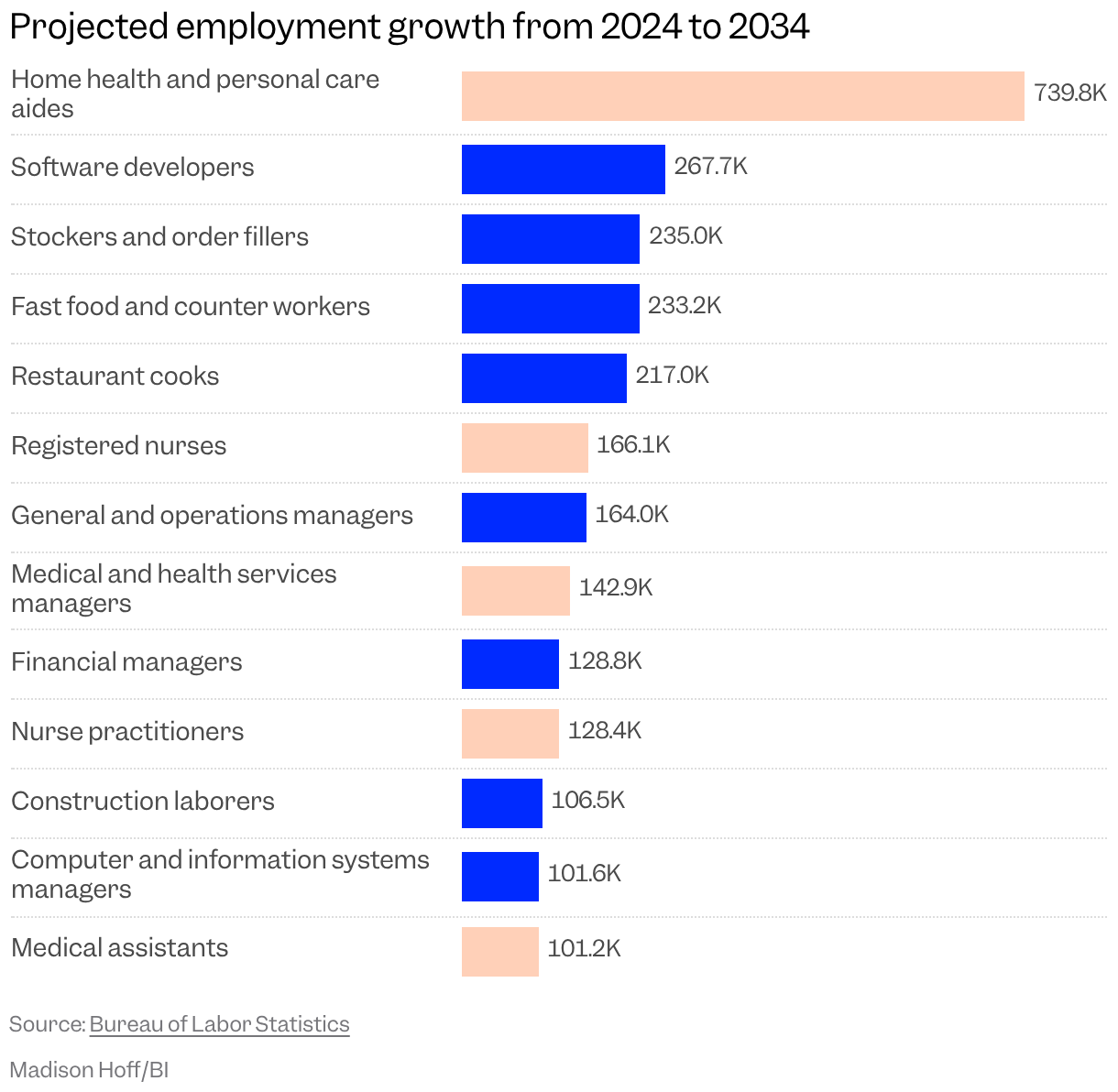
Based on Bureau of Labor Statistics employment projections, several healthcare occupations are projected to increase a lot from 2024 to 2034. Home health and personal care aides and registered nurses are projected to experience robust demand to help care for the aging population. BLS projected large job growth in medical and health services managers, as more healthcare demand means more people are needed to oversee work.

New college graduates will likely have an easier time navigating the job market if they're on a more rigid path, like the requirements and schooling for doctors, nurses, or teachers.

"Graduates in education and healthcare, where there are licenses or pathways into a job, it's a lot easier right now," Cory Stahle, senior economist at Indeed, said. Meanwhile, computer science majors are more likely to be affected by job market fluctuations and can have a more flexible post-college path, which can lead to greater uncertainty.

Within healthcare, security can vary. Zhao pointed to the difference in nursing assistants and anesthesiologists, where the latter requires specific expertise, medical school, and completion of an internship and medical residency. Bureau of Labor Statistics data showed there were over a million nursing assistants as of May 2025, compared to about 39,000 anesthesiologists.

"Generally speaking, having more education, more experience, more credentials helps you define a rarer set of skills and helps that thus create more job security," Zhao said.

More secure: Skilled trades

From electricians to plumbers, skilled trades are another more secure career option; Zhao said these jobs won't be replaced by AI and are geographically spread out.

"It's not nearly as concentrated as some white-collar sectors, with tech or finance that tend to be concentrated in the big cities," Zhao said. "So in that sense, there is more flexibility and more security in that."

Electricians are projected to be a fast-growing job, and they typically are paid well. Employment is projected to grow 9% from 2024 to 2034, and plumbers, pipefitters, and steamfitters are projected to grow 4%, just above the projected 3% for all occupations.

Skilled trades can also be an opportunity for being your own boss, said Ed Brady, president and CEO at Home Builders Institute. "Once you master that skill, once you perfect that skill, now you know what you're doing, you can hire people, you can build your own business and become an entrepreneur," he said.

Working in skilled trades can take time, including attending trade school and thousands of hours of on-the-job training to become an electrician, a career guide from Indeed showed.

"If you're working your way up in one of the skilled trades, those early years, you might feel very insecure or very unstable," Zhao said. "And in fact, there's even a higher cost of switching at that point because you've sunk that time and effort into going down that path."

Less secure: Leisure and hospitality

Despite the flashy headlines of white-collar layoffs, lower-paying service work in sectors like leisure and hospitality has historically been much less stable.

"It tends to be blue-collar workers who face the most instability and insecurity," Zhao said. "If you think about hospitality, for example, which would include restaurants, hotels, and workers at those sorts of firms, those tend to be some of the places where you see the highest amount of uncertainty and insecurity."

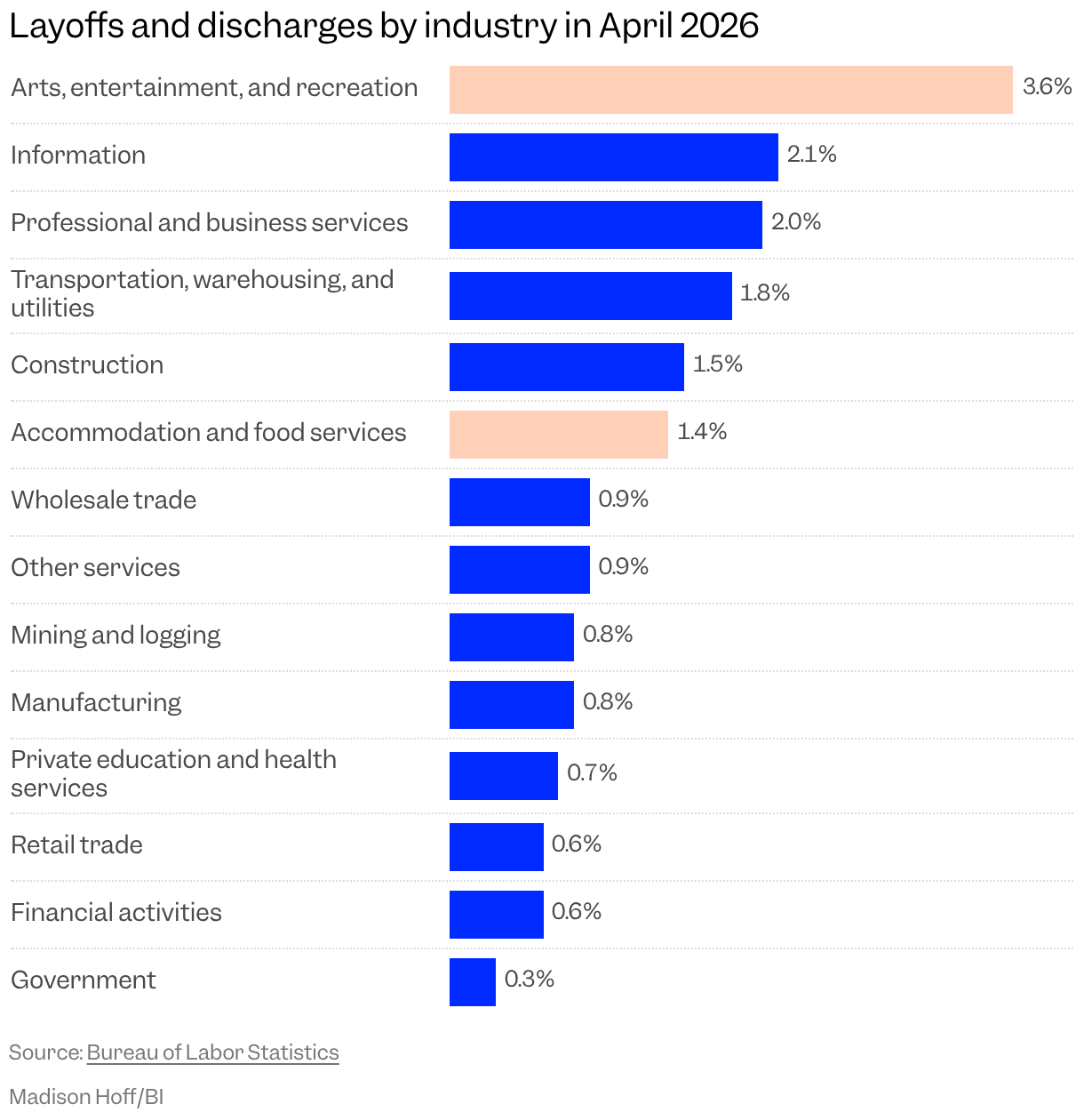
The leisure and hospitality sector tends to have a high quits rate, and the arts, entertainment, and recreation subsector tends to have a high rate of layoffs and discharges.

Less secure: Tech

Abdelwahed said data scientists and software engineers are among the "nice to have" jobs for many businesses, where adding new hires might not be essential for them if there's economic uncertainty going on.

Employment in the computer systems design and related services sector has generally been falling, down 1.5% from a year ago as of May. Employment in computing infrastructure providers, data processing, web hosting, and related services was down 3%.

"Many computer science and computer engineering graduates are still holding out for the tech job market to turn around, and they have a degree that, in theory, should be valuable once this downturn in the tech market ends," Zhao said.

Zhao said people in tech can branch out to employers in industries that are looking more stable and that need workers with technical skills. Still, job seekers may prefer being in tech. Zhao said maybe someone wants to join a startup, hoping it becomes the next unicorn and offers high compensation.

"For some workers, they might have more appetite for risk in their careers and be willing to really try to make it work in the tech sector, knowing that there is this higher risk if the economy slows down," Zhao said.

Read the original article on Business Insider


from Business Insider https://ift.tt/UCQTrZE

Sunday, 28 June 2026

The hottest new real estate marketing tactic: accepting IPO stock

Two luxury properties, in Miami and New York, are being listed with stock trades as a financing option
Some luxury home sellers — including the Miami and Tribeca properties above — have started saying they'll accept tech stocks in place of traditional financing.
  • In a slow market, luxury home sellers have started saying they'll accept tech stocks as payment.
  • Advertising stock options in listings allows real estate marketers to subtly target wealthy buyers.
  • Although the strategy is making headlines, it's not clear if it has translated into completed sales.

Luxury-home sellers are finding a new way to stand out in a sluggish market: telling buyers they'll accept startup stock.

Listings from Brooklyn to the Bay Area have begun advertising that sellers are willing to consider accepting shares in companies such as Anthropic, OpenAI, and SpaceX in exchange for multimillion-dollar properties.

While few expect many homes to ultimately trade hands this way, some real estate marketers say the strategy can be an effective way to capture the attention of newly wealthy tech workers and investors sitting on hard-to-access private-company equity.

Andrew Rohm, founder of the luxury real estate marketing firm DMR Media, said the tactic works "100%" as a marketing strategy, adding that, while stock-for-home transactions aren't unheard of, they're uncommon.

Most buyers with significant stock holdings simply use those assets as collateral for loans rather than trading the shares outright, he said. However, as a marketing tool, IPO stock may be a different story.

Rohm said real estate marketers have long tried to position homes in front of buyers as they approach major liquidity events. In the AI boom, that means employees at companies like Anthropic and OpenAI who could eventually see windfalls from public offerings.

Housing advertisers face restrictions on targeting buyers by profession or demographics, Rohm said. By explicitly mentioning pre-IPO stock in listing descriptions and advertisements, sellers can create marketing that resonates with a specific audience without running afoul of the rules.

"You just have to call someone out through the advertising," Rohm said, adding that modern algorithms tend to identify and amplify those messages to prospective buyers.

The trend is emerging as luxury homes are taking longer to sell. High home prices and elevated mortgage rates have sidelined many buyers, while homeowners with low-rate mortgages have been reluctant to sell. For luxury properties, which already appeal to a limited audience because the pool of potential buyers is relatively small, standing out has become increasingly important.

"Houses are sitting on the market extremely long right now," Rohm said.

The rooftop patio of 3 Wythe LN in Brooklyn, a home listed with Anthropic shares as a buying option.
By explicitly mentioning stock deals in listing advertisements, luxury sellers can market toward a specific audience without running afoul of restrictions on targeting buyers based on profession.

The investment appeal of a tech stock deal

One example is a Tribeca apartment owned by Sebastian Sagar, a finance professional and investor. The property has been on the market for about a year and has taken a $1.5 million price cut after being originally listed at $7.8 million.

Sagar said the idea came to him after he learned Anthropic had leased office space a few blocks from his apartment.

He said he had been reviewing his portfolio and realized he wanted less exposure to real estate and more to AI. At the same time, he imagined Anthropic employees sitting on valuable private-company equity that they couldn't easily sell or borrow against.

Sagar described the arrangement as a potential "win-win" that would allow him to gain early access to a company he believes has significant long-term upside while helping a buyer acquire a home near work.

In Miami, Luis Noguera said his family is open to accepting shares in Anthropic, OpenAI, or SpaceX for a $2.6 million home owned by his father.

Noguera, who previously worked in tech, said his family recently established a family office and views AI companies as potentially attractive long-term investments.

The patio at 415 Washington St APT 5A in Tribeca
Luxury properties typically sit on the market for six months or more. In the current market, some homes — like the Tribeca apartment above — haven't sold in more than a year, despite aggressive price cuts.

The house, which was previously a rental, doesn't really play a strategic long-term role for the family, Noguera said. Owning stock in one of the companies instead, he said, feels like a better investment.

In Brooklyn, the owner of a townhouse at 3 Wythe Lane told Business Insider that mentioning Anthropic shares in the listing was less about a specific company than a broader acknowledgment of where wealth is being created.

"Every generation has its wealth-creation vehicle," the anonymous seller said in an emailed statement, sent through their listing agent. "For many people today, that's private technology companies and digital assets."

The seller said the reference to Anthropic was intended to signal openness to "creative transaction structures" and to appeal to buyers who may be approaching a major liquidity event.

Some of the sellers experimenting with the idea acknowledge that any eventual deal would likely involve a mix of cash and stock rather than an all-equity transaction.

Whether any homes ultimately trade hands for startup shares remains to be seen, but for sellers struggling to attract attention in a difficult luxury market, that may not be the point: The listings generate headlines, spark conversations, and put properties in front of a highly specific group of potential buyers.

In a market where multimillion-dollar homes can sit for months, simply getting noticed may be more valuable.

Read the original article on Business Insider


from Business Insider https://ift.tt/1H0m53M

Saturday, 27 June 2026

A relationship banker and a risk manager: Meet the two candidates vying to succeed JPMorgan's Jamie Dimon

Doug Petno and Troy Rohrbaugh
Doug Petno and Troy Rohrbaugh are the two frontrunners in the race to succeed Jamie Dimon.
  • JPMorgan named Troy Rohrbaugh and Doug Petno co-presidents, making them the frontrunners in the CEO race.
  • Though they co-led the investment bank, Rohrbaugh and Petno have distinct strengths.
  • Here's a guide to the two top contenders, one a great risk manager, the other a client confidant.

And then there were two.

JPMorgan elevated Troy Rohrbaugh and Doug Petno to co-presidents on Thursday, the clearest sign yet that they are leading the race to replace CEO Jamie Dimon.

The announcement comes after more than a decade of speculation and a rotating cast of succession candidates. Even now, the field could keep shifting until the day Dimon steps down. While both are held in high esteem at JPMorgan, Petno and Rohrbaugh have distinct strengths — the former is known for his charm and client relationships, the latter for his trading chops and quieter risk management.

Petno and Rohrbaugh had jointly led the commercial and investment bank, which Petno will now lead on his own as Rohrbaugh becomes CEO of the firm's consumer and community banking unit. Marianne Lake, the current head of consumer and community banking who had been seen as a frontrunner in the CEO race, is retiring.

Though the announcement effectively narrows what had been a more crowded field to a two-person race, it doesn't seem that Dimon, 70, plans to step down anytime soon. Analysts from Bank of America said the announcement, especially Lake's retirement, suggests Dimon will stick around for several more years, and his timeline could impact whether Petno, 61, or Rohrbaugh, 56, lands his job.

"It's a question of timing more than anything," Mike Mayo, a Wells Fargo banking analyst, said. Mayo said that Rohrbaugh, with his relative youth, likely has a better shot at becoming CEO the longer Dimon stays in the position.

Their decadeslong careers at the bank

Petno has worked at JPMorgan for more than 35 years, though originally thought he would be a veterinarian, he told his alma mater, Wabash College, in 2019. He started at the firm as an investment banker and eventually became head of the natural resources group.

He became the CEO of commercial banking in 2012, and under his leadership, revenue more than doubled. In 2024, he became the co-head of global banking, before becoming co-head of the investment bank in 2025, the role he shared with Rohrbaugh.

Through his three decades at the firm, Petno became known as one of Dimon's close associates, with a finger on the pulse of top customers. Dimon described him as "a great client guy and a culture carrier" in an interview with Bloomberg at the beginning of last year, adding that he has a good sense of humor. The CEO has trusted him with big projects over the years, tapping him to help combine the corporate and investment banks and build up the firm's startup banking capabilities.

"I learned to observe the people and types of behavior I admire and embrace it, building it into my own style," Petno told Wabash in 2019 about his rise. "People took chances on me, including Jamie."

Rohrbaugh has been less of a public- and client-facing figure. A veteran trader who started at JPMorgan in 2005, he's built a reputation as someone who knows how to navigate risk — he said in an interview with Bloomberg last year that, being a trader by background, "I worry about everything." That skill could make him an attractive CEO candidate, an industry recruiter previously told Business Insider.

The 56-year-old studied political science and played football at Johns Hopkins, and started his finance career trading options at the Philadelphia Stock Exchange. He then worked at Banque Nationale and Goldman Sachs before joining JPMorgan's foreign-exchange business. Rohrbaugh helped stabilize and mature the business while pushing to modernize its technology capabilities. He's also served as head of global markets, and his experience at JPMorgan has spanned Asia, London, and New York.

Rohrbaugh was vaulted more publicly into the succession race when he became co-head of the commercial and investment bank in 2024.

In a video to Johns Hopkins' football team in 2023, Rohrbaugh, dressed in blue jeans, advised staying "calm under pressure" — potentially useful words of advice given his current circumstances.

Proving they're up for the job

Now that Rohrbaugh and Petno are locked into their roles as co-presidents — they each received a one-time $30 million retention bonus, according to an SEC filing — they'll need to prove they're up for the CEO job that's been synonymous with Dimon's name for decades.

Petno, as the sole head of the corporate and investment bank, has the chance to maintain his strong client relationships and impact on firm culture, Chris McGratty, an analyst at KBW, said in an email. On top of that, the veteran investment banker will need to demonstrate his handle on the markets business. He's also one of the people spearheading the Security & Resiliency Initiative, a $1.5 trillion effort that's a huge focus for Dimon.

Rohrbaugh, on the other hand, is now overseeing an entirely new group of people and line of business on Main Street rather than Wall Street, giving him wider insight into the sprawl that is JPMorgan. In his new position, he's overseeing more than 5,000 branches across the country. The new role could also address his more limited experience in high-profile leadership roles, which Mayo, the Wells Fargo analyst, described as a potential "shortfall."

With Dimon seemingly entrenched as CEO for at least a couple more years, the two men, former football and soccer players, have just started what might be the most public game of their lives. It seems all of Wall Street is filling the stands.

Read the original article on Business Insider


from Business Insider https://ift.tt/vikM4Qq

Microsoft's Satya Nadella says every company should build its own AI model

Microsoft CEO Satya Nadella
  • Satya Nadella said firms should create AI models tailored to their unique business needs.
  • Microsoft is embracing a multi-model AI strategy, hosting diverse models on its Azure AI Foundry.
  • Nadella warns of economic risks if AI models are concentrated in the hands of a few companies.

If you own a company, Satya Nadella thinks you should build your own AI.

In an interview that went live Friday, Microsoft's CEO told Yash Patil, cofounder of Applied Compute, that every company should create AI models tailored to its own business.

"My simple thing is there should be as many models in the world as firms in the world," Nadella said. "Because after all, what is a firm? A firm is a learning system."

"I don't want to be locked into any one model," Nadella added. "I want to be able to use my own context, my own data — in fact, my own traces to maybe even take a much more open-weight, cost-efficient model or a fine-tuned model."

The comments mark one of Nadella's clearest visions yet for enterprise AI. Many companies rely on foundation models from a relatively small group of AI companies, including OpenAI, Anthropic, Google, and Meta.

Microsoft has increasingly embraced a multi-model strategy through Azure AI Foundry, which also hosts models such as DeepSeek and Cohere, rather than relying solely on OpenAI. Amazon has pursued a similar strategy with Bedrock, while Google Cloud offers a growing catalog of third-party and proprietary models alongside Gemini.

Many enterprises are also experimenting with open-weight AI models, which have publicly available parameters so that companies could fine-tune and deploy the AI themselves, such as Meta's Llama and Mistral's models.

Nadella said that AI concentration poses long-term economic risks.

"It can't be, 'Hey, look, I have two frontier models or three frontier models' or whatever, some finite set that have learned everything that is differentiated today in the economy because then it collapses,'" Nadella said.

"You can always buy a tool, you can even outsource a task or even a job, but you can't outsource your learning," Nadella added. "If you outsource your learning, then why exist?"

Read the original article on Business Insider


from Business Insider https://ift.tt/o1EznNv

Friday, 26 June 2026

This new research challenges nearly every big AI narrative of 2026

Sarah Friar speaks during a conference in New York
OpenAI CFO Sarah Friar leads one of the most popular AI companies among chief information officers, said RBC.
  • A new RBC survey of chief information officers and tech leaders shows no freakout over AI token budgets.
  • The research found that OpenAI is the most popular among companies, outperforming Anthropic.
  • Corporate customers are spending more on software while rapidly adopting hybrid AI pricing models.

New research from RBC Capital Markets turned up a string of unexpected findings that challenge many of the biggest AI narratives.

Every six months or so, Rishi Jaluria and other RBC tech analysts survey more than 100 chief information officers and other tech leaders to gauge spending on corporate IT. These annual budgets represent many billions of dollars.

And Jaluria is no AI cheerleader. He's urged caution when it comes to AI adoption by businesses. So I pay attention when he publishes.

This time, the message is clear: Companies are spending a lot on AI and are willing to spend even more.

"We came away encouraged by broad-based enterprise spending momentum into 2H 2026, with AI adoption beginning to transition from pilot to production," Jaluria wrote.

Surprise No. 1

For months, investors have worried that ballooning token bills would become AI's biggest headache. RBC's survey found the opposite.

Nearly nine in 10 respondents said token budgets are manageable, even though almost half have already exceeded their original spending plans.

A chart from a CIO survey by RBC
A chart from a chief information officer survey by RBC.

Instead of scrambling to cut AI costs, most companies plan to spend even more on AI tokens in the future. (Token prices are likely to plunge, making returns on AI spending more attractive, so this makes sense).

A chart from a CIO survey by RBC
A chart from a CIO survey by RBC.

OpenAI is way ahead

This result really caught my eye: OpenAI isn't just ahead — it's lapping the field.

Fifty-seven percent of respondents said ChatGPT is the AI model-based service they use most, compared with just 12% for Anthropic's Claude.

A CIO chart from RBC
A chart from a CIO survey by RBC

OpenAI also comfortably leads on performance, with 44% naming it the highest-performing model provider versus 24% for Anthropic.

A chart from a CIO survey by RBC
A chart from a CIO survey by RBC.

Sustained, and very large, business adoption of AI is required for successful IPOs by OpenAI and Anthropic.

SaaSwhat-alypse?

The long-predicted "SaaSpocalypse" has failed to show up so far, according to this survey.

The vast majority of respondents expect to spend more on software, and not a single respondent expects to spend less. Even companies spending more on AI largely aren't paying for it by gutting the rest of their software stack.

A chart from a CIO survey by RBC

From pilot to production

The survey also suggests enterprise AI has graduated from experimentation. Late last year, a similar survey from RBC raised concerns about enterprise AI adoption.

This time, more than half of respondents said AI is already in production, while another 35% expect to reach production within six months.

A chart from a CIO survey by RBC

New pricing catches on quick

Meanwhile, hybrid pricing models that combine seat licenses with usage-based pricing have quickly become the preferred way enterprises want to buy AI.

That's a remarkably fast shift for a market that typically adopts new technology at glacial speed.

A chart from a CIO survey by RBC

The 100% chart

Perhaps the most striking chart in the report is also the simplest: a solid blue circle showing 100% of respondents are allocating budget to AI and large language model projects.

A chart from a CIO survey by RBC

Of those, 91% said they're creating entirely new AI budgets rather than simply reshuffling existing spending — another sign that, for corporate America, the AI investment cycle is accelerating.

Sign up for BI's Tech Memo newsletter here. Reach out to me via email at abarr@businessinsider.com.

Read the original article on Business Insider


from Business Insider https://ift.tt/yu9QeLB

I missed my chance to invest in Anthropic. Now I'm trying to trade my luxury NYC apartment for shares.

The interior of 415 Washington St APT 5A in Tribeca
Sagar's apartment at 415 Washington St in Tribeca features a 20-foot-tall tree in the living room.
  • Sebastian Sagar has listed his Tribeca apartment for $6.25M, accepting Anthropic shares as payment.
  • He's seeking Anthropic stock after missing an opportunity to invest in the company's pre-IPO shares.
  • The property has been on the market for over a year — accepting AI stock could help prevent a loss.

This as-told-to essay is based on a conversation with Sebastian Sagar, who works in finance and is selling a $6.25 million luxury apartment in New York. He is accepting shares in Anthropic as part of a potential sale of the property. It has been edited for length and clarity.

A few years ago, I had an opportunity to buy pre-IPO shares in Anthropic. At the time, I passed. I thought there were better places to put my money.

Looking back, I wish I had taken the opportunity in the early investment round.

Now Anthropic is one of the most talked-about AI companies in the world, and I started thinking about whether there was another way to invest in it.

I own a luxury apartment in Tribeca that I no longer use. My life is in Florida now. I'm getting married and planning to start a family, so I won't be spending much time in New York City.

So I had an idea: What if I traded the apartment for Anthropic stock?

That's why my listing now says I'll consider accepting shares as part of a deal.

It may sound unconventional, but to me it makes perfect sense. Looking at my portfolio, I realized I was overweight in real estate. I already own a lot of property, and I want to invest more in AI.

The patio at 415 Washington St APT 5A in Tribeca
The exterior patio overlooks the Tribeca neighborhood in New York.

When I bought the apartment, I was in a completely different stage of life. I loved spending time in New York, and it was a great home base. Then I met my fiancée. Almost overnight, my priorities changed. We built our lives in Florida and decided we weren't looking back.

I still love New York. I'm actually very bullish on the city long term. Even though the market is rough right now, New York has survived and reinvented itself countless times.

The apartment itself is beautiful. It's in northwest Tribeca, which I think is one of the best neighborhoods in the city. It's quiet, safe, family-oriented, and the building is incredible.

I'll genuinely miss it when it's gone. But I don't want to be a landlord or spend my time managing a rental property from another state. I want to focus on my work and on investing. So I decided it was time to sell.

I bought the apartment for about $7 million at the end of 2024. When I listed it in June 2025, I didn't imagine I'd still be talking about it a year later.

Since then, I've lowered the asking price to $6.25 million, changed brokers, and explored different ways to attract the right buyer. The idea of trading for Anthropic stock didn't come until I read that the company was opening an office a few blocks away.

If I'm going to sell an asset that no longer fits my life, I'd rather turn it into an investment I genuinely want to own for the long term.

I started imagining Anthropic employees sitting on valuable pre-IPO equity that they can't easily access. They can't simply sell their shares whenever they want, and traditional banks aren't lining up to lend against private-company stock. Meanwhile, I was sitting on an apartment I wanted to convert into a different type of investment.

The kitchen of 415 Washington St APT 5A in Tribeca
The kitchen features dark marble countertops and massive windows.

It felt like a situation where both sides could solve each other's problems. Someone could acquire a home within walking distance of work. I could gain exposure to a company I believe has enormous long-term potential.

That's what attracted me to the idea.

I'm not exclusively interested in Anthropic. I'd be open to OpenAI shares, too. If someone from another major tech company wanted to structure a creative deal, I'd listen, but Anthropic is the company that first came to mind because I had the chance to invest before and missed it.

And yes, I would seriously consider taking Anthropic stock rather than cash.

If two buyers came to me tomorrow and one offered all cash while another offered Anthropic shares, I'd be inclined to take the stock deal. Even if the tech buyer came in under the asking price, I'd still prefer it — if I accepted a stock deal below my asking price, I believe the future growth of a company like Anthropic could more than offset the difference.

That's because I believe strongly in where AI is headed. I use these tools every day, and I think we're still in the early innings. Companies like Anthropic haven't even scratched the surface of how AI could be used in healthcare, education, and other industries.

As an investor, that's exciting to me. I'm simply trying to move from one asset that no longer fits my life into another asset that I think has tremendous future potential.

Most people sell a property and take the cash — I'm just trying something a little different.

Read the original article on Business Insider


from Business Insider https://ift.tt/JkqdRCw

Thursday, 25 June 2026

Palo Alto Networks CEO: We're in 'a Darwinian moment' where employees have to prove their AI skills

Nikesh Arora looks on
Palo Alto CEO Nikesh Arora sees companies reducing G&A roles like HR and marketing as AI models and tools advance.
  • Palo Alto Networks CEO Nikesh Arora said 90% of enterprise employees aren't "AI savvy."
  • The cybersecurity CEO said the struggle is how to overhaul workforces to meet the moment.
  • Arora said Palo Alto Networks is only hiring its technical roles from hackathons.

Palo Alto Networks CEO Nikesh Arora says enterprises don't have the workforces they need for the AI moment.

"The challenge right now is 90% of the enterprise employees are not AI savvy," Arora said during a recent episode of the "20VC" podcast.

Arora said the issue is there's no training course he can send his 21,000 employees at the cybersecurity firm to. It's on them to level up and help the company that has a total market cap over $235 billion.

"They have to be able to learn on their own," he said. "I think we're back to a Darwinian moment where everybody has to figure out who's really good."

Other companies, Arora said, are facing this reality and choosing to respond with mass layoffs. The former top executive at Google and SoftBank specifically referenced Coinbase CEO Brian Armstrong and Block CEO Jack Dorsey.

"You've seen people like Brian Armstrong and Jack Dorsey go out and say, 'I'm going to decimate my organization and I'm going to start building from scratch,'" Arora said. "And they've gone to some version of 30 to 40% less people because they've figured out there's no redemption. I can't train these people. I'm going to just find the people who are going to come in and help me do this stuff."

Dorsey announced in February that Block was laying off over 4,000 workers, nearly half of the company. The former Twitter CEO said the company was doing well but needed to be "honest" about how AI, what he called "intelligence tools" was changing the status quo.

In May, Coinbase announced it was laying off 14% of its workforce, affecting about 700 roles. Armstrong wrote in an email to employees, which he posted on X, that cuts were designed to make the crypto company "leaner, faster, and more efficient for our next phase of growth."

Arora said Palo Alto Networks has a different approach. Instead of large-scale layoffs, the cybersecurity firm is using natural attrition to gradually replace workers. He said the company also knows exactly where to find future technical workers.

"We've been hiring people only through hackathons," he said, referencing technical roles. "Give me 12 months, I'll have sort of transformed 20, 25% of my team," he added. "Give me three years, I'll have hopefully enough AI savvy people working at Palo Alto."

The company is continuing to grow. Palo Alto Networks has added 5,423 total employees to its headcount from the end of fiscal 2025 to the third quarter of 2026, according to its most recent 10-Q filing.

How Palo Alto Networks will change

That doesn't mean every role at the company will grow in the same way.

Arora questioned why he needs "400, 600 people in marketing" when frontier models can already be trained on marketing strategies and a company's specific voice.

"My biggest problem in marketing is I have 600 people, but I'm not sure they all fully understand how to consistently deliver my tone of voice, my value proposition, and how not to break my brand by having different collaterals in public domain," he said.

Arora said his "rule of thumb" is that in the next three years companies will "probably have half of the people" in general and administrative roles like marketing, HR, and finance. In that time, Arora said AI applications will advance to the point of being able to replace a lot of the work those employees do.

One of those advancements will be when AI models/tools more freely express their opinions by providing feedback to human users.

"Your scholar, whether you want to call it an AI assistant, AI marketing assistant, AI HR assistant, is going to say, 'I looked at your copy, it sucks. It's not good enough It's not consistent with a tone of voice. Here's what I would recommend,'" he said. "This has an opinion. That will make my average employee much smarter than they were today. Then I don't need so many of them because they're doing most of the work for you."

At the same time, Arora said he wants many more technical and sales resources. Arora previously said he wants more cybersecurity engineers and researchers in the future. During the 20VC interview, he said he has employees who want AI resources to help implement plans to transform marketing and HR.

"I think there's this fallacy people believe we're going to have less people working because AI is going to take over our jobs," he said. "I don't believe that. I think what's going to happen is you can't imagine the number of people on my team who want more technical resources, more AI savvy resources because they want to do exactly these things."

Read the original article on Business Insider


from Business Insider https://ift.tt/YqNsg0t

Meta's reckoning has arrived

A photo collage featuring Mark Zuckerberg, a crowd of people, an AI chatbot, and the Meta logo

Early last year, Meta's chief technology officer, Andrew Bosworth, had a clear message for his staff. "You should quit if you feel that way," he told one employee who said workers were being treated poorly. "You should consider working elsewhere," he told another person who questioned controversial changes at the business. He was reinforcing the company Meta had spent the last few years trying to become: a lean, fast, high-pressure organization that no longer had the patience for internal debate. "You can leave," Bosworth said, "or disagree and commit."

But this month, in a memo and a meeting with employees, Bosworth sounded like a different person. Morale is "probably one of the worst it's ever been," he said, adding that the business had done "an atrocious job" with its recent restructuring. "We've undermined the trust you have that your specific expertise and contribution will be valued."

Since 2022, Meta has remade itself around a ruthless management playbook that helped define a new era in Silicon Valley. Through relentless layoffs and many other unpopular decisions, executives charged ahead, emboldened by record profits and apparently immune to the building discontent. Bosworth's comments last week were different — an acknowledgement that Meta's leadership may finally be confronting the costs of its actions.

Meta's workforce is at a breaking point. Employees in the UK are trying to form a labor union, decrying executives' "cruel and shortsighted behaviors." More than 1,600 workers have signed a petition demanding that Meta stop tracking employees' keystrokes to improve its AI models. As Wired reported this month, things have gotten so bad that one frustrated employee hijacked a livestreamed meeting with a profanity-laced outburst directed at an executive. Another compared working in a new AI-training unit to the gulag. Others are so dejected they're actually praying to get laid off so they can leave with at least some severance.

Against this backdrop, Bosworth was one of several executives in recent weeks scrambling to do damage control. Chief Product Officer Chris Cox acknowledged the "insanity of this company" that created a "difficult" and "brutal" environment. CEO Mark Zuckerberg admitted "we've made mistakes."

It's unthinkable that Mark Zuckerberg would be a credible spokesman for change.Sandra Sucher, a professor of management practice at Harvard Business School

"It's a classic example of chickens coming home to roost," says Sandra Sucher, a professor of management practice at Harvard Business School. "They have almost systematically destroyed trust. They are trying to figure out how to dig themselves out of the hole that they dug."

The digging started with a mass layoff of 11,000 people in late 2022, which Zuckerberg was at least apologetic about. The company then slashed another 10,000 jobs the next spring in what Zuckerberg hailed as a "year of efficiency," and then another 3,600 in 2025 that he said was to get rid of "low performers," effectively torpedoing some workers' job searches (many of them, it turned out, had received good performance reviews). In March this year, news leaked that the company was about to ax even more jobs, but it didn't confirm the cuts for weeks and didn't notify those affected until May, sending everyone into a nauseating, two-month purgatory. In April, amid the limbo, Meta announced it would start tracking employees' keystrokes, stoking fears that the company wanted to automate their work. And in May, as it laid off 8,000 employees, it reassigned another 7,000, many of them to menial jobs that involve training AI. Meta declined to comment on this story.

In a meeting with Instagram employees this month, Cox compared working there to "running a marathon in the middle of a hailstorm and then, like, your teammate gets replaced and then we're recording you." He added: "It's like what the fuck."

For employees caught in the hailstorm, it must have felt validating for an executive to empathize with their situation. But surely he and the rest of Meta's leadership knew all these things would make employees unhappy, and yet they did them anyway. So why the sudden mea culpa?

Perhaps all the anger, dissatisfaction, and open rebellion was harming productivity. Or the particularly public nature of Meta's dysfunction, with the crescendo of news reports, had become a liability for its reputation with investors. Or maybe executives finally realized what had become patently obvious to everyone else — that whatever Meta was doing just wasn't working. The whole point of adopting this hard-charging management style was to get employees to innovate faster and catch up to competitors like OpenAI, Anthropic, and Google in the all-consuming battle over AI. Instead, Meta has been falling farther and farther behind. Last year, the company delayed — and ultimately never released — what was supposed to be its flagship AI model after engineers reportedly struggled to improve its capabilities; this year, it has repeatedly pushed back another model's rollout to developers.

Which raises the question: Was the post-2022 Meta a huge mistake? Decades of management research suggest fear and instability are a surefire way to hemorrhage star employees, struggle with recruiting new hires, and suppress the kind of creative risk-taking that leads to meaningful breakthroughs.

"I hope we can rekindle the best of the culture we joined," Bosworth said. "One where people have the psychological safety to take risks and do the right thing over a long period of time."

Sucher, who studies trust inside organizations, says executives are making the right move by acknowledging what they did wrong. So are the small concessions they have made in recent weeks, including promising to reduce the size of teams managers oversee, scale back the keystroke-monitoring program, and increase budgets for social events so employees spend more time with each other. Employees who had been reassigned to AI training roles also now have the opportunity to opt into a different role of their choice, the company announced internally this week.

But the real first step, Sucher advises, is for Zuckerberg himself to offer a proper apology that actually includes the word "sorry." And most importantly, she says, Zuckerberg needs to make a credible commitment that he won't keep making the same fundamental error: treating his employees as if they're not human beings deserving of respect and care. That means understanding that workers don't watch their colleagues get laid off, submit to surveillance, and get moved into unwanted assignments — and then magically go back to doing their best work.

"It's very hard to turn the ship on these things," she says. "Usually, it requires a new leader. It's unthinkable that Mark Zuckerberg would be a credible spokesman for change."

Whether that ship will actually turn is a big question for the 70,000 or so people who remain at Meta. It also matters for the rest of the tech industry. We now look back at November 2022, when Meta became the first tech giant to conduct mass layoffs, as the beginning of Silicon Valley's take-no-prisoners era. Will Meta executives' recent comments mark a real course correction at the company and beyond — or just a temporary pause before they return to their harsher ways?

There are some hopeful glimmers. In recent months, both Google and Microsoft have been opting to offer voluntary buyouts over mass layoffs, a more humane approach that helps preserve morale. Zuckerberg himself has promised a period of stability, pledging to hold off on any more big job cuts — at least through the end of the year.


Aki Ito is a chief correspondent at Business Insider.

Read the original article on Business Insider


from Business Insider https://ift.tt/8it1LAN

Wednesday, 24 June 2026

The quest to look hotter is reshaping America's homes

Home Spa

After a long day selling multimillion-dollar condos in downtown Miami, Maile Aguila retreats to her five-acre farm about 30 miles south. The place is a far cry from the city's soaring high-rises, where uber-rich buyers enjoy access to perks like indoor lap pools, private padel courts, and spacious balconies overlooking the water. Tucked inside a barn on Aguila's property, though, is an amenity that would feel right at home in any penthouse: her prized infrared sauna.

Aguila, 71, has lived on the property for decades, but she awoke to the wonders of the sauna a couple of months ago at an event hosted by Biohack Miami. "When you walk out of there, you feel brand new," says Aguila. Several evenings a week, she cranks up Bad Bunny or Marc Anthony and sinks into the hot glow for 20 minutes. Then she enjoys the best sleep she's had in years.

Our twin obsessions with longevity and looksmaxxing — hacking our way to healthier lives and looking hotter while doing it — are reshaping not just bodies but homes, turning spare rooms and garages into dens of tech-enabled optimization rather than lo-fi leisure. The McMansion era had its man caves and home movie theaters; the pandemic sent everyone scrambling to set up a home office or a makeshift gym. The biggest flex these days is a cold plunge, red-light therapy room, or sauna.

These modern luxury markers aren't solely for the superrich. It's never been cheaper to bring the spa home: the model Aguila bought fits two people and costs less than $5,000. I also spoke with a 27-year-old Austin couple who transformed an empty covered patio into what they've playfully dubbed a "wellness hut," complete with sauna and cold plunge, for less than $8,000 — a fraction of the cost of a typical kitchen renovation.

Of course, the wealthy are all in on this stuff, too. During a recent trip to Miami, I watched health-conscious patrons curl up in hyperbaric oxygen chambers and chatted with condo developers at the bleeding edge of the wellness boom. I'm always a little wary of buzzword-y sales pitches, which can veer into the nonsensical, but the longevity craze seems to have real legs. For health-obsessed homeowners, that means a host of new status symbols.


America's homebuyers are a fickle bunch. Marble countertops were all the rage until buyers warmed to quartz. Popcorn ceilings, once en vogue, are now a liability. At least open floor plans are still hot — wait, nope, people suddenly want defined living spaces again.

Home spa
Roger and Haley Macin turned a former garage in their backyard into a "wellness hut" with a cold plunge and sauna.

The latest real-estate buzzword is "wellness." Mentions of the word in Zillow listings increased 33% last year, the home search platform said, while "spa-inspired" bathrooms showed up 22% more often. The uptick likely reflects a couple of things, says Amanda Pendleton, Zillow's home-trends expert: More people are splurging on nice-to-haves like steam showers and wet rooms, while savvy real estate agents are recognizing the surge in interest and grasping for anything that could fall under a capacious definition.

"It's sort of a mixed bag," Pendleton tells me. "It is marketing, but it's also that these features truly are more common in homes today than they were a year ago."

Cold plunges and saunas are undeniably on the rise. The US sauna market is expected to grow in value by $161.3 million from 2025 to 2030, according to a report from the market-intelligence firm Technavio. Grand View Research, a similar firm, projects an even bigger rise in the cold plunge segment, from roughly $355 million in 2025 to $660 million by 2033. In addition to these mainstays, luxury homes have turned into testing grounds for more exotic amenities. Rich buyers are turning what might once have been a walk-in closet into a red-light therapy room, or swapping a hyperbaric chamber for a plush sofa.

Longevity, it's in our DNA. I mean, who doesn't want to live longer?Ricardo Dunin, Miami developer

High-dollar condo developers are also allocating more square footage to amenities for buyers looking to optimize their health. Aguila's latest undertaking is selling units at HQ Residences Miami, a condo tower in the city's Edgewater neighborhood where the second-highest floor is devoted entirely to wellness rituals like the requisite hot-and-cold spa circuit as well as yoga, pilates, and robotic massages. The most expensive units will go for $2.2 million. On the more affordable end is House of Wellness, another planned condo development in Miami, where units start at $400,000. The 35-floor tower will include a full-service spa and offer residents a personalized health assessment each year.

"Longevity, it's in our DNA," says Ricardo Dunin, the developer behind the project. "I mean, who doesn't want to live longer?

A rendering of steam rooms and a shower in a neutral-toned spa room at the planned House of Wellness condo development in downtown Miami.
A steam room and sauna at the planned House of Wellness condo development in downtown Miami.

Just outside Miami, I toured Oasis Hallandale, a development that includes two residential towers, restaurants, and a "fitness and biohacking hub" called Oasis Fit, where residents of the condos — priced from $750,000 to $5.02 million — will enjoy heavily discounted access to features like cryotherapy, peptide injections, several saunas, and a range of recovery treatments. The place leans more into the sterile feel of a doctor's office than the soothing tones of a new-age spa, but it's easy to imagine a resident spending a good chunk of their day there, hopping from a pilates class to the recovery room and maybe tacking on an hour of hyperbaric oxygen therapy.

Infrared saunas and hyperbaric oxgen chambers line one side of the room opposite an array of recovery machines.
Infrared saunas and hyperbaric oxgen chambers line the walls of the Biocell Lab at Oasis Fit in Hallandale Beach, Florida.

While multimillion-dollar homes may represent the most aspirational end of this shift, I found myself more struck by the regular people devoting slices of their living rooms or backyards to cheaper, prefab longevity tech. The more attainable versions of these status symbols are nonetheless still flexes — especially from my vantage point in a cramped New York City apartment.

Roger and Haley Macin, both 27, began their house hunt in Austin with dreams of finding a place that could accommodate their growing obsession with the cold plunge. Haley, in particular, had been following the work of functional medicine doctor Mark Hyman and seeking out any treatments that could reduce stress and anxiety — the cold plunge was the only thing she tried that delivered instant results. "The first time I did it, I was like, 'Oh my god,' Haley tells me. "I had energy all day. My body felt better, my mind felt clearer."

We got a cold plunge before we even got, like, a guest bed or a lot of our furniture.Haley Macin, 27-year-old Austin homeowner

They found their match in a low-slung, two-bedroom home with a separate structure in the backyard that had once served as a single-car garage. Bug nets on the sides let in light while the roof offered protection from the elements, making it a prime spot for their cold plunge, which they purchased for roughly $6,000 soon after moving in.

"We got a cold plunge before we even got, like, a guest bed or a lot of our furniture," Haley says.

In addition to their big splurge, they've since added more features to round out what they affectionately call their "wellness hut," like a two-person infrared sauna they purchased for about $1,500 and assembled themselves. Sometimes friends drop by to hang out and rotate between the heat and cold. Roger says he knows a few other people who have cold-plunge setups, and he comes across many other boosters on LinkedIn, where he spends a lot of time for work: "They're like, 'I live and die by the cold plunge.'"


Compact amenities like these are natural fits for the age of the shrinking American home, with the typical new house about 300 square feet smaller than it was a decade ago. Stressed out and stretched thin, today's professionals are searching for ways to maximize their space and reduce the amount of time they spend driving to and from the gym.

"We work all day, so we don't really have time to go to another location for a workout, or then a third location for a sauna and cold plunge," Roger tells me.

Home spa
Wellness tech and health-focused features can be a mixed bag when it comes to a home's value.

For now, at least, wellness features may or may not juice your home's value. Zillow found that homes with cold plunges sell for 2% more than comparable places without one, a sizable bump for some bone-chilling water. A sauna, on the other hand, was associated with a 0.2% decrease in value. Homebuyers, Pendleton says, may be willing to "pay above and beyond for a home with wellness features they're actually going to use, but they're not going to pay for a sauna if that's not their vibe, right?"

OK, so clearly some can't handle the heat (or simply don't want an entire room devoted to it). My time in Miami made clear that homeowners these days have a broad range of options at their fingertips. Aguila, for her part, is more than happy to extol the benefits of the sauna. She's still warming to the cold plunge, though.

"I don't know if I can handle it," she tells me. "Maybe I'll go to another biohacking event and submit myself to it."


James Rodriguez is a correspondent on Business Insider's Discourse team.

Read the original article on Business Insider


from Business Insider https://ift.tt/DF5lBCm

Tuesday, 23 June 2026

The AI talent wars are heating up again. In the battle for stars, Google is losing out.

Noam Shazeer
Noam Shazeer is leaving Google to join OpenAI.
  • A series of high-profile AI moves in recent weeks has upped the ante in the race for top talent.
  • The difference this time? The caliber of the talent that's moving around.
  • It's a boon for Anthropic — and a loss for Google, whose shares slid on Monday.

A Nobel laureate, an OpenAI cofounder, and the architect of modern AI announced they're joining new AI labs.

It reads like the opening of a niche joke for techies. It's actually a sign the AI talent wars have entered their celebrity era, as labs compete not just for top talent but for superstar names in the quest for AI supremacy.

On Wednesday, Noam Shazeer, a vice president of engineering working on Gemini, said he is leaving Google to join OpenAI. Shazeer is a co-inventor of the Transformers architecture that underlies most of today's large language models from the likes of Meta, OpenAI, and Anthropic.

Two days later, Google DeepMind's John Jumper, whose work on AlphaFold won him and CEO Demis Hassabis a Nobel prize, announced he was leaving the lab to join Anthropic. He has one year of garden leave, a source familiar told Business Insider.

The moves come a month after Andrej Karpathy, an OpenAI cofounder who coined the phrase "vibe coding," said he would join Anthropic.

Andrej Karpathy
Andrej Karpathy is working on Anthropic's pretraining team.

Together, the tech transfers ups the ante in what was already a relentless battle for AI talent. Last summer, Meta was offering some researchers eye-popping amounts of money to jump to its "Superintelligence" lab. It recruited over a dozen top researchers from DeepMind and Scale AI, and other tech giants similarly raised the bar.

While the flow of talent never stopped, Jumper, Shazeer, and Karpathy are among the field's most decorated and recognized names — the kind of hires that could even tip the scales in the finely balanced AI race.

Google takes a hit

For Google, the talent moves are a setback after the company cemented its place back in the AI race late last year.

Its share price fell by as much as about 7% on Monday, the first day of trading since both Shazeer and Jumper had announced their departures, before closing down 5%.

A Google spokesperson told Business Insider that AI talent is a competitive space and that the company remains confident in its ability to attract and retain people, including from rival labs.

In 2024, after Shazeer had left Google to launch his own AI startup — Character.AI — Google paid $2.7 billion to license the startup's technology and hire Shazeer back, underscoring how valuable the company considered him.

Those at Google recognize the loss, but point to its deep bench of talent.

"The talent density at Google is extremely high. That leads to incredible internal competition for resources but also means that there is inherent resiliency built into the system," wrote Samira Khan, a Google DeepMind employee, on X last week.

"That being said, there is just one Noam Shazeer," she added.

The Google spokesperson said its talent pool includes top-level PhDs, researchers, and engineers, and so its overall trajectory would not be affected by a handful of departures.

Meanwhile, Anthropic and OpenAI have pulled ahead of rivals — including Google — in coding, which has emerged as the first major enterprise use case for modern artificial intelligence.

Google knows this and is trying to move fast to catch Anthropic. "everyone I know is hopeful and locked in, lots of things in the pipeline that will hopefully pay off short and long term," Logan Kilpatrick, a member of technical staff working on Gemini, wrote in a post on X.

Of course, Google also holds a hefty stake in Anthropic, somewhat hedging any gaps between the two. Plus, many have counted Google out of the AI race in recent years — only to realize they had spoken too soon.

Have something to share? Contact this reporter via email at hlangley@businessinsider.com or Signal at 628-228-1836. Use a personal email address and a non-work device; here's our guide to sharing information securely.

Read the original article on Business Insider


from Business Insider https://ift.tt/rmSJoG5

Monday, 22 June 2026

America is stuck in a never-ending rush hour

Angry and distressed young man driving a car with a speech bubble that has angry swearing emojis.

"Who are all these people? Why are they not at work?"

That's typically the first thought that crosses the mind of Erika, a 36-year-old attorney in New Jersey, when she commutes mid-day or runs an early-afternoon errand, only to find the sidewalks stuffed with people. Then comes the sobering realization: "I'm like, 'well, you're also not at work.'"

The 3:44 pm express train she catches from New York City back to Jersey should be a fairly breezy, off-peak commute. Instead, she often finds herself shoulder to shoulder with other supposedly savvy workers. Across the country, there's been an influx of commuters like Erika: Folks who, pre-pandemic, would be chained to their desks until 5 p.m. (at least). Now, these workers are far more flexible — able to head home a little early to handle childcare pickups, errands, or pets, and then pick up work remotely — which means a better quality of life for many.

It also means we're all commuting in really weird ways. If you've decided to drive home at 2:17 p.m., or hop on the subway at 10:08 a.m., you've probably noticed you're not alone — even if you thought you would be.

"The hours have been, I think, changing for a lot of jobs. They're allowing people to come in either later or earlier," says Richard Hack, a med tech based in Pennsylvania. Hack's daily commute of nearly 160 miles round-trip has slowly expanded from an hour and a half a few years ago to around two hours each way. He now leaves his house at 5 a.m. to make a 7 a.m. start, and heads out at 3:30 p.m to make it home by 6 p.m.

When the pandemic hit and reshaped work, we were handed something beautiful: The end of the commute. But as employees began getting called back in, and remote work dissipated for many, this lavish travel-less era quickly came to a close.

Traffic on Interstate 80 in El Cerrito, California, US, on Thursday, May 21, 2026
Traffic snarling an interstate in California.

The full remote-work era is over, and now we're living with the vicious commuting aftereffects. Americans are spending more time than ever before in traffic — an average of 63 hours in 2024 — and congestion has spread out throughout the day as more Americans head to and from work at odd hours. It turns out that there's no off-peak when everyone is commuting at all times of the day.

Welcome to the never-ending rush hour.


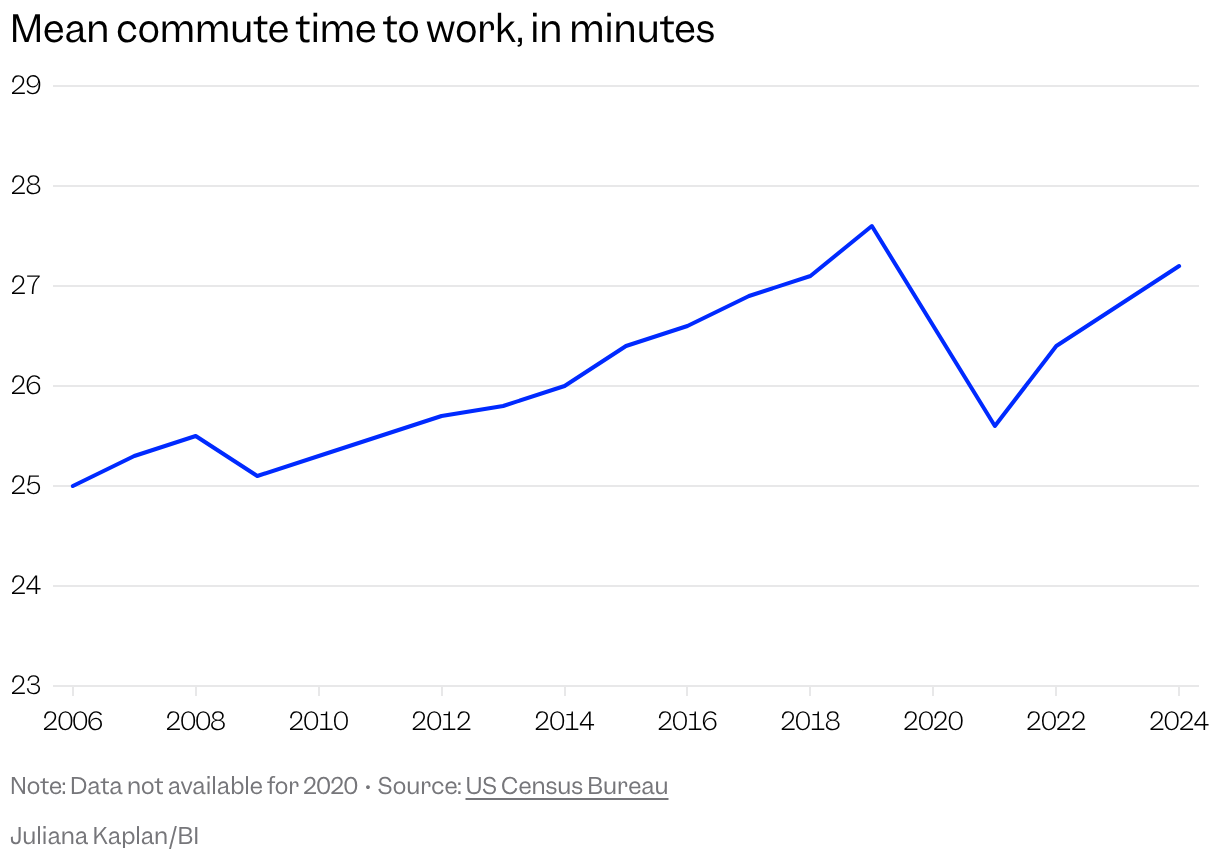
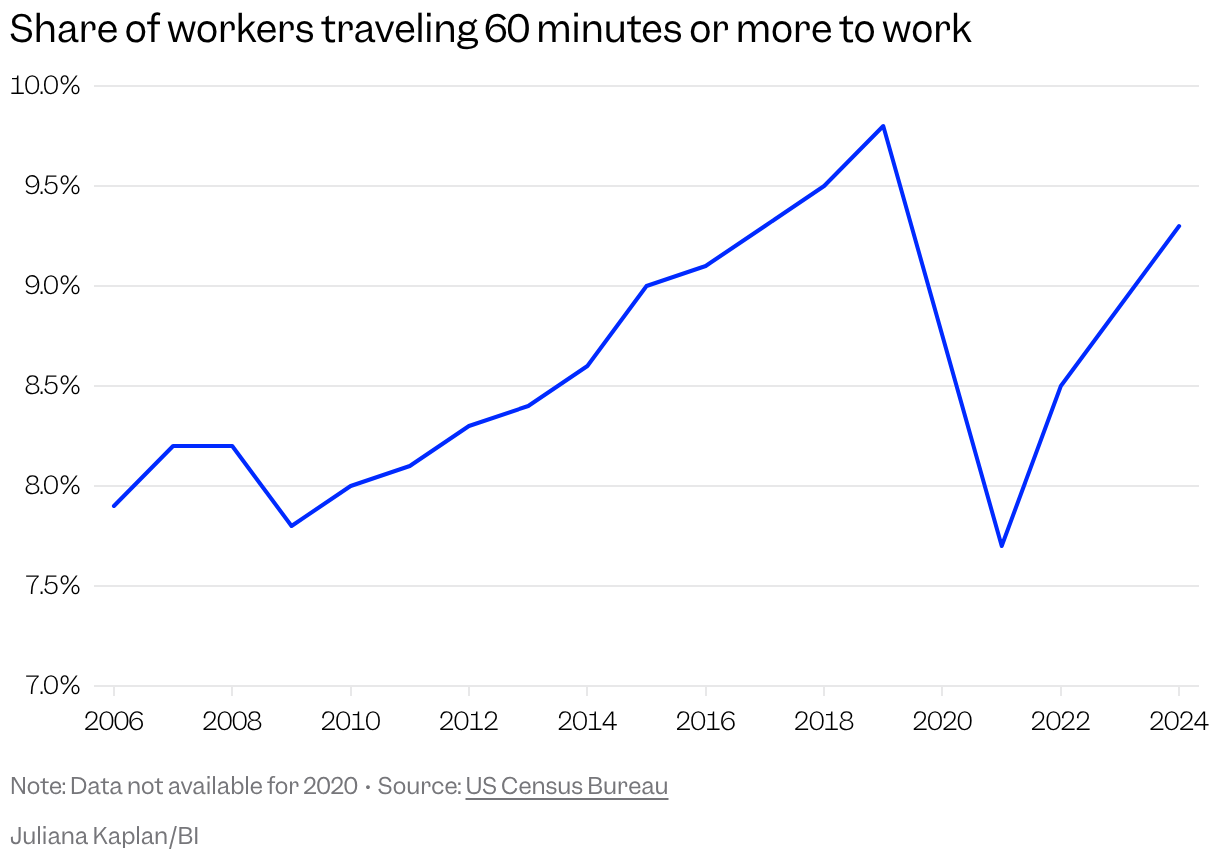
Commuting has always been a pretty bleak part of the modern work experience. The mean travel time reached a new high in 2019, with Americans spending an average of 27.6 minutes for a one-way trip, up from 25 in 2006. That data tracks workers aged 16 and older who don't work from home and looks at survey respondents' last week of commuting. In the year before the pandemic, a record high 9.8% of workers spent an hour or more commuting.

Then came the remote work shock. Commute times plunged, even as vaccines became more widespread and more folks started tentatively reentering their cubicles. Now, though, we're approaching those pre-pandemic peaks: In 2024, the average commute time rose to 27.2 minutes — the second highest on record.

The share of workers driving to work has ticked back up over the last few years, although it's below pre-pandemic levels. Ultra-long commutes are also making a sharp comeback, with 9.3% of workers traveling an hour or more to work — a sharp increase from 7.7% in 2021.

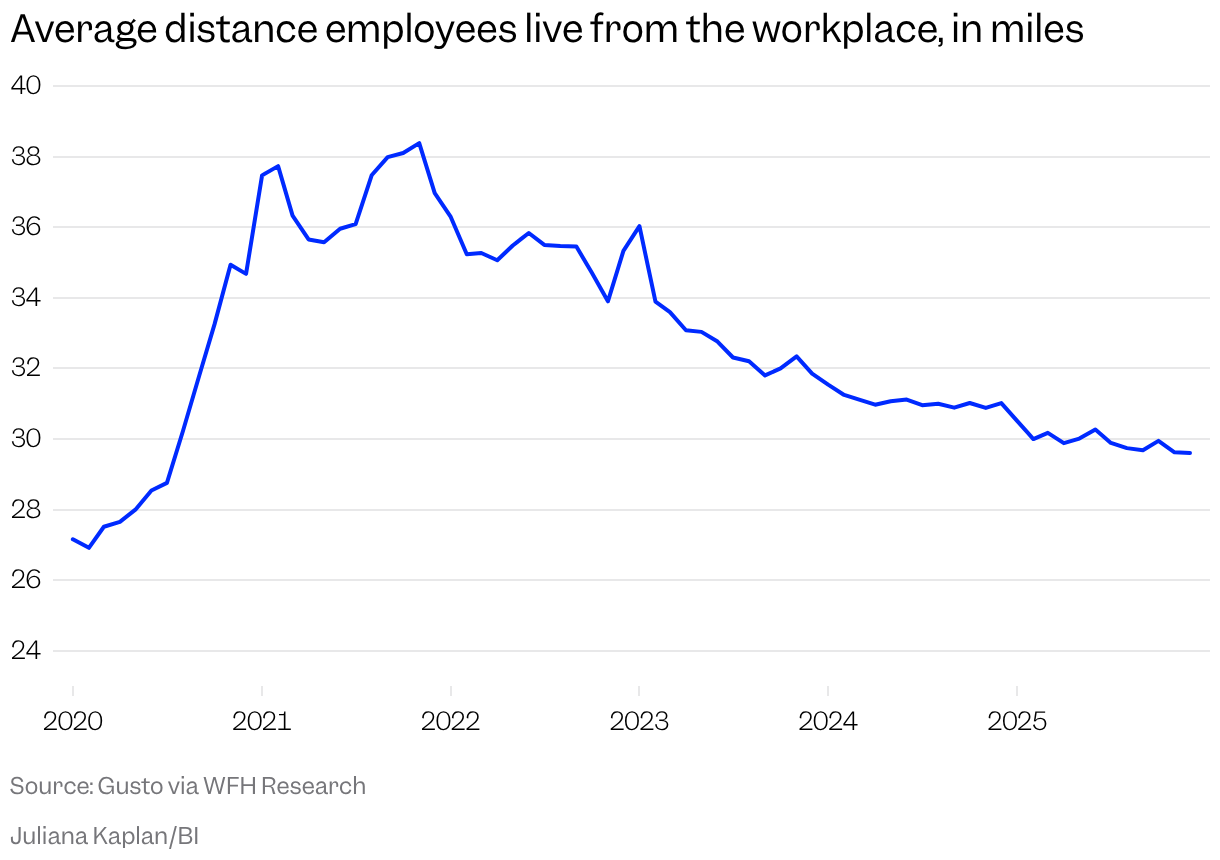
Chalk some of that up to pandemic migration patterns. On the whole, folks moved further away from their offices, according to data shared with me by Stanford's work-from-home research team. A greater share of Americans now live more than 50 miles from the office, and the mean distance to work is higher than it was pre-pandemic.

Part of that might be due to the kinds of homes Americans could afford in the wake of the real estate chaos of the past few years. Alex Thomas, a research manager at John Burns Research and Consulting, tells me that Americans moving into new-build homes are spending longer on the road. "A new construction homebuyer typically commutes about 10 to 15% longer than the typical homeowner," Thomas told me. In other words, the places where people can afford to buy (especially younger people looking for a deal) are much further from office hubs. Take ex-urban markets like Stockton, California, or Greeley, Colorado, for example. They're both tied to major employment hubs, the Bay Area and Denver, respectively, but offer much cheaper, newly-constructed housing — and much longer commutes — than the core of those cities.

"There's this notion of drive till you qualify," Thomas says. "If you're going to buy a house that's a little bit cheaper, a little bit further out, you're probably going to have to drive further to work or to cultural amenities."

Lana and Kelley with daughter Jenna, age 12, were already anchored on the shoulder for two hours waiting for the traffic to ease. They were returning to Gypsum after at trip to Greeley and Nebraska for boating.
A family waits out traffic after a trip to Greeley.

Not all new construction buyers are cash-strapped. Some might be seeking a more luxurious, customizable, or spacious option. But for entry-level buyers, new homes offer affordability that other properties might not — as Thomas says, developers and builders will often offer incentives like mortgage rate buydowns, which help lower monthly payments considerably and help entry-level buyers get in the door. And moving far away is still worth it for new home buyers. Thomas found that, on average, they work from home more often than the typical homeowner, so while each trip may be longer, their total weekly commute time may even out.


On the whole, many folks seem willing to make a longer commute trade-off, especially since they have more flexibility baked into what was once a rigid routine. Michael Manville, a professor of urban planning at the UCLA Luskin School of Public Affairs, said it's possible a hefty chunk of white-collar workers would say that their commutes are better than before, simply because they hop behind the wheel or hoof it on the train less often. Maybe they're exposed to more congestion when they're on the road, but if they're not commuting daily, they mentally bake in the days they're not dealing with traffic.

The problem is that everyone is on the road all the time now. If you work from home part-time, and your other neighbor does too, and then you both head out at an off hour for a long drive, you're now two more cars on the road. In 2019, according to a report from the Texas A&M Transportation Institute, 70.5% of weekday delays on national freeways happened during the morning and evening peaks — from 6-10 a.m., and 3-7 p.m., respectively. Around 5% of that delay has shifted from peak periods into the midday hours of 10 a.m.-3 p.m. The hours of 1 p.m. and 2 p.m. have seen marked increases, in particular. The magnitude of the delays is also greater; even if there's technically less share of delay during peak hours, commuters are still spending more time in traffic than they did in 2019.

Whenever Carrie Weston, 43, sits in her Minnesota office, she's constantly staring down at her afternoon fate. Her window overlooks one of the main highways circling the city, giving her a real-time update on how snarled her road home will be. Weston is one of the flexible workers putting in long commuting hours (she drives at least 45 minutes one way, and that can stretch to 2.5 hours depending on the weather). As a mom of six, she adds on drive time for after-school activities.

"If the traffic is bad or if there's an accident, it really, really impacts the rest of our life," Weston says. According to the TAMU report, commuters across the country are accumulating a historic number of hours delayed, even as weekdays account for a smaller share of total delay. The endless rush hour is even snaking into the weekends: both Saturday and Sunday have a higher share of total delays than in 2019.

"My family will be out and about on the weekends, and we're like, 'Why is it stop-and-go traffic on a Saturday afternoon?'" Weston says. That could come from a slew of factors: partial-remote workers are eager to get out of their houses; they live farther from the cultural or economic activities they enjoy; they no longer have to allocate that weekend time to errands, and can instead devote it to longer leisure trips. Add in all of the workers who have to go in on weekends — like service workers, or those in healthcare — and you've got a traffic jam.

So what's there to do about our now-omnipresent rush hour? It's possible that we're doomed to a traffic-infested country — the price we pay for that oh-so-valuable flexibility. But if we want to actually fight back against the ballooning time behind the wheel, there are options. One answer: scaling up public transportation. New York's subway system has added more trains on busy express lines to accommodate shifting travel times, extending rush-hour service earlier and later, and removing trains from previously peak slots. But unless America dramatically revamps and builds a huge swath of public transportation, it might be worth looking to the road — and putting that flexibility to good use.

A crowded A train subway platform, March 30, 2026, in New York City.

"What do we do about the fact that highways and urban areas are so congested?" Manville says. "The answer that no one particularly likes, but the only one that's ever been shown to work at all is, you price those highways dynamically." That would be a different model than the flat congestion pricing in New York City, but instead more akin to Singapore: Depending on how many people want to use the road at certain times, the price goes up or down, with pricing calibrated to keep the road moving between 45 and 55 miles an hour. When the road is moving faster than the target traffic flow, the pricing should drop; when it creeps above that, the pricing should go up, making drivers reconsider whether to take another route or wait it out.

That might lead to a more moderate, but still constant, rush hour, spreading out cars further — in other words, midday driving might become more prevalent, but will clear the road for those who have hard ins at the office (like service workers). It could end up being an accelerant of the current trend, spreading traffic out more, while also generating revenue for road maintenance and reducing wear and tear. Importantly, according to one study, some forms of this pricing can offer something current traffic-dwellers crave: Knowing how long it'll take them to travel somewhere. Of course, that type of pricing can have its own drawbacks. For tradespeople or workers with set shift commutes, which might fall during the higher-priced times of day, the tax can fall regressively — an area where, Manville says, it might be worth localities thinking about who to exempt from a potential levy.

If the first work-related reckoning of the pandemic was the discovery that remote work is feasible, maybe its subsequent flexibility — and the high-traffic situations it brings — can spark a new reckoning about how and when we get to where we're going. We're all sharing the road (or subway) together a lot more; maybe that commuting visibility can spark a larger change.


Juliana Kaplan is a senior reporter on the economy team, where she covers the labor force, kitchen table economics, and the people behind the numbers.

Read the original article on Business Insider


from Business Insider https://ift.tt/u3BfvTR

Ford's $30,000 EV truck is under wraps. Its camouflage is an ad.

Ford's all-important EV pickup truck has donned camouflage during public outings. The sneaky attire includes a QR for a hidden website l...