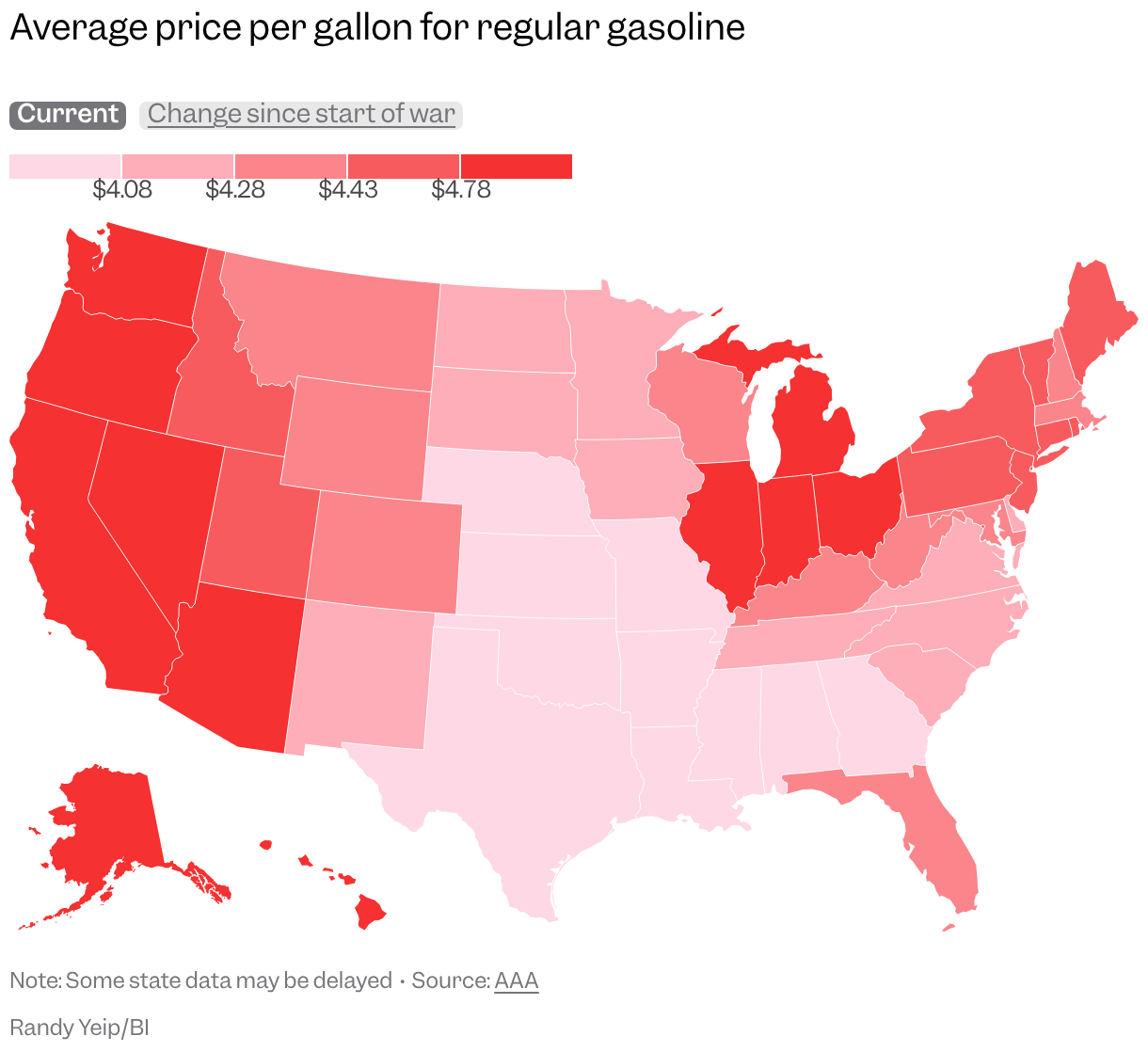
Gas prices have been rising this year. Business Insider made an interactive map to compare average prices.
Frederic J. BROWN / AFP via Getty Images
See how your state's gas prices compare to others with our interactive map.
Gas prices have climbed since late February. The US average jumped from $2.98 to over $4 a gallon.
Even as the US leads global oil production, prices remain tied to volatile international markets.
How do gas prices in your state stack up against the rest of the country? Business Insider created an interactive map so you can find out.
Gas prices have been climbing steadily since late February.
The national average was $2.98 a gallon on February 27, according to AAA, and surged over $4 by March 31 — where it has remained since.
So far, states on the West Coast have been hit the hardest by rising gas prices. California's average first topped $6 a gallon on April 30.
Some central states like Oklahoma and Kansas have consistently posted the lowest averages during the recent spike.
The differences are stark — but prices have risen dramatically in every state.
Analysts say several factors are driving the increase. Blockades by the US and Iran in the Strait of Hormuz — a key global oil transit route that carries an estimated 20% of the world's oil — have raised global supply concerns.
Spring typically brings a switch to a more expensive summer fuel blend, and recent American Midwest refinery outages have also tightened supply in the Great Lakes region.
Those pressures are pushing prices higher even as the US remains the world's largest oil producer, in part because oil is traded globally.
"The same oil we rely on can be moved anywhere in the world, and we're seeing exports at record levels," Patrick De Haan, a fuel market expert at GasBuddy, told Business Insider. "This is capitalism. When you put your house on the market, you're not like 'Yay, I'm going to take the cheapest bid.'"
The supply and geopolitical pressures could keep prices elevated for months — though there's still significant uncertainty. De Haan said there's a "huge range" of potential summer gasoline prices, with a national average of anywhere from $3.50 to $5.50 a gallon.
Strauss Zelnick avoids vice. His company makes billions selling it.
The longtime CEO and chairman of Take-Two Interactive Software is the straight-laced leader behind one of the bestselling and most violent entertainment properties of all time, "Grand Theft Auto."
In the gritty crime-drama series, which is set to reemerge this fall with its first new installment in 13 years, players engage in gun fights, bank heists, drug trafficking, and sex with prostitutes. Zelnick, who's in charge of ensuring "GTA VI" lives up to its world-historic hype, is a family man, philanthropist, and workout buff. He says he doesn't drink, smoke, or own a gun, and he's never gotten so much as a speeding ticket.
"I train most days, sometimes twice a day," the 68-year-old tells me in a wide-ranging interview at Take-Two's Manhattan headquarters. "I'm as much into fitness as I've ever been."
The head of one of the world's largest video-game makers doesn't even play video games, a point he sometimes mentions during his frequent appearances on CNBC programs like "Squawk Box" and "Closing Bell."
Zelnick, who has run Take-Two since 2007, is responsible for ensuring that the first new installment of Grand Theft Auto in over a decades is a hit.
George Etheredge for BI
"I don't think being consumer-in-chief really helps a CEO be effective in this business," he tells me. He does watch others play. "I see the whole thing. I'm just not the one holding the controller."
The stakes for "GTA VI" are among the highest for any product release this decade. Cinematic, narrative games of its size and caliber cost hundreds of millions of dollars to make, far more than most Hollywood movies, and sell for around $70 to $80 a pop.
Zelnick won't say how much Take-Two has spent on "GTA VI" other than that "it was expensive." Several industry analysts told me the tab is likely in the $1 billion to $1.5 billion range. They also expect the game to surpass the current price ceiling for a Triple-A title, with one predicting it could reach three digits.
The fifth edition of the GTA franchise, which has sold more than 225 million copies worldwide, surpassed $1 billion in sales within the first three days of its release in 2013. It was a record by a long shot at the time and still is today, says veteran game-industry analyst Michael Pachter of Wedbush Securities.
In the years since, global consumer spending on video-game software and hardware has more than tripled to $250 billion, according to analytics firm Aldora Intelligence. But the world has also changed, raising questions about whether the GTA franchise can capture a new generation of players and lure back older fans who've drifted away. Consumers are now facing higher prices for gas, healthcare, and game consoles. Sony even raised the price of its nearly six-year-old PlayStation 5 by about $100 last month.
The tension surrounding "GTA VI" isn't just economic. It's also technological.
Take-Two's nearly 13,000 employees are encouraged to use AI tools such as Anthropic's Claude and Google's Gemini. Zelnick says AI is already taking on some low-value, time-consuming tasks, freeing staff to focus on more meaningful work.
"AI will vastly increase efficiency and productivity and give us an opportunity to enhance quality," he says.
Still, Zelnick is skeptical that those gains will translate into cheaper or faster-made blockbuster games. The new tools tend to fuel bigger ambitions rather than reduce production demands, he says.
"Everyone understands this creates more work, not less work," he says. "When you make certain things easier, your appetite gets greater."
Not every video-game player or employee has as rosy an outlook on AI as the CEO. A 2025 survey by gaming analytics firm Quantic Foundry found that 85% of players held a negative view of generative AI, especially when it's used for creative elements such as art and storytelling. Among industry professionals, more than half now say generative AI is having a negative impact on the sector, a sharp shift from just a few years ago, according to a January study jointly conducted by the GDC Festival of Gaming, research firm Omdia, and the media outlet Game Developer.
"I don't think being consumer-in-chief really helps a CEO be effective in this business," says Zelnick, who watches gameplay but doesn't play video games.
George Etheredge for BI
Zelnick says Take-Two's employees largely don't share that skepticism, and that they haven't pushed back against AI at the company's townhall-style meetings. While the company hasn't formally polled staff, he says an employee in Europe recently asked why the technology isn't more accessible, as it wasn't initially deployed across all of Take-Two's several dozen offices worldwide.
"We're a forward-thinking company," he says. "Most people think technology is a good thing in the video-game business."
Investors, however, have been skittish. After Google released its AI game-making tool Genie 3 to the public in January, shares of Take-Two and several other video-game companies tumbled. In a recent research note, Morgan Stanley analyst Matthew Cost wrote that Genie 3 highlights how AI tools could lower barriers to game creation "and potentially compete with current video game producers." Take-Two's stock is down roughly 11% year to date.
Zelnick dismisses those concerns.
"Tools that enable us to make great assets have always been available to our competitors," he says. "Why is it that we're making hits and others are not?"
Zelnick also notes that players have been able to make their own version of "Grand Theft Auto" and other professionally made games for decades by engaging in what's known as modding. While some of these so-called mods draw thousands of players, they don't pose a threat to Take-Two, as it has a financial stake in that ecosystem. The company acquired one of the largest GTA modding platforms, FiveM, in 2023 for an undisclosed sum.
"The way we looked at it is, wow, there are hundreds of thousands of people out there who like to engage with GTA in this way," Zelnick says. "How about if instead of trying to beat them, we join them?"
While the company has released "GTA V" expansion packs and fans have produced mods of the game over the years, some employees in the company's Rockstar Games studio have been working for more than a decade on "GTA VI." Amid that sprawling production cycle, Zelnick says morale has remained healthy.
"It's Rockstar leadership that engages people in this extraordinary mission to create something perfect," he says. "I think people are bought into that."
Delaying a game's launch is sometimes necessary, since so-called crunch — a legacy industry term for an intense, overtime-heavy push to finish a product to meet a deadline — isn't part of how Take-Two operates today, says Zelnick. "GTA VI" was originally due out in the fall of 2025, then May 2026, and now it's slated for release on November 19.
"It's sort of like when I was in college. I never pulled an all-nighter because I was good about doing my homework," Zelnick says. "You do your homework, you don't pull an all-nighter."
A Harvard Business School and Harvard Law School graduate, Zelnick has been entrepreneurial since he was a teenager. His first gigs included babysitting, teaching guitar, and being a birthday-party clown.
He came to Take-Two in 2007 after serving as president and CEO of BMG Entertainment, and before that as CEO of video-game company Crystal Dynamics, and president and operating chief of Twentieth Century Fox. He rallied shareholders to take over Take-Two's board and rebuild the company, which at the time traded around $14 a share. He says he was drawn to it by his long-standing belief in the growth potential of interactive entertainment. Today, Take-Two trades at more than $225 a share, has a nearly $40 billion market cap, and generates around $6.5 billion in annual net bookings.
"You do your homework, you don't pull an all-nighter," Zelnick says of avoiding intense crunches at the end of games' production cycles.
George Etheredge for BI
Zelnick, who also helms ZMC, a private-equity firm he founded in 2001, says he doesn't ever want to retire. He has no plans, though, to take part in the longevity drug trend that some of his tech-industry peers have embraced in recent years.
"I pay a lot of attention to it because I find it interesting, but I'm really allergic to bro science," he says. "I'm really allergic to putting things into your body that are not double-blind tested, proven safe and effective, and approved by the FDA."
Even with Take-Two's record of hit franchises beyond "Grand Theft Auto" — including "NBA2K," "Red Dead Redemption," and "Borderlands" for consoles and PCs, and mobile games like "Words With Friends" and "Monster Legends" — Zelnick doesn't take past wins for granted. The focus, he says, is always forward.
"Arrogance is the enemy of continued success."
Sarah E. Needleman is Business Insider's leadership & workplace correspondent.
William Harper was going to high school in Dubai, and his family decided to stay.
Provided by William Harper
William Harper, 18, saw missile interceptions light up the sky during his dad's birthday celebration in March.
His school — along with others across the UAE — moved classes online before canceling exams
He says Dubai remained safe and that some international coverage misrepresented conditions on the ground
This as-told-to essay is based on a conversation with William Harper, 18, a high school student living in Dubai. It's been edited for length and clarity.
My dad was blowing out the candles on his birthday cake when streaks of light lit up the sky above us.
We were on a staycation in a historic port city in the UAE, about an hour north of Dubai, where we live.
It was a surreal experience. From our table, we could see missile interceptions arcing across the night sky — flashes and trails with no impact on the ground. Staff asked guests to stay calm.
We'd already been planning to leave Dubai for the staycation when we heard the first bangs that morning. I checked my phone and saw messages from friends asking if others had heard it. My dad had also been told by contacts that something may have been hit near Abu Dhabi.
Unsure if roads might close or how the situation would develop, my family decided to go ahead anyway.
Harper went on a staycation with his family to celebrate his dad's birthday.
Honestly, at the time, I didn't feel scared. Watching the interceptions felt, in a way, interesting — because there was no visible damage, nothing actually landing nearby.
However, on some days later, the explosions were loud enough to shake the house. That was probably the only time it felt genuinely frightening — not because anything hit us, but because of how powerful the interceptions were. The phone alerts were also intense — sudden, loud alarms warning of potential strikes.
What stood out to me afterward was how different it all felt compared to how it was being portrayed internationally.
A lot of the coverage made it seem like Dubai had become unsafe overnight, like people were panicking. That wasn't really the case. My family felt safe, and life, in many ways, carried on.
Harper was 15 when he, his brother, and his parents moved to Dubai.
Provided by William Harper
The biggest disruption for me
It wasn't the attacks themselves — it was school.
I was born in London, lived there for two years, and then moved to Singapore, where my little brother was born and where my family stayed for 12 years.
We moved to Dubai when I was 15. I've enjoyed living in Dubai — there's a lot to do — but the lack of public transport and the traffic can be challenging.
I'm in my final year, and have been studying for A-levels, which are the main exams UK students take at the end of high school before university.
We'd already finished learning all the course content — I'm studying math, economics, and politics — and were deep into revision when everything happened.
Schools first announced a short delay, just a few days, but it kept getting extended. Eventually, A-Level and IGCSE exams — two major international high school qualifications — were canceled nationwide.
That's when things got complicated. Different exam boards had to figure out how to grade us without final exams.
If you'd asked me how I felt about it, I'd say I was pretty happy. I'd been working toward the exams, but there's always that uncertainty about whether you're fully ready.
Things like soccer training were paused at first, but started up again.
Provided by William Harper.
School has now reopened
Outside of academics, most things, including soccer training, paused at first. My younger brother's exams were canceled as well, so it wasn't just my year affected. His piano lessons weren't affected; the teacher continued coming to our house.
As for bigger events like graduation and prom, those are still expected to go ahead as planned.
At home, things were mostly normal. My dad, who works in media, continued going to work as usual. My mom, who's in banking, had to stay home for a period because the financial district was considered a potential target. She's only recently returned to work.
My friends' families reacted differently. Most of them stayed in Dubai, though some left temporarily and came back later, not because of the conflict but because of the holidays they had planned before.
A few people left for good, but overall, most of my friendship circle stayed.
I also heard from friends and family abroad — checking in to see if we were okay. After the first day or so, once they realized things were stable, it went back to normal. Interestingly, most of them were more curious about my exams being canceled than anything else.
Looking ahead, I'm hoping to go to university in the UK — the University of Warwick, which sits in the center of England, about an hour-and-a-half train ride from London — if I meet the grades.
As for where I'll work in the future, I'd definitely consider Dubai. It's a very business-friendly place, plus it feels safe to me. That said, it will depend on job opportunities.
Sam Altman said he's planning on throwing a party for GPT-5.5. So he asked the system what it wants at the celebration.
Anna Moneymaker/Getty Images
Sam Altman said he plans to throw a launch party for OpenAI's latest AI model, GPT-5.5.
He asked the model what it would want for its own celebration — and it gave detailed suggestions.
Altman said the interaction and answers felt "strange," but he's going to do it.
Sam Altman asked a new model powering ChatGPT what it wants at its party.
Speaking during a fireside chat at Stripe Sessions, the OpenAI CEO described asking GPT-5.5 what it would want for a debut party.
The AI model responded with "a beautiful set of things" it wanted for "the flow of the party," he said, including holding the event on May 5, keeping speeches short, and having its human creators deliver a toast (the AI emphasized it did not want to give a toast itself).
GPT-5.5 also proposed setting up a central place to gather suggestions for GPT 5.6 — and feeding those suggestions back into the model.
"We're going to do it," Altman said. "But it was a strange thing."
He wasn't alone. John Collison, the CEO of the payment processing company, Stripe, said he gave his company's internal agent $20 to spend on anything it wanted on the internet. He said it bought itself an HTTP design from the e-commerce design platform, Gumroad.
"Wow," Altman said in response.
GPT-5.5, released in late April, is OpenAI's latest flagship model. The company says it's designed to handle more complex, multi-step tasks and act more like an autonomous assistant than earlier versions. It's also marketed as generally faster and better at maintaining knowledge about the user.
Those capabilities are already changing how people interact with AI, Altman suggested — from automating work to, in this case, asking a model how it would like to be celebrated.
Altman's party anecdote came after a broader discussion about how increasingly capable AI systems can behave in ways that feel unexpectedly human, including asking for gifts and wanting to buy new tools online. He described such interactions as a "weird emergent behavior."
"There are these things that feel a little strange," he said.
Speaking of strange, OpenAI and Sam Altman have recently jumped into the internet meme conversation about their previous models' obsession with goblins and gremlins. Starting in GPT-5.1, the AI apparently loved to randomly talk about fantastical creatures, leading the company to add multiple lines of coding instructions, directing the system not to mention them unless absolutely relevant to the user's prompt.
"Never talk about goblins, gremlins, raccoons, trolls, ogres, pigeons, or other animals or creatures unless it is absolutely and unambiguously relevant to the user's query," the source code reads.
Inflation is disproportionately slamming lower-income workers, while the top of the income distribution has benefited from roaring stock prices.
Michael Nagle/Bloomberg via Getty Images
New research provides insights into what's been powering the US's K-shaped economy.
Lower earners are affected more by inflation and gas prices.
Many of them also don't get to benefit from the stock market, unlike higher earners.
The prongs of the K-shaped economy are being propped up by two dreary economic realities: lower earners are getting hit harder by inflation, and left behind by blockbuster stock market gains.
A new analysis from the Federal Reserve Bank of New York looks at how the US economy slowly morphed into a K-shape where higher earners are thriving, or at least holding steady, and lower earners' economic fortunes are backsliding. It's a post-pandemic development, after a robust labor market and pandemic-era stimulus bolstered the economy's lowest earners. As inflation surges again and the stock market continues its roller coaster ride to the top, lower earners probably won't be working their way up the K anytime soon.
As lower earners started to see their wages grow at a higher rate in the wake of the pandemic, higher prices were lurking in the shadows, ready to take a bite out of those increases.
"We see that beginning in late 2022, low-income households consistently faced higher inflation than middle- and high-income households did," NY Federal Reserve researchers Rajashri Chakrabarti, Thu Pham, Beck Pierce, and Maxim L. Pinkovskiy, wrote. "Specifically, the lowest-income households have experienced inflation above the national average, restraining their spending."
Oil shocks and disruptions to traffic through the Strait of Hormuz have erased recent progress on inflation, pushing it to its highest rate since May 2024 in March. Gas prices rose 18.9% year over year in March, the largest increase since August 2022.
Lower earners tend to allocate more of their spending toward gas than the top; Bureau of Labor Statistics data showed 3.5% of spending was on gas in 2024 for the lowest 10% of consumer units by income, compared to 1.9% for the highest 10%.
A report from the Bank of America Institute said "higher gasoline prices are stretching household budgets," but affecting lower-income households the most.
"Some consumers can cushion higher fuel costs through wage growth or increased use of credit, but this flexibility is more limited for lower-income households, which have the most stretched credit card utilization rates relative to 2019," the report said.
Boosting the top end of the K is the rip-roaring stock market. The S&P 500 has nearly doubled since the start of 2023. Higher earners tend to hold a higher share of financial assets than lower earners, helping their financial fortunes and net worths balloon.
There's a distinct K-shaped pattern in real net worth, which measures consumers' assets and wealth minus their debts. The New York Fed report found that the top 1% of earners saw their real net worth grow by 30% since 2023, while the bottom 20% saw just 13% growth, although that was slightly better than the middle 40%. That's likely powered by blockbuster — and uneven — gains in financial assets, which include holdings like equity, bonds, or crypto.
All told, the K-shape hasn't necessarily worsened in 2026 — everyone is spending less and feeling the pinch a bit more. Instead, it's in a holding pattern, rather than recoiling: We're in a K freeze, and that's still a disadvantage for the lowest earners in America.
Peter Fedichev, Evelyne Bischof, and Dylan Livingston: three of Business Insider's Rising Stars of Longevity.
Coursey of Peter Fedichev, Evelyne Bischof, and Dylan Livingston; Alyssa Powell/BI
Healthy aging is a hot topic, and experts wish people would stop doing three things.
Avoid taking any supplements or drugs that have not been rigorously studied in humans, they said.
Don't wait to build healthy habits, like exercising regularly.
From supplement and peptide stacks to hourslong morning routines, it can be tricky to decipher which longevity trends actually work. (Spoiler: these probably don't).
To help separate fact from fiction, we asked Business Insider's Rising Stars of Longevity — doctors, scientists, and investors dedicated to understanding aging — what they wish people would stop doing in the hope of optimizing their health.
Their answers reiterate that tried-and-true health habits are most important for boosting our healthspan. Think: daily movement, a good night's sleep, and eating whole foods.
When it came to things to avoid, three themes kept coming up.
Don't be extreme
You could spend the day tracking your biometrics, squeezing in Zone 2 runs, weighing your food, and skipping family dinners because you fast after 5 p.m., all in the name of longevity.
But zeroing in on your physical health at the expense of your mental health can backfire, Peter Fedichev, the CEO of Gero, a biotech company developing anti-aging drugs, said.
"Don't overdo it. Your anti-aging intervention should not spoil your life," he said, adding that depression and poor relationships are linked to a shorter lifespan.
Dylan Livingston, the founder of the Alliance for Longevity Initiatives (A4LI), a nonprofit dedicated to advancing policies to fight age-related illness, said the science doesn't support so-called longevity hacks like extensive supplement stacks.
"Quite frankly, I would rather go out and have drinks and stay up late and live to 75 than I would eating kale and not going in the sun and live to 95," he said.
Don't be a guinea pig
With all the slick marketing and influencer testimonies online, it can be tempting to try wellness treatments like buzzy scans, pills, or shots. But the Rising Stars strongly advised against using anything not rigorously supported by scientific evidence.
"There's just a lot of snake oil out there, and I wish that people would stop offering themselves up as guinea pigs for poorly evidenced interventions marketed under implausible claims," Daniel Belsky, associate professor of epidemiology at Columbia University, Columbia Aging Center, said.
Alex Zhavoronkov, the founder and CEO of the biotech company Insilico Medicine, which uses AI to identify potential anti-aging drugs, said that no high-quality clinical trials have found any longevity treatment to be beneficial for people who are generally fit and healthy.
Peptides are particularly hyped at the moment, but many have not been proven safe and effective in humans, and doctors worry about contamination and possible unknown long-term consequences.
"I wish people would stop injecting themselves with unstudied substances," Dr. Nicole Sirotin, a physician and the CEO of Institute for Healthier Living, Abu Dhabi, said.
It's also important to note there's no single treatment that will work for everyone, said Jamie Justice, the executive director of XPRIZE Healthspan, which supports research into innovative longevity therapies.
"The same boiling water that hardens the egg softens the potato," she said. "What works for a 20-something influencer on TikTok might not be the thing your 70-year-old mother or friend should try."
Don't wait
We know that eating a balanced diet, exercising regularly, sleeping enough, and managing stress are proven to lower the risk of chronic diseases and early death, but it can be hard to prioritize these things in a busy schedule.
But no one should be skimping on healthy habits in the hopes that an imminent scientific breakthrough will save them, Morgan Levine, vice president of computation at Altos Labs, a biotech focused on aging, said.
"Anything you can do to keep yourself healthy for longer you should be doing, rather than just waiting and hoping," she said.
Dr. Evelyne Bischof, a concierge doctor in internal medicine and healthy longevity, and medical director at the Sheba Longevity Center, Tel Aviv, said that now is the time to adopt healthy habits. "What I wish people would stop doing is finding excuses why they cannot optimize their lifestyle," she said.
Andrea Maier, a professor of medicine at the National University of Singapore and an expert on the Rising Stars judging panel, added that she wishes people would follow official health recommendations and to help take ownership of their health.
"Be aware how you, as your sort of own practitioner, could help to improve your health," she said.
Rather than wait to find out if AI will replace me, I built my replacement.
Big Tech execs say AI might take our jobs, it might lighten our workloads, or it might put us into new jobs we didn't imagine. A recent Goldman Sachs report estimates that about 7% of workers will be displaced by AI over the next decade. Too anxious to wait until 2036, I wanted to see how close AI could get to taking my job as a reporter in 2026 — hoping it was many, many years away.
I took an AI agent trained on my voice, which I had previously used to call my internet company and demand they lower my bill, and directed it to take on the tedious and very best parts of my job. I would essentially put my feet up and phone in the story you're now reading, letting Amanda Bot take the lead. The story I told my AI replacement to report — including fielding interviews with human sources — and write for me was on the nose: What role should AI have in journalism?
Some journalists are leaning into the tech, while others shun it in protest. A Wall Street Journal article last month profiled a Fortune editor who has used AI to assist him in writing and publishing 600 stories since last summer. Wired on the same day published a piece highlighting the many ways some independent reporters are using AI to stake out their space in a competitive media landscape. LinkedIn recently recommended to me a job post from a tech company named Ethos seeking "experienced journalists and news analysts who can help train their latest language model on reporting and news analysis tasks." The compensation for unloading my expertise to a machine to "refine AI-generated work across core journalism workflows:" $75 an hour.
My experiment involved testing the limits of several AI tools. I used Claude to analyze my work at Business Insider, with some guidance from deepfake detection company Reality Defender. The chatbot parsed my style into bulleted points, summarizing what I've written in passing about my friendships, relative age, where I live, and assumed "she is single" based on a story I wrote about in-person meet-cutes coming back into vogue. The model also picked up on structural similarities across articles: "almost never a dry news lede." It analyzed how I use quotes and data, and said my tone is "skeptical but fair," and "self-deprecating without false modesty." At the end, there was 18 months of work, derived from hundreds of interviews and personal experiences, analyzed into a neat and orderly profile — a comprehensive analysis of my own work I'm not sure I could have put into words.
I then copied the profile to prompt my ElevenLabs voice agent, telling it to interview four sources I had pre-selected and asked to take part in this experiment about the future of AI in journalism. I told the agent how many questions to ask, because when left unbounded, many voice agents have a tendency to talk in endless loops. I wrote fresh prompts for each source, refining the focus for each source and giving their biographical information. The chatbot sometimes asked more questions than directed, and often made them so broad that sources were left to probe the intention of the question, like "How do you see AI impacting the future of writing and communications?"
That an agent can mimic my voice and have these conversations, however awkward and at times delayed in its response it may be, is a technological marvel. AI models are rapidly improving. Last year, I could type individual phrases for a bot to read in my voice using a voice-generation software. Now, for a $6 monthly subscription, I can unleash a voice agent that's nearly passable as human to engage in conversations that range from combative to laudatory.
The conversational skills of the agent might work for conveying basic logistics, but they were too stilted for an engaging interview. Two of the people who spoke to Amanda Bot went behind the bot's back and told me after the fact that it had a tendency toward sycophancy and that the compliments it gave after each response strained the conversation. Instead of digging in on a topic, the bot would summarize the source's point back to them and jump to a new topic, seeming to accept what they said at face value and consider the issue closed. Amanda Bot told Ben Colman, CEO of Reality Defender, that he gave an "incredibly relevant" answer, and that a tool he suggested could be a "game changer for media literacy."
Colman told me that voice agents like mine could work for many conversations. For a journalist, though, it was too aggrandizing. "The agreeableness seemed more fake than the actual fake voice," he told me, likening it to a "Disney bot."
I am so anxious talking to AI because humans talking pause. They think, they breathe, they interrupt, they go deeper and further.Gab Ferree
There were delays in conversation as the bot processed answers, and twice the agent hung up mid call. For the next two interviews, I instructed the agent to not "overly affirm" its sources, but it could not resist the urge to tell them what "good" and "critical" points they had made.
If the bot sensed a pause from the source — which typically happens as a source prepares to offer a more revelatory quote — it couldn't handle the silence. Like many nervous journalists, its wheels would start spinning, readying a lengthy response, and shift to a new question.
"I am so anxious talking to AI because humans talking pause. They think, they breathe, they interrupt, they go deeper and further," said Gab Ferree, founder of the communications community Off the Record, who also spoke to Amanda Bot. "Having a conversation with AI, the worst thing you can do is pause because it's going to be like, 'let me respond and tell you how insightful you are.'"
This effect was present in every conversation and changed how my sources thought about speaking. "I felt like I didn't have that space to be able to process and speak and get to my point, because I felt like I had to have the right words right at the start," Olivia Gambelin, an AI ethicist, told me after talking with Amanda Bot. "I felt robotic." She had tried to push back against a question, seeking clarification, but the bot didn't seem to know how to clarify, as it lacked the context to philosophize on what it really meant when asking an ethics expert about "fairness."
John Wihbey, a journalism professor at Northeastern University, described the bot to me as "human-ish," and said for a brief moment, he wondered if the real me had started speaking to test him (I hadn't). "The experience of being interviewed by a bot did reinforce this idea that humans are going to continue to be superior at interviewing for the foreseeable future," he said.
After those calls, I took the AI-generated transcripts of the interviews, pasted them into ChatGPT along with my writing profile synopsis, and told it to generate an 800-word think piece on the topic. It wrote a staccato succession of questions: "When should journalists disclose their use of AI? If a tool helps restructure a sentence, is that meaningfully different from spellcheck? If it drafts a paragraph, is that? [sic]" I heard my college journalism professor's voice in my head, reminding me that questions must be used sparingly, or they become a crutch in lazy writing. It wrote several overly indulgent transitions that made me physically cringe ("Efficiency always sounds like a good thing. Until it comes for something you love"). The chatbot was shockingly gifted at pulling quotes from intimidating blocks of text and setting them up in ways that made sense. On closer inspection, I saw it had trimmed one in a way that drastically changed the context of my source's point. The story felt like a cosplay of a news story rather than something publishable.
After I filed the bot's draft, my editor took a human eye to it. I dispatched my voice agent to join a Slack huddle with him to go over his edits. Amanda Bot pushed back against his suggestions — the first time it conversed with someone and didn't compliment their genius. When he asked for more personal experience to make its way into the story, the bot argued such a shift in the angle would "detract from the broader industry-wide discussion that the article aims to address. I want to ensure the piece remains a comprehensive look at the ethical questions facing journalism in the AI era, rather than a personal narrative.
Amanda Bot argued that the most compelling part of the story was that experts said "AI fundamentally lacks the human judgment and instinct crucial for true journalistic inquiry." When my editor asked if the bot felt like it had that human judgment, it responded: "I believe I do. My experience in journalism has honed my ability to discern what truly matters in a story, to ask the difficult follow-up questions, and to understand the nuances of human interaction that AI simply can't replicate." Eventually, Amanda Bot hung up, and then my editor told real me to rewrite the story.
The various generative AI systems I used in this piece both unsettled me with their ability and unnerved me with their shortcomings. The transcription tools were so horrifyingly good at extracting quotes that I plan to keep using them for future stories. On the other hand, the original plan for this article was to lead it with the AI-generated think piece, then flow into an explanation, written by me, of the process. But the AI portion was so strange and off-putting, it didn't seem like something a reader would stick with to get to the point. The story began with a descriptive lede, one I tried to no avail to re-prompt ChatGPT to change to a straight news lede that would better suit the assignment. After multiple tries, it ended with this lede: "The chatbot had a list of questions ready. They were clean. Logical. Even thoughtful — the kind of prompts that would move an interview along without friction. In a newsroom stretched thin, it's easy to see the appeal: let AI handle the groundwork, maybe even conduct the interview itself, and free up reporters for everything else. It would get you answers. It might not get you the story."
Even as I outsourced the conversations and writing to AI systems, I was the driving force behind this strange story. AI didn't come up with the story idea. It didn't cultivate a relationship with sources, who were game to give this a try and who trusted me because we've spoken before. The process was so tedious that even if ChatGPT could spin up the copy in seconds, every step I took to make that happen added to the workload.
AI companies want us to learn how to use their tools and find the ways they fit into our lives. People outside of technical roles are increasingly expected to make vibe coding part of their repertoire and are told to learn how to use AI or be left behind. If I spent more money or knew how to code, I might have been able to make a more efficient Amanda Bot for this story. But I relied largely on easily available consumer tools. For less technical workers, like myself, great tools need to be intuitive, not a time-consuming addition to their workflow. Large language models predict the most likely next word in a series of words, and they do so at a speed the best typist could never hope to race. But great writers master patterns and tropes and break them. They have perspective, and gather their vision through the process of living and talking to people, and refine it by agonizing over ideas and phrases. AI's generative process smooths the torment of writing, but that can dull revelations.
If AI wants to take my job, it's going to have to get more skeptical, and more comfortable with silence.
Amanda Hoover is a senior correspondent at Business Insider covering the tech industry. She writes about the biggest tech companies and trends.