Friday, 22 August 2025

Tesla or Waymo? Here's where autonomous and automotive leaders stand.

Jim Farley, Andrej Karpathy, Kyle Vogt
Leaders of the autonomous and automotive industry, including Ford CEO Jim Farley (left), Tesla's former Autopilot executive Andrej Karpathy, and ex-Cruise CEO Kyle Vogt, have spoken on the Tesla-versus-Waymo debate.
  • Tesla and Waymo have fundamentally different approaches to solving autonomous driving.
  • Tesla has a cameras-only approach, whereas Waymo uses a suite of cameras, radars, and lidars.
  • Here's where leaders of the autonomous and automotive industry are placing their bets.

Waymo or Tesla?

The two companies are far from the only robotaxi players in the industry. But their fundamentally contrasting approaches to solving autonomy have attracted vigorous debate in the arena of self-driving cars.

Tesla has a cameras-only philosophy that its CEO, Elon Musk, says is the key to quick and cost-effective scaling of robotaxis. With what's known as the end-to-end approach. Tesla's cars largely rely on an AI trained on massive amounts of data and video from external cameras to make driving decisions. More sensors, Musk says, are redundant.

For Waymo, redundancy is the entire point. Its current generation of robotaxis uses a suite of 29 cameras, radar, and lidar. Lidar, which stands for light detection and ranging, is a sensor that shoots out laser pulses to help the car detect its environment. Waymo's co-CEOs argue that this combination of sensors and a smart AI will help robotaxis see what humans can't.

CEOs and leaders of the autonomous and automotive industry have differing thoughts on the lidar-versus-cameras-only conversation.

Some argue that while Waymo is in the lead, Tesla has set itself up to scale quickly in the future. Other industry leaders argue that Waymo's emphasis on safety through redundancy is critical as robotaxis have yet to take on wide-scale consumer adoption.

Here's where they stand on the Tesla-Waymo debate.

Jim Farley, Ford CEO

Jim Farley, the CEO of Ford, is seen holding a microphone and speaking.
Jim Farley, Ford's CEO, said a Toyota 4Runner made in Japan could cost $10,000 less than a Ford Bronco made in Michigan.

During an interview with biographer Walter Isaacson at the Aspen Ideas Festival in late June, Farley was asked whether Tesla's vision-only approach or Waymo's use of lidars "makes more sense."

"To us, Waymo," Farley said. "People trust Ford. And when you have a brand like Ford, when there's a new technology, you have to be really careful. And we want to have a trusted brand. … This is another wave of safety technology. So we really believe that a lidar is mission critical."

A Ford spokesperson did not respond to a request for comment.

Kyle Vogt, ex-CEO of Cruise

Cruise founder and CEO Kyle Vogt speaks onstage during TechCrunch Disrupt 2023 at Moscone Center on September 20, 2023 in San Francisco, California.

Vogt, who resigned from Cruise in 2023, said in an interview with Stripe's cofounder John Collison, published in June, that Tesla has made the "right technical bet, long-term," with self-driving, while adding a lot of restrictions on how the company develops its autonomous technology.

"They said, 'Hey engineers, you can't have the best sensors — like lidars and radars — and the sensors have to look good when we put them on the car. Oh and by the way, they have to cost one-tenth as much as the guys down the street who are doing this.' So they put some crazy constraints on that," Vogt said.

Vogt added that, while Waymo has shown a system that is now working on public roads, the Alphabet company will need to move "more in the direction of Tesla."

The ex-Cruise CEO said Waymo's approach of creating high-definition maps of every city before robotaxis are deployed in the area is not sustainable.

"It is just intractable to maintain a 3D map of every square inch of the planet and update it in real time and then expect that, every time you go somewhere, the map is still accurate," he said. "And also probably unrealistic to assume that every car built in the future is going to have these giant spinning KFC buckets on the roof."

Vogt said that Waymo has started moving toward a "Tesla-like approach."

"The challenge is: They've got a validated, safety-critical system on the road. And the last thing you want to do to a system like that is start changing stuff in it, cause that introduces risk," he said.

Vogt did not respond to a request for comment.

James Philbin, Rivian's Vice President of Autonomy

James Philbin
Rivian's Vice President of Autonomy James Philbin

Philbin, a former director at Zoox and Waymo, told Business Insider in an interview from late June that cameras alone don't provide the same kind of perception capabilities as early fusion camera-lidar or camera-radar systems, especially in inclement weather such as a snowstorm.

"Humans don't have lasers shooting out of their eyes, but the goal is not human at all. The goal is superhuman," he said. "So there's definitely situations where cameras alone are not enough right now."

"I don't know why you would constrain yourself to cameras," he added.

Andrej Karpathy, Tesla's former Senior Director of AI

Former Tesla AI director Andrej Karpathy.
Andrej Karpathy thinks Tesla is more than a car company.

Karpathy, who also cofounded OpenAI, led Tesla's Autopilot team from 2017 to 2022. In an interview on the No Priors podcast that was published in September, Karpathy said he was "very bullish on Tesla."

"I think personally Tesla is ahead of Waymo, and I know it doesn't like that," he said on the podcast.

He said Tesla and Waymo have opposite problems: the former has a software problem, and the latter has a hardware problem. This echoes the sentiment Tesla bulls have for the EV company's strategy to rely mostly on camera vision and neural networks to scale robotaxis.

"I think when we look in 10 years and who's actually at scale and where most of the revenue is coming from, I still think (Tesla's) ahead in that sense," Karpathy said.

Karpathy did not respond to a request for comment.

Chris Urmson, Aurora cofounder and CEO

Chris Urmson
Aurora CEO Chris Urmson.

Urmson led the team at Google's Self-Driving Car Project and left in 2016, the same year the venture was rebranded to Waymo. He cofounded Aurora, the autonomous trucking company, in 2017.

In a Bloomberg interview published in 2021, Urmson said Tesla's self-driving technology was "technically very impressive" but that his team at Google was "doing better in 2010." He also told the publication that he was skeptical of Tesla's pitch to turn every personally-owned Tesla into a robotaxi.

"It's just not going to happen," he said.

Three years later, Urmson published a blog post in which he said, "those naively attempting to solve self-driving using a pure end-to-end system will find themselves bogged down in a game of whack-a-mole." The blog did not specifically name Tesla, but Musk and Tesla have described FSD as an "end-to-end AI."

The Aurora CEO wrote that the issue with an end-to-end system — in this case, self-driving technology that relies purely on an AI interpreting video feed — is that the system can exhibit unwanted human-driving behaviors learned from video data. As a result, engineers will have to step in and write code that will, for example, enforce stopping at stop signs rather than mimicking the common human behavior of rolling through them."

"Without some systematic, proactive framework, this will descend into an unmaintainable quagmire of code," Urmson said. "For this reason, we expect that any self-driving system claiming to be 'end-to-end' isn't, or won't be, in practice."

An Aurora spokesperson did not respond to a request for comment.

Travis Kalanick, Uber cofounder and former CEO

Travis Kalanick stepped down as CEO of Uber under pressure from major investors, according to media reports

Kalanick hasn't publicly weighed in on the Waymo-versus-Tesla debate. But in his July interview with the All-In Podcast, the Uber cofounder framed the two companies as the only two major US players in the robotaxi industry.

He made the statement in response to a question about a New York Times report that said Kalanick was in early talks for a potential acquisition of Chinese self-driving startup Pony.AI.

"In the US, we have Waymo. We see the Waymos in San Francisco, Los Angeles, Austin — coming soon to Miami, coming soon to Atlanta, coming soon to DC. They're even talking about New York," he said. "Tesla's sort of like doing it the hard way. Classic Elon style. Like, let's do this sort of in a fundamental, holy shit, let's go all the way kind of approach. And it's unclear when it gets over the line. Of course, he launched sort of a semi-pilot of sorts in Austin recently. But there's no other alternatives."

Kalanick did not respond to a request for comment.

Jesse Levinson, Zoox cofounder

Zoox cofounder Jesse Levinson

During his talk at TechCrunch Disrupt in October, Levinson said a safe self-driving technology that can only rely on cameras isn't close to coming to fruition.

"So our perspective is you really do need significantly more hardware than Tesla's putting in their vehicles to build a robotaxi that's not just as safe but especially safer than a human being," he said.

Levinson did not respond to a request for comment.

Sebastian Thrun, Google X Labs cofounder

Sebastian Thrun
Sebastian Thrun, founder of Waymo, told Business Insider that safety has always been the guiding ethos at the autonomous vehicle company.

Thrun cofounded Google's moonshot projects factory, Google X Lab, which was established in 2010. Its first venture was the Self-Driving Car Project.

In a May interview with Business Insider, Thrun said safety was a priority in the early days of Waymo. Lidar and detailed maps of the cityscape are part of the solution. He declined to speak on Tesla.

"Look, I cannot comment on Tesla. I don't know the details of the technology. I can only tell you what my ethos was when I built up the early version of Waymo. Our ethos was that safety is so paramount," he said. "I can tell you, positively, that if you took Waymo and ripped out all the radars and lasers, that would make the car less safe. I can say that with confidence, even though I'm not part of the current team."

"The laser and the radar provide a layer of environment understanding that is succinctly different from a camera. They'll pick up objects just by virtue of being there, even if they're unknown to the machine learning system. I know from the team that they're obviously getting better and better with a subset of sensors," Thrun added.

John Krafcik, former Waymo CEO

Former Waymo CEO John Krafcik

The former Waymo CEO has consistently dismissed Tesla's robotaxi vision.

In October, after Tesla debuted the Cybercab prototype, Krafcik said that no serious company would build a robotaxi that has Cybercab's form factor.

"Serious robotaxi companies like Waymo use taller vehicle forms and have high-mounted sensors to improve accessibility, comfort, and safety — this vehicle form compromises all of these attributes," Krafcik told BI.

More recently, Krafcik told BI that Tesla's pilot launch in Austin is notable for robotaxi.

"Please let me know when Tesla launches a robotaxi — I'm still waiting," he said. "It's (rather obviously) not a robotaxi if there's an employee inside the car."

Read the original article on Business Insider


from Business Insider https://ift.tt/kNbTsJ8

Thursday, 21 August 2025

Meta's hot AI hiring summer is over

Zuckerberg meta
Meta froze hiring in its AI division after months of costly poaching.
  • Meta's hot AI hiring spree just iced over.
  • The tech giant said it's "creating a solid structure for our new superintelligence efforts."
  • The hiring chill lands as Wall Street scrutinizes Meta's soaring AI spend.

Meta has just put the brakes on its red-hot AI hiring spree.

In a statement to Business Insider, Meta called the hiring freeze in its artificial-intelligence division "basic organizational planning."

The Meta spokesperson said the company is "creating a solid structure for our new superintelligence efforts after bringing people on board and undertaking yearly budgeting and planning exercises."

The Wall Street Journal, which first reported the freeze, said it began last week and also bars employees in the division from transferring across teams. The Journal added that the duration of the freeze hasn't been communicated internally.

Meta declined to comment to Business Insider on the number of superintelligence hires it has made so far or when the freeze took effect.

Meta's hiring chill comes after months of poaching AI talent with eye-popping offers, as the tech giant races to build "personal superintelligence."

Tensions have already emerged within the newly formed team between the lavishly compensated new hires and the existing researchers, some of whom have threatened to quit, Business Insider previously reported.

In a recent email seen by Business Insider, Alexandr Wang, the leader of Meta Superintelligence Labs, wrote that "superintelligence is coming" — and to "take it seriously," Meta needs to make major changes. The email outlined Meta's biggest reorganization of its artificial intelligence operations to date.

The freeze also comes as Wall Street is scrutinizing how much Meta is spending to compete in the AI race.

Morgan Stanley analysts wrote in a Monday note that Meta's labor costs are climbing as the company leans heavily on stock grants to recruit AI talent.

The analysts warned that those grants are taking up a bigger slice of Meta's cost structure and could be the next investor concern after capital expenditure.

Stock-based compensation is a "strategic capital allocation decision" that could either "drive AI breakthroughs with massive value creation" or simply dilute shareholder value without clear innovation gains, the analysts wrote.

Meta's stock is up about 28% so far this year.

Meta's AI hiring spree

Meta has made headlines for shelling out $100 million signing bonuses to lock down hires in the cutthroat AI race — and rival tech leaders have not been shy about pushing back.

OpenAI CEO Sam Altman said in a June podcast that he found it "crazy" that Meta was willing to spend so much to acquire talent.

"The strategy of a ton of upfront guaranteed comp and that being the reason you tell someone to join, like really the degree to which they're focusing on that and not the work and not the mission, I don't think that's going to set up a great culture," Altman said on the podcast.

Anthropic CEO Dario Amodei said that the company wouldn't play the bidding war game.

On an episode of the "Big Technology Podcast" published last month, Amodei said he posted a message to staff saying the company was "not willing to compromise our compensation principles, our principles of fairness" in response to outside offers.

Such massive salary changes could "destroy" a company's culture by treating people "unfairly," he added.

Other leaders have also expressed caution.

AMD CEO Lisa Su said in an interview with Wired published last week that she didn't think she would ever offer a billion-dollar pay package to a potential hire.

"I think competition for talent is fierce. I am a believer, though, that money is important, but frankly, it's not necessarily the most important thing when you're attracting talent," Su told Wired.

"It's important to be in the ZIP code of those numbers, but then it's super-important to have people who really believe in the mission of what you're trying to do," she added.

Read the original article on Business Insider


from Business Insider https://ift.tt/z7hDmV2

Tuesday, 19 August 2025

Pivotal tech moment: iPhones are no longer Foxconn's most important business

Terry Gou, founder and chairman of Foxconn, speaks at the World Intelligence Congress in Tianjin, China
  • Foxconn's cloud and networking revenue just surpassed its consumer electronics business.
  • Sales from the Cloud & Networking division jumped 47%, driven by AI server demand.
  • Foxconn is expanding AI server production in the US, while its iPhone business languishes.

If you wanted a signal that we've truly entered the AI era and left mobile behind, this is it: iPhones are no longer Foxconn's most important business.

For investors and industry watchers, this is a pivotal moment. The company best known as Apple's factory floor has become an AI-first manufacturer. If Foxconn was once the backbone of the smartphone era, it's now building the infrastructure of the AI age.

For the first time, Foxconn's Cloud & Networking Products division has overtaken Smart Consumer Electronics, which runs the iPhone assembly operation. In the second quarter of 2025, Cloud & Networking revenue jumped 47% year-over-year to NT$731.8 billion, eclipsing the NT$634.5 billion generated from Smart Consumer Electronics, according to Barclays research.

More than half of that cloud revenue now comes from AI servers, which grew more than 60% in the second quarter alone. The company expects AI server revenue to soar 170% year-over-year in the third quarter, fueled by growing demand from hyperscale cloud providers.

"The company has grown from its legacy business of building smartphones or assembling computers for the likes of Apple to being a critical player in not only AI servers but also in emerging new product categories such as EVs and humanoid robots," Barclays analysts Jiong Shao, Lian Xiu Duan, and Xinyao Song, wrote in a note to investors on Monday.

This surge marks a tectonic shift: Apple, long Foxconn's most important customer, is no longer its primary growth driver. Instead, Foxconn is rapidly positioning itself as an AI infrastructure heavyweight. The firm has increased its market share in AI servers, including specialized ASIC variants, and is working closely with partners such as Nvidia on next-gen server architectures and humanoid robotics integration.

Geographically, Foxconn is hedging against geopolitical and tariff risks by expanding AI server production in the US, including in Texas, Wisconsin, and planned operations in California and Ohio. Mexico remains a primary base, but the growing US footprint reflects strategic repositioning for North American customers, including the big cloud providers.

Beyond AI servers, Foxconn is diversifying into electric vehicles, semiconductors, and healthcare robotics. Yet it's the server business that has seized the spotlight, now representing 41% of total revenue and expected to grow over 70% for the full fiscal year, according to Barclays research.

Meanwhile, Foxconn expects no growth in its iPhone-heavy consumer electronics business.

Sign up for BI's Tech Memo newsletter here. Reach out to me via email at abarr@businessinsider.com.

Read the original article on Business Insider


from Business Insider https://ift.tt/n0pVHLt

The under-the-radar number that's a huge red flag for America's job market

Red flag stands upright in a pile of yellow construction helmets and briefcases.

Wall Street bigwigs, major investors, stock analysts, and economists agree on very little these days. Whether it's about technical levels, recession indicators, or the yield curve, everyone seems to have a different outlook for the economy and markets. One of the few points of consensus, however, is the fundamental importance of the job market.

It's not a particularly revelatory stance: A vast majority of Americans rely on employment as their primary income, and when Americans make money, they spend money. Given that about 70% of economic output is generated through consumer spending, if a bunch of people lose their jobs, spending will fall and, in turn, crush the economy.

This is why many economists and analysts focus on the unemployment rate. Surging unemployment is both the hallmark of a recession and a painful event in people's lives. It hits Wall Street and Main Street equally hard. That's why many of us think about the job market through the lens of unemployment. When your best friend gets laid off, you rush to their side with ice cream and a pep talk.

Given this focus on unemployment, you may think that economists would have a fairly sanguine view of the current job market. The headline jobless rate is 4.2%, up from record lows set in 2023, but hardly at a catastrophic level. And beyond the uber-popular rate, there are a few other signs of a resilient job market: Layoffs aren't swallowing corporate America's workforce, and claims for unemployment benefits have leveled out recently.

Still, there is one number that is just under the hood of these well-watched statistics that represents a serious cause for concern. The official US labor force, which measures the number of working-age Americans actively working or looking for work, is shrinking at a rate normally seen during the depths of economic crises. In fact, the pool of available workers has now stalled for three straight months, the first such streak since 2011.

Labor supply may be an overlooked metric, but it points to a troubling economic chasm. The reasons for this shrinkage point to worrying shifts in America's job market, and the consequences could be perilous. Over time, a smaller labor force presents a set of pernicious challenges: lower growth, lower tax revenue, and lower productivity.

Turning around this decline requires better economic fortunes and a change in policy, but reversing the trend is necessary to keep the US moving in the right direction.


The issue with a shrinking labor force goes back to a concept from Econ 101: supply and demand. We usually think about supply and demand in terms of shopping, whether sellers have enough toys, TV, or whatever goods they provide to meet the desires of buyers, but these dynamics show up everywhere, including the job market. When it comes to the workforce, the supply side of the equation is you (if you're working or looking for a job) and your fellow employees, while the demand is businesses that currently employ people or are looking for more employees via open jobs.

When the labor supply falls, the number of workers available to take a job also decreases. This leaves businesses scrambling to find people to staff their positions. While this scenario may seem ideal for the workers whom employers are fighting over, the job-hunting bliss may be temporary. If these struggles are prolonged, then companies operate at less than full capacity, missing out on growth and shrinking the country's overall economic pie.

The slowdown can also filter over to the demand side of the business — if there are fewer workers to buy things, then companies may slash their production and slow their hiring. For much of the 2020s, the job market narrative has been all about low-wage workers finding pay increases and better positions because of the desperate demand for more employees across the spectrum. If demand drops, this story can reverse. Even with a smaller pool of workers available, contraction on the part of businesses would force higher-skilled workers to accept lower-skilled positions.

A smaller labor force also increases the likelihood that there aren't enough of a certain type of experienced worker that certain industries need.

Take homebuilding, for example. Harvard University's Joint Center for Housing Studies has found that the shortage of skilled construction workers — an issue since the housing market meltdown in the mid-2000s — has led to longer project times and unexpected delays nearly two decades later. Not only is this bad for the homebuilders themselves, but it slows down the number of new homes that can be built, leading to fewer opportunities for homebuyers and higher home prices.

This hasn't been much of a fear for the US over the decades. The supply of workers usually grows as more Americans enter the employment age. Yes, older workers offset this as they retire (or die), but since 2007, the number of new entrants has outweighed those exiting in 63% of monthly jobs reports. That trend has reversed over the past three months as the total number of people in the labor force has declined by 790,000 workers from April to July.

Another way to look at the change in the pool of workers available in America is the prime-age labor force participation rate — or the percentage of people ages 25—54 who are either employed or looking for work. A higher participation rate shows that working-age Americans have enough faith in their job prospects to apply for positions and that businesses are able to meet their employment needs.

The participation rate plummeted during the global financial crisis and stayed toward the lower end of the historical range for much of its aftermath, a sign that people were so discouraged with job prospects that they stopped looking entirely. Fast forward to today, and we're starting to see some worrying signs again. The labor force participation rate has dropped for four straight months, aligning with the drastic slowdown in hiring.

There are a few big reasons for this shrinking. Perhaps the most significant is the precipitous drop in immigration — evidenced by a 90% drop in border encounters over the past year. The lack of immigration has clearly dealt a big blow to the labor force. Immigration may be a political hot-button issue, but there's no doubt that the flow of immigrants was a necessary source of workers. Over the past two decades, four of the five strongest years for hiring have coincided with higher-than-average growth in immigrants as a share of the labor force.

The effects of this immigration slowdown are evident in the widening gap between the supply of native-born and foreign-born (immigrant) workers. Over the past four months, the share of foreign-born employees in the labor force has slid nearly one percentage point, the biggest drop on record.

The immigration crackdown and a rough hiring environment are only part of the story. Other long-term trends could be depressing the number of people willing to jump into the workforce. Labor force participation among women has yet to recover from pre-COVID levels given steep childcare costs and return-to-office mandates and the cost of childcare. The participation rate among teenagers 16 to 19 years old has also plummeted over the past few months, likely a product of fewer entry-level opportunities.

This shrinking of the labor supply means that there simply aren't as many people for American businesses to hire, which can distort other highly followed measures of economic health. Over the past three months, the unemployment rate has barely budged, despite corporate America adding a measly 35,000 jobs a month. Ironically, that seemingly good news is another weird downstream effect of the stalling labor supply. Unemployment is calculated by dividing the number of people who don't have a job but are actively looking by the number of people in the labor force. A smaller overall labor force can therefore shrink the denominator in that equation, keeping the unemployment rate low while masking weakness in the underlying economy.

As the job market weakens, Wall Street desperately wants a salve for higher unemployment. And if hiring totals decelerate, you'll likely see some economists hand-wave the data as a symptom of this labor force anomaly.

Neither trend is healthy, though. A short-term relief might be what ultimately holds our economy back for years to come. Crack open your Econ 101 textbook again, and you'll see that population growth times higher consumption per capita equals growth in GDP. In other words, for the country to grow, we need to grow the number of working people and grow the amount that they spend on homes, meals, and the variety of activities that keep our economic engine running. For every worker we lose in supply, we also lose a motivated spender and a source of revenue. If this impact compounds over the years, we may find ourselves in an economy that can't shift into a higher gear.

The labor force supply challenge is insidious and complicated. Thoughtful policy can help stem the bleeding from immigration, and a stronger economy could further improve the balance in the job market. For now, neither outcome seems to be on the horizon.


Callie Cox is the chief market strategist at Ritholtz Wealth Management and the author of OptimistiCallie, a newsletter of Wall Street-quality research for everyday investors. You can view Ritholtz's disclosures here.

Read the original article on Business Insider


from Business Insider https://ift.tt/nAOX6GD

Monday, 18 August 2025

Millennials' favorite companies are growing up or dying out

A person pushing a dolly of millennial pastel colored boxes towards a hearse
 

Janel Strachan, a 31-year-old New Yorker, loved her Midea air conditioner. Strachan's techie boyfriend recommended the model, and she soon became a devotee. She liked its convenient, apartment-oriented features. She could easily use an app to turn it on, and its sleek design made it easier for her to see outside. The unit, which first hit the market in 2020, was acclaimed by Wirecutter, the reviews arm of The New York Times, and developed a cult following among a certain type of consumers: Younger adults who like design and quality and have enough disposable income to throw a few hundred dollars at an air AC, and aren't in a situation where they can afford or finesse a home or apartment with central air. When her parents came to visit her apartment, they were blown away.

In other words, Midea is a very millennial brand. It came with a particular air of being in the know, through both word of mouth and the more rarified reader and viewership of high-profile recommenders, and modernizing a not-so-sexy but very necessary appliance. It's an aesthetic that has come to define the generation: Appealing packaging, digital word of mouth in all of the right places, and vaguely purpose-driven (the Midea is also known for its energy efficiency). But a few months ago, Midea owners got majorly in their feels amid a big yikes. Around 1.7 million Midea units were recalled due to the risk of potential mold exposure. For Midea devotees, it was a recall heard around TikTok, X, and, yes, even The New York Times. The bad news even managed to reach my friend, who was traveling on a generally unplugged camping expedition in the Sahara Desert.

"To see that it got recalled, it was a big letdown," Strachan says. "Everyone hates when tech doesn't work right."

Of course, an air conditioner filled with mold is an extreme example, but the demographic it's tailored toward is having its own consumer reckoning. Glossier is at Sephora; Mideas are having holes drilled in them; their dentists can no longer be replaced with flashy online products. Millennials are waking up to the fact that their beloved, cutting-edge, never-done-before brands are just that — brands. The heady days of pastel-toned websites with quirky ad copy are long gone. What once seemed like a permanent move toward a direct, values-centered relationship with consumers has been exposed as a marketing ploy. The era of the trendy millennial brand is over, and the brands that have settled into just boring old retailers have emerged on top — another signpost that millennials have, just maybe, become old and boring.

The rise and fall of the millennial brand

The turnover of generationally-associated trends and brands is nothing new. Throughout the decades, companies that become associated with one age group face struggles as they grow. Dhananjay Nayakankuppam, a marketing professor at the University of Iowa who studies branding, gave the example of whiskey: In the 1950s and 1960s, whiskey was the drink of choice, but within 20 to 25 years, a generational shift led to whiskey falling out of favor. Whiskey supplier Brindiamo said that, from 1970 to 1990, bourbon lost almost 50% of its market share. The younger generation started pivoting toward wine and lighter alcohols as a healthier alternative. When it comes to a specific company, he pointed to the car company Buick, which had struggled to shake its stuffy, older reputation — younger consumers saw it as a grandparent car, and eventually the older generations started to question if the brand was even for them anymore.

Those are the moments when brands can end up stuck between a rock and a hard place, Nayakankuppam said. If they market themselves as still young and cool, that younger and cooler cohort might look around and see that it's only their grandparents or parents consuming those goods. At the same time, the older audience might worry that the brand is, in fact, not for them anymore.

"If you have brands which get too tightly tied to a particular cohort or a generation as that cohort and generation ages, it can leave the brand high and dry," Nayakankuppam said.

There are a few things that make a brand quintessentially "millennial." One of the hallmarks of the era was the direct-to-consumer model. Casper made the mattress shopping process into a seamless box at your doorstep. Warby Parker made it so that you could try on trendy tortoise-shell frames at home. SmileDirectClub would fix your smile with invisible aligners — until it abruptly shut down, leaving some customers high and dry but on the hook for bills.

When these brands decided to move into brick-and-mortar, they tried to make the shopping experience more interactive or immersive. At clothing brand Reformation's stores, for instance, customers can pick out an outfit "Clueless"-style on a screen, and have items in different sizes and styles magically transport into a dressing room wardrobe. Millennial corridors — trendy downtown areas where shoppers could peruse goods straight from their Instagram ads — began to appear in urban neighborhoods and offered a sleek, fun shopping experience. This wasn't your childhood mall; stores were showrooms, and the products were the art. Beyond remaking the shelves, millennial brands made you feel good about consuming: You weren't just buying cloth slippers or hipster glasses; you were also saving the world. They were packaged in pastel fonts and winky innuendos, showing that you were with the times, or at least in on the ironic joke. In a world where the economic odds were stacked against millennials, these brands reasoned, why not make the essentials have a little bit of fun?.

Much like the generation they cater to, these brands have gone through some growing pains. Some were gobbled up by more established companies, others tried to push the limits of their business models and branch out, with varying degrees of success. The least lucky millennial brands shuttered completely or declared bankruptcy, unable to grow beyond their youthful origins and pandemic-fueled booms. Casualties included SmileDirectClub, trendy wine club Winc, cheap consumer staples maker Brandless, and online retailer Jet.com.

Now, though, run-of-the-mill big box retail stores are already shuttering thousands of locations, and it seems like the DTC brands in trendy locations are doing the same — no one is immune from the retail headwinds or the perils of the rapid-fire growth that grew out of the zero interest rate era. Part of that might also be chalked up to millennials' own life shifts: After all, many fled their urban lives in the thick of the pandemic and headed to the cheaper and more spacious suburbs. They brought some of their favorite urban brands with them, as suburban retail began to boom.

One big marker that has separated the successful millennial brands from the flops has been the use of "integrity" as a brand differentiator. Some companies sold an undistinguished product and relied on cause or purpose as their main distinction. By contrast, others had a "greater good" mentality, but didn't solely rely on that to make them stand out, Kevin McTigue, a marketing professor at Northwestern's Kellogg School of Business, said. McTigue said that the brands that succeed offer more than just that appealing concept of purpose — they actually have a product that people want. He gave the example of wunderkind Warby Parker, where consumers valued the quality of products first, and then the purpose-based mission as a nice differentiator. For all of the millennial posturing around different values and a different world, they're remarkably similar to consumers throughout time: They just want something good.

Then, there's the best-case scenario for millennial brands: shedding the higher aspirations (or hokey claims, depending on who you ask) and doubling down on making a good product. Take Glossier, arguably one of the epitomes of the millennial branding era. The makeup company started in 2014 as an outgrowth of founder Emily Weiss's Into The Gloss blog. The brand thrived, even launching a gasp physical location in Manhattan in 2018. But this was the millennial cool version of retail. Going to the store was more than just going out to buy makeup: It was a full experience. In its heyday, I would even drag out-of-town visitors there. Glossier's perfectly pink, just laidback-enough marketing worked its wonders on me, and lots of other devotees: Everyone wanted to be a cool Glossier girl. The store was multiple stories tall and built to be Instagrammed. Instead of just grabbing something off the shelf, the actual product for sale was tucked away and disbursed via workers holding iPads.

Over the past seven years, Glossier has had its own ups and downs, but it's settled into a familiar rhythm — one that isn't as sexy as a multi-story, wonderland flagship. Instead, it's a good makeup brand sold at a national, visible retailer, and at its own stores. Now, I get my Glossier at Sephora, and the brand successfully capitalized on newer trends: Its "You" perfume, as Business Insider's Katie Notopoulos writes, saved Glossier from the proverbial millennial dustbin of irrelevance. That original Glossier store quietly closed in 2020, although another flagship rose back up in downtown Manhattan in 2023.

"What this is suggesting is that you have a small time window of maybe 10, 15 years where you have to somehow get beyond just being a brand of that generation in some sense," Nayakankuppam said. "You have to become mainstream enough that your appeal goes beyond just that generation."

While brands like Midea may have followed the branding rules — clearly, it succeeded at marketing to a specific market segment and sold a lot of air conditioners — the recall of its trendy ACs also points to the larger fact that millennials' sway has shifted in the larger consumer market. No longer is the once trend-setting generation making headlines about the new shoes, glasses, or apparel company it's minted as a cool new darling. Instead, it's now relegated to coronating the next sensible home appliance.


Juliana Kaplan is a senior labor and inequality reporter on Business Insider's economy team.

Read the original article on Business Insider


from Business Insider https://ift.tt/zHrSPeE

3 charts show Shein's big leaps in a key market ahead of its IPO

A girl unwraps a black Shein skirt
Shein and other fast-fashion companies have come under scrutiny for chemicals in their clothing.
  • Shein had a great year in the UK in 2024 as it gears up for its London IPO.
  • The fast fashion giant reported a more than 56% profit gain in 2024 compared to 2023.
  • It also nearly tripled its headcount, going from 33 employees in 2023 to 91 last year.

Shein had a blockbuster year in the UK in 2024 ahead of its highly anticipated London IPO.

The Singapore-based fast fashion giant posted annual revenue hikes of more than 30% in the UK and a profit increase of more than 55% compared to 2023, per a company filing on August 13.

It also more than tripled its head count in the UK. The country is Shein's third-largest market, per Reuters.

The filing comes after the company confidentially filed for a Hong Kong IPO in early July, the Financial Times reported, citing anonymous sources.

It has been gunning for a London IPO. Reuters, citing anonymous sources, reported in April that the company had submitted a prospectus to the UK financial conduct authority, which was approved.

However, its appeal for a foreign IPO was rejected by the China Securities Regulatory Commission, per Reuters.

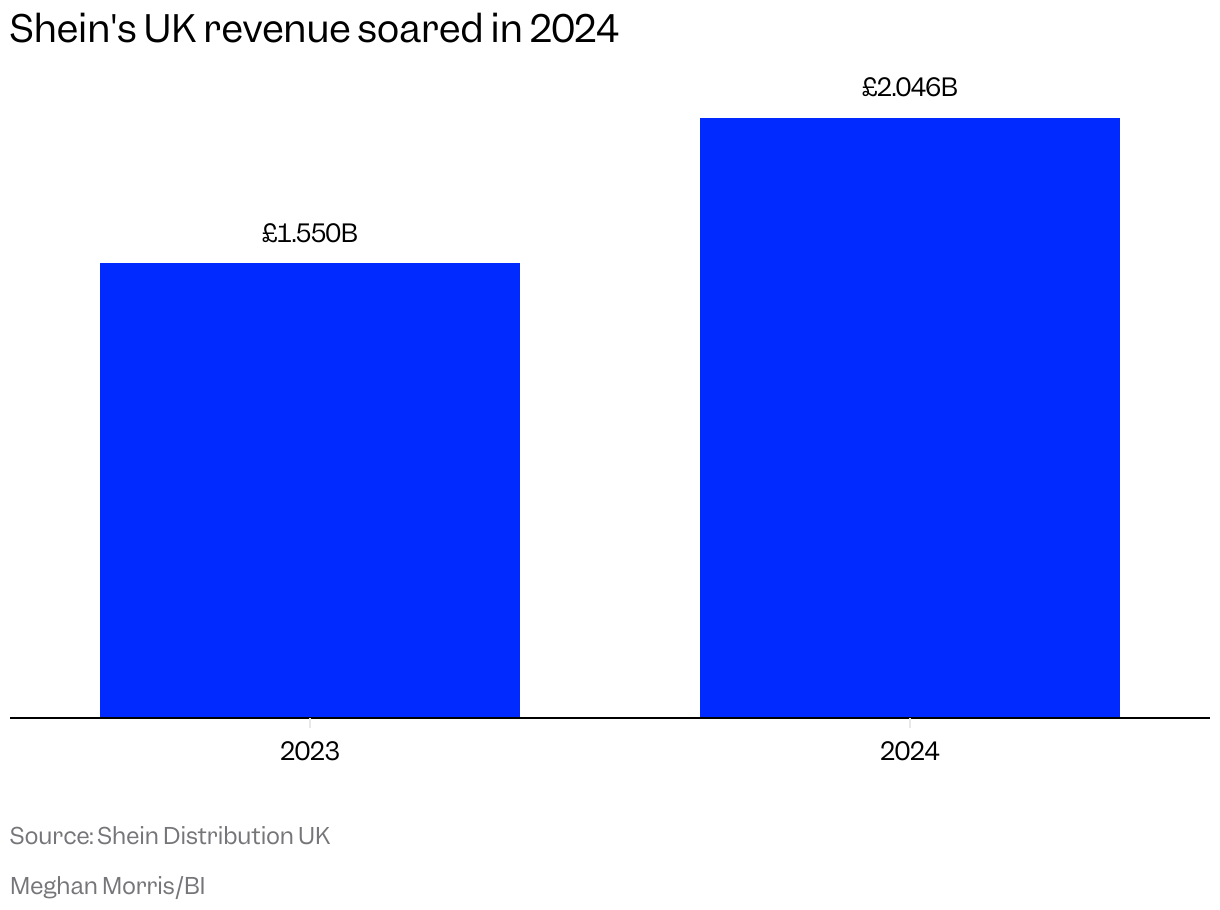
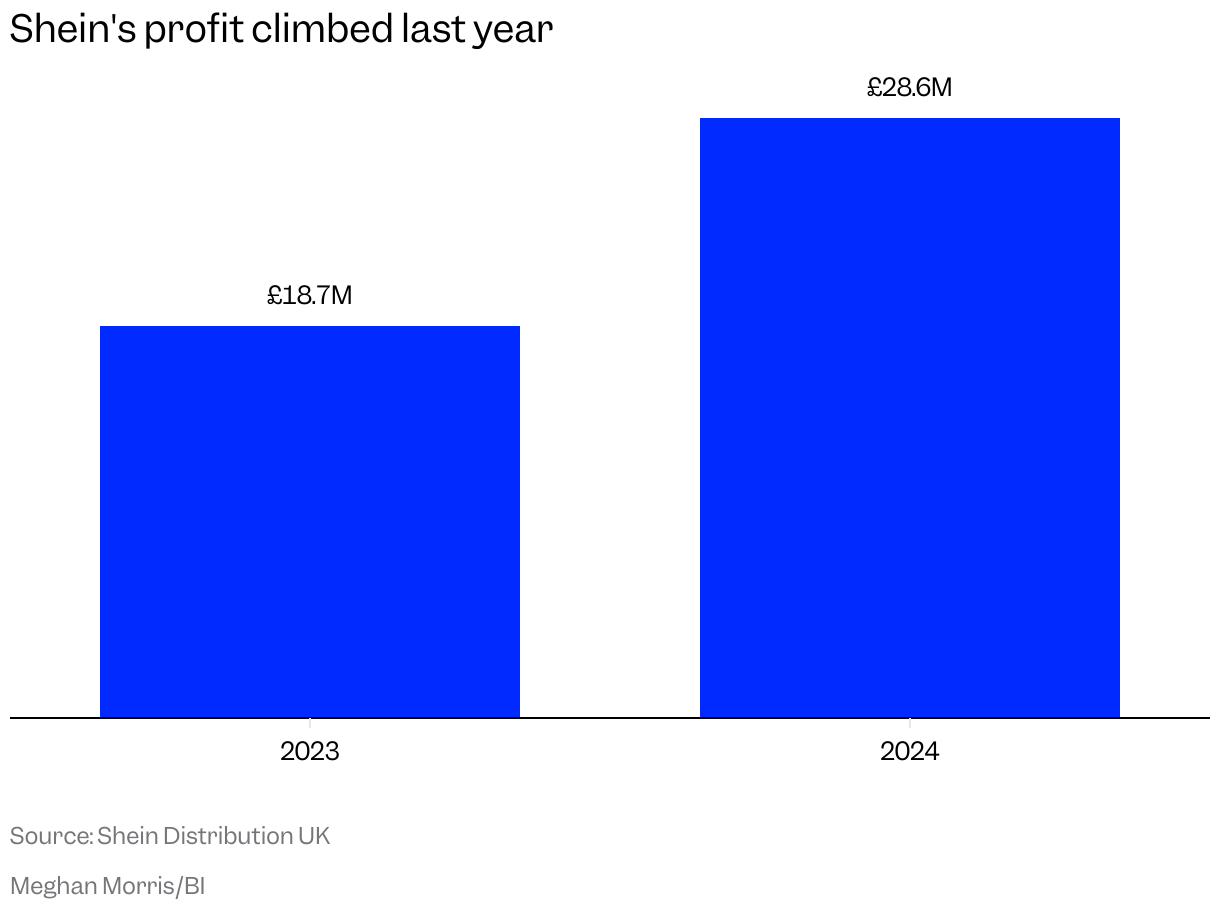
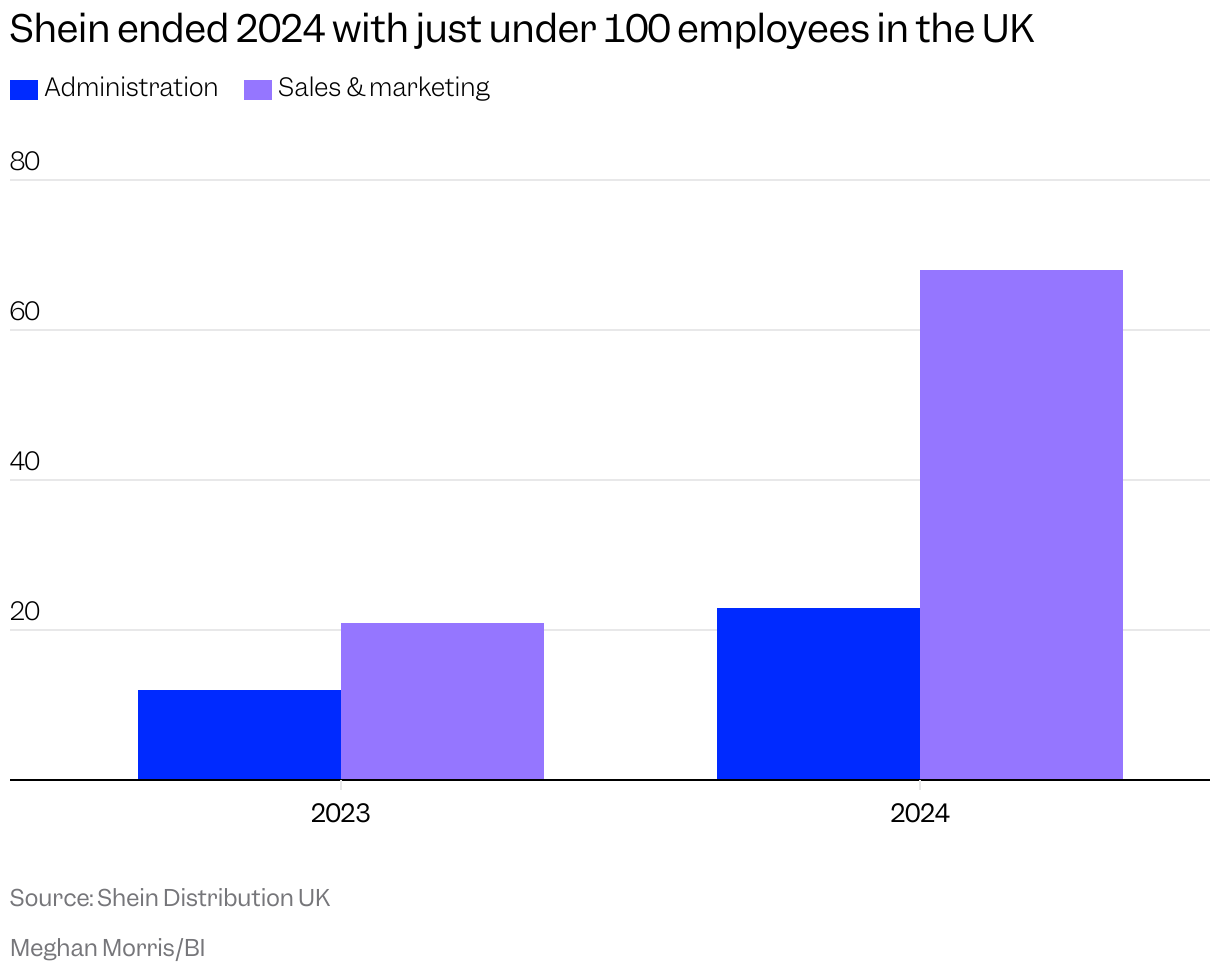
Here are some charts to visualize how Shein fared in the UK in 2024.

Revenue

Shein posted UK revenues of £2.046 billion in 2024, or about $2.78 billion. This was a 32% increase from 2023, when it earned revenues of £1.550 billion.

Profit for the year

According to the filing, the company reported a 56.6% increase in profits from 2023 to 2024 in the UK.

Its profits increased from £24.4 million in 2023 to £38.3 million in 2024.

Head count

Shein ramped up its workforce in the UK in 2024, nearly tripling its head count.

According to the filing, Shein's UK employee count rose from 33 at the end of 2023 to 91 at the end of 2024. The employees were involved in administrative, sales, and marketing roles.

"The Company had 91 employees during the year to 31 December 2024 who were primarily providing marketing expertise for the UK market," it added.

The filing added that of the 91 employees, 23 were men and 68 were women.

While its sales have soared, the company has also been the subject of scrutiny, with regulators investigating its operations.

In May, the European Commission said it had conducted an investigation into Shein. The organization accused Shein of engaging in multiple practices "in breach of EU law."

These included offering fake discounts, using deceptive product labels, and making misleading sustainability claims.

Its US operations have also been affected by President Donald Trump closing the de minimis loophole, which allowed small packages under $800 to enter the US tax-free. It had to increase its prices in the US to offset Trump's tariffs.

Representatives for Shein did not respond to a request for comment from Business Insider.

Read the original article on Business Insider


from Business Insider https://ift.tt/DVk0IrQ

AI is taking over the painstaking work of Silicon Valley's most-coveted engineers

CUDA inventor Ian Buck, vice president of hyperscale and high-performance computing at Nvidia. GTC CUDA engineers are elite coders who squee...