Rob Hobson focuses on cooking with whole foods most of the time, but doesn't sweat it when he eats the occasional ultra-processed food.
Andrew Burton
Rob Hobson, a registered nutritionist, cut out ultra-processed foods two years ago.
Hobson has since started eating what he deems healthier UPFs, like pre-made pasta sauce, to save time.
He feels comfortable eating ultra-processed foods that contain nutrients as part of a balanced diet.
Two years ago, after learning about how eating lots of ultra-processed food is linked to a range of chronic health problems, Rob Hobson, a registered nutritionist, decided to cut them out of his diet.
UPFs don't have a set definition, but they generally undergo industrial processing and contain ingredients that you wouldn't find in a home kitchen. They are highly-marketed, shelf-stable, and designed to contain an irresistible combination of sugar, salt, and fat. As well as obvious foods like frozen pizza, items such as packaged bread can fall into this category.
In his first three months of quitting UPFs, Hobson cooked from scratch as much as possible by leaning on meal prepping, and avoiding foods containing additives, including staples like ketchup or grocery store whole wheat bread.
"I was like a vigilante," he previously told Business Insider, but that approach quickly became too time-consuming to be sustainable.
In 2024, Hobson told Business Insider that he'd changed tack to incorporate what he considered to be healthier UPFs, like store-bought pasta sauce, into his meals, to save time while eating a balanced diet.
"I still believe the first port of call is cooking everything as much as you can from scratch. But I'm not going to give myself a hard time about buying tomato sauce, I'll just buy the best one I possibly can," he said.
Today, he has a similar approach to UPFs: he eats whole, unprocessed foods most of the time, but has wine or chocolate when he craves it and eats "healthier" UPFs when it makes sense.
Hobson has made two additional helpful tweaks to his meal planning and preparation to better fit his busy schedule.
Considering convenience instead of avoiding all UPFs
Since UPFs started making headlines a few years ago, the conversation around them and their impact on health has evolved, Hobson said.
"We're starting to understand that some of them are really not as bad for you because they have other added health benefits," he said.
Fortified breakfast cereals, for example, contain vitamins, while flavored yogurts can be a good source of calcium and protein.
Hobson's dietary focus is now more about prioritizing convenience and nutrition than solely avoiding UPFs.
"With nutrition, it's just making sure everything is on hand so that you have everything ready to go," he said. "I'm really busy at the moment. So for me, it's finding the easiest way to do it."
Hobson still cooks from scratch most of the time.
Kemal Yildirim/Getty Images
Refridgerating instead of freezing meals
Hobson would batch cook and freeze meals when he first avoided UPFs. Then the extra step of defrosting food became tedious.
The food "was just sitting in the freezer. I couldn't really be bothered to defrost it," he said.
Now, he still batch cooks, but makes dishes that will last in the fridge for a few days, such as turkey chili, which he eats in a variety of ways throughout the week.
He might have it with rice one day, then on a baked potato or in a wrap the next.
"It saves me loads of time, and it's just so nice when there's stuff in the fridge that's ready to just heat up in a pan," he said.
Using a pressure cooker
Pressure cookers speed up the cooking process.
felixmizioznikov/Getty Images
Hobson reduced the time he spent cooking this year by buying a pressure cooker, an airtight device that quickly cooks food using steam.
He uses it to make the same kind of one-pot meals, such as stews and curries, he's favored for years, without needing to supervise the food.
"It's much easier for me to batch cook with very little effort," he said.
The billionaires said reading is the top habit they attribute to success.
twomeows/Getty Images
Business Insider staff highlight our top business, tech, and innovation books of 2025.
Selections include memoirs, biographies, and deep dives into Wall Street and Silicon Valley.
Our favorites offer insights on Big Tech, behavioral economics, corporate scandals, and AI's impact.
As the curtain falls on 2025, it's only natural to look back at the stories and ideas that shaped our thinking this year — and for Business Insider staffers, that includes books.
We asked our reporters to share the business, tech, and innovation books that left the biggest impression on them this year. Not all of these titles hit the shelves in 2025, but each offered something valuable: a new perspective, a spark of creativity, or simply a story we couldn't put down.
Our picks span everything from Big Tech memoirs and Wall Street deep dives to pop culture biographies and reflections on identity and innovation.
Here's a look at the books that defined our year in reading — and might just inspire your next picks over the holidays and into 2026.
"Burn Book: A Tech Love Story" by Kara Swisher
Journalist Kara Swisher
Chip Somodevilla/Getty Images
Hugh Langley: It's hard to think of a reporter who's had a better front-row seat to the history of Silicon Valley than Kara Swisher. "Burn Book" attempts to both chronicle the unstoppable rise of tech and her role as the dogged reporter caught in the frenzy. Lord knows that journalists love stories about journalists, so the latter aspect grabbed me most.
For those more interested in Swisher's central line of inquiry — how and why did Big Tech end up so cozy with the Trump administration? — "Burn Book" offers a whistle-stop history lesson of how the internet upended the media industry, our relationship to technology — everything, really — and crowned a new generation of eccentric moguls.
For anyone who has followed Swisher's reporting as closely as I have (she launched Recode the year I got my first job as a tech journalist) it's not quite an earth-shattering exposè, but eminently readable and chock full of anecdotes — including a particularly weird one about Sergey Brin's baby shower.
"The Winner's Curse: Behavioral Economics Anomalies Then and Now" by Richard H. Thaler and Alex O. Imas
Samuel O'Brient: As both a fan and scholar of behavioral economics, I was extremely excited when I saw that Richard Thaler would be releasing an updated edition of the book that helped shape the entire discipline.
Its release led to me having a great conversation with both he and Alex Imas about their insights, both old and new, and how much they apply to my work at Business Insider. Behavioral economics is extremely important for anyone seeking to understand the investing world and this book helps illustrate why.
"Doppelganger: A Trip into the Mirror World"by Naomi Klein
Kasia Kovacs: There's no easy way to sum up this book, but I'll take a stab: It's a social and political commentary grown from author Naomi Klein's frustration with being confused with the "Other Naomi" — Naomi Wolf. But the book covers a lot more ground, too. It's an exploration of tech and the attention economy, and how our online personas (our shadow selves, or doppelgangers, if you will) and the deep corners of the internet spur misinformation and conspiracy theories.
"Doppelganger" was published two years ago, and in that short time AI has continued to proliferate at a rapid rate. Reading it in 2025, one must wonder about the increasing impact of AI on this spectrum of issues in the online "mirror world."
"Gwyneth: The Biography" by Amy Odell
Gwyneth Paltrow
Monica Schipper/Getty Images for Daily Front Row
Henry Chandonnet: Hear me out: This biography is 60% delicious pop culture gossip and 40% a stellar business book. After almost entirely quitting acting, Gwyneth Paltrow devoted herself to her wellness brand Goop. There have been peaks and valleys between its boom as a media business, its expansion into beauty and food delivery, and its subsequent bust, marked by layoffs and shutdowns.
Odell made me just as interested in Paltrow the business maven as I was in Paltrow the actor. Her first book on Anna Wintour is great, too, if you're into the Condé-ology that blew up this year.
"Unit X: How the Pentagon and Silicon Valley Are Transforming the Future of War" by Raj M. Shah and Christopher Kirchhoff
Julia Hornstein: "Unit X" offers up the requisite context a good, serious piece of nonfiction should — the kind a new defense tech beat reporter might artfully deploy when chatting with her editors. It makes the compelling case that the US lost its edge in battlefield tech around the turn of the century as rivals learned to build complex weapons cheaply and quickly. But the strength of the book comes from its pace — the authors realize the stakes only moments before the reader does.
"Unit X" opens with Shah flitting over Iraq's border aboard an F-16 fighter jet, a technological marvel with a small problem: The aircraft couldn't display exactly where Shah was. On his next flight, Shah jerry-rigged his own navigation software using cheap commercial tech. The fix worked, catalyzing the authors' driving purpose — to bring ready-made tech from Silicon Valley to Capitol Hill, as they put it, "we had to hack the Pentagon itself."
"What Do You Do With an Idea?" by Kobi Yamada and illustrated by Mae Besom
Melia Russell: The venture capital firm Andreessen Horowitz once sent this book to my techie husband when our daughter was born. She's five now, and this was the year the book finally earned its place in the bedtime rotation.
"What Do You Do With an Idea?" follows a child who discovers a strange, slightly unwieldy idea that trails him like a lost puppy. The child worries about what people will think, until he finally decides to nurture the idea. The world is better for it. It's a quietly powerful read about creativity, courage, and the fragile early days of a big thought.
"Careless People: A Cautionary Tale of Power, Greed, and Lost Idealism" by Sarah Wynn-Williams
Sarah Wynn-Williams, an ex-Meta employee whose book debuted at the top of the New York Times Bestseller list,
Flatiron Books
Jyoti Mann: Few books this year have captured Big Tech's inner workings as vividly as this memoir from a former Facebook public policy director.
Reading it through the lens of someone who covers Meta, I was both fascinated and unsettled by the eye-opening details that give us a behind-the-scenes look at the company and dynamics within Meta's top ranks. The book is a feast of insight — deliciously written and impossible to put down.
"1929: Inside the Greatest Crash in Wall Street History — and How it Shattered a Nation" by Andrew Ross Sorkin
Emma Cosgrove: If you want to feel calmer about the financially precarious moment we find ourselves in now, read about a real crash. Before the SEC, before so many regulations that keep us from financial oblivion, psychics were prolific stock pickers of the day and trading was a cultural phenomenon — a trendy, addictive hobby as much as a stairway to wealth.
Nothing calmed me down about the AI bubble quite like studying The Great Depression and Sorkin's take is vivid, fast-moving, and about as fun as a financial disaster story can be. Can I hear echoes today? Sure. Do I think we're on the brink of anything similar? Nah.
"No More Tears: The Dark Secrets of Johnson & Johnson" by Gardiner Harris
Ellen Thomas: This is both a corporate history of an iconic and trusted American heritage brand and an exposé into its long pattern of exploiting that trust in pursuit of maximal profit, no matter the cost to human health and life. The book breaks down J&J's history of legally and ethically questionable — and frankly dangerous — business practices chapter by chapter, covering a different product and related disaster in each one.
The J&J talcum powder scandal has been well-covered, but I think you'll find it shocking how many J&J products have caused harm at scale. "No More Tears" is really infuriating and to be honest I had to take a little break from corporate non-fiction after I read it, but ultimately it's an important and revealing book that reminded me why I do this job.
"Chip War: The Fight for the World's Most Critical Technology" by Chris Miller
Meghan Morris: From Intel's new CEO to US-China export controls, Chris Miller's prescient 2022 book explains many of 2025's headlines. The book traces the underpinnings of today's astronomical wealth creation and sensitive geopolitical questions back decades, through vignettes about people and companies you know and those that have faded from public consciousness.
For tech experts and Luddites alike, this history will inform your understanding of the currency driving much of the world's economy. Readers gain new appreciation for the technology that powers your iPhone and 401(k) alike — and insights into just how fragile the gazillion-dollar ecosystem is.
Jeff bezos and Lauren Sánchez Bezos typically spend part of the December holidays in Aspen, Colorado.
MEGA/GC Images
The world's billionaires have taken off, jetting — or yachting — to spend the holidays at exclusive destinations.
The 0.001% travel to locales like St. Barts and Aspen at the end of the year, where a single night's stay can cost five figures.
Here's a look at some of the most popular places for the rich during the holidays.
The holidays are all about time with family and friends. For some of us, that means pullout couches and six to a bathroom. For others, it's a villa in St. Barts or a ski house in Aspen.
Now that the end of the year is upon us, the uber-wealthy are deploying their private jets and superyachts and heading to expensive destinations to enjoy vacations — and often the company of other billionaires.
"It's going to places that are exclusively pretty much high net worth," Winston Chesterfield, the founder of Barton, a consulting firm focused on luxury and the wealthy, told Business Insider. "They want these private resorts away from everyone else."
On the other side of the continent, Jeff Bezos's Koru, David Geffen's Rising Sun, and Eric Schmidt's Whisper are among the dozens of yachts floating in the Caribbean Sea.
Once their billionaire owners are aboard, several of these ships will likely head to St. Barts to celebrate New Year's Eve.
"I always say if you want to have your toes in the sand and eat a croissant that feels like you're in Paris, St. Barts is the place for you," Elisabeth Brown, the membership director at the luxury concierge service Knightsbridge Circle, told Business Insider.
St. Barths is a wintertime destination for superyachts.
Walter Bibikow/Getty Images
Those who don't stay aboard their ships can spend upward of $7,000 a night for a room — and well into five figures a night for a suite — at luxury hotels like Eden Rock and Cheval Blanc, owned by the billionaire Bernard Arnault's LVMH.
The steep price is part of the appeal.
"There is nothing mass-market about it," Chesterfield said. "It's impossible to be there unless you are really wealthy."
Other superrich travelers choose to embrace the winter weather.
"The holidays in the mountains are more of an escape than any other holidays, even escapes to their own remote private islands and things," Chesterfield said.
In Europe, that means the Alps. Gstaad, St. Moritz, Courchevel — which used to be a favorite of Russian oligarchs — and Val-d'Isère are classic choices for the ultrahigh-net-worth set, Chesterfield and Brown said.
Real-estate prices continue to rise in these locations, with homes in Gstaad, the most expensive locale, costing as much as 47,300 euros, or about $55,600, per square meter, according to the property consultancy Knight Frank's 2025 Alpine Index.
Stateside, Aspen, Vail, and Carbondale in Colorado are among the most popular ski resorts for the ultrawealthy, Charlie Garcia, the founder of centimillionaire membership club R360, told Business Insider.
Aspen has the highest density of homeowners worth more than $30 million in the US and the second-highest in the world, behind Monaco, according to a 2025 report by the wealth-tracking firm Altrata.
Hedge fund titan Ken Griffin, Walmart heir Rob Walton, and businessman Charles Koch are among the richest of those with second (or third or fourth) homes near the ski resort. Bezos and Lauren Sánchez Bezos are regular visitors.
"It is the closest you'll get to a European après situation," Brown said. "Great mountains, great skiing, the hotels are top-notch, the restaurants are awesome."
There's a restaurant by the chef Nobu Matsuhisa, designer shops like Gucci and Prada, and private clubs like Casa Tua and the Caribou Club to make the überrich feel at home.
But skiing is the real draw. The No. 1 interest of Aspen's ultra-high-net-worth homeowners is sports, according to Altrata.
Those with more spiritual interests may prefer a different type of trip — quite literally.
"They're doing these inward journeys with psychedelics," Garcia said of several R360 members doing retreats in places like Peru or Costa Rica.
Maybe a little plant medicine is the secret to families getting along over the holiday.
This story was initially published in December 2024 and has been updated with new information.
When your family asks why you didn't find a new job this year, show them these charts.
It's been a year full of milestones for the job market — but not the good kind.
Unemployment rates for 20-somethings hit their highest level in years.
Kanika Mohan lost count of her job applications.
With a new bachelor's degree, a slate of summer tech internships, and years of networking at campus career fairs, she hadn't expected getting a job to be this hard.
"I remember waking up every single day to at least a few rejection emails, and these emails have absolutely no personalization to them," Mohan, 22, told Business Insider over the summer. "You can do three rounds of interviews, yet you'll still get a very generic, 'Sorry. You're not a good fit."'
She eventually landed a role at a top tech company, but months of editing cover letters, prepping for interviews, and getting ghosted had been exhausting. And brutal job search experiences like hers aren't an outlier — they've become the norm.
The job market in the US hit some major milestones this year. Unfortunately for the dozens of job seekers Business Insider has heard from, they weren't the good kind. AI, economic uncertainty, and a shift toward employer power have been felt across the workforce.
Tyler Sorenson knows this all too well. The Gen Zer was so frustrated by limited job vacancies and slow replies to his online applications that he began leaving paper résumés at local businesses.
"I literally just had to walk into that store and hand them an actual résumé for them to even take a look at me," he said in the summer. For him, that actually ended up yielding results: He was able to bypass the onslaught of AI applications and get directly to a human. It's part of just how topsy-turvy the job hunt has become.
The economic situation has everyone feeling stuck: Companies are pulling back on hiring, while people with a steady paycheck are feeling too cautious to make a move. It's culminating in a frozen job market — and Americans are feeling the chill.
The number of job openings for each unemployed person has tightened
Millions of people are struggling to get a job — the unemployment rate as of November is the highest since 2021. Meanwhile, job openings have cooled off 37% from their high point in 2022.
"This job market is terrifying," Hilary Nordland, a Gen X job seeker told Business Insider over the summer. "It's a black hole that makes you question everything — and I don't see a clear path through."
The number of job openings for each unemployed person has come way down over the past few years — from two openings per unemployed person in 2022 to one this past September. The number of people unemployed briefly surpassed job opportunities in July and August, which hasn't happened since the economic disruptions caused by the pandemic in 2020 and 2021.
"Job growth has been very slow over the course of 2025, and it doesn't seem like we've turned around quite yet to translate the pent-up demand for hiring and the recent increase in job openings into actual hires," Nicole Bachaud, an economist at ZipRecruiter, said.
The 'Big Stay' intensified
In 2023, Business Insider wrote about how the Great Resignation, where many workers were switching into new roles amid robust options, was pivoting into the Big Stay, where more workers would keep their jobs, whether they wanted to or not.
That shift became clearer in 2024 and persisted in 2025. The quits rate fell to 1.8% this past October, the lowest since May 2020.
The quits rate provides a good indicator of how confident workers feel about being able to transition to a new employer. The low rate means workers likely don't see many new opportunities.
"When we look at the fact that inflation is still strong, wage growth is cooling in respect to inflation, a lot of workers are maybe thinking a steady paycheck, whether it's my ideal job or not, is better than the risk of me going for something else because there's not a lot of something else out there," Bachaud said.
The job switcher wage premium evaporated from Great Resignation highs
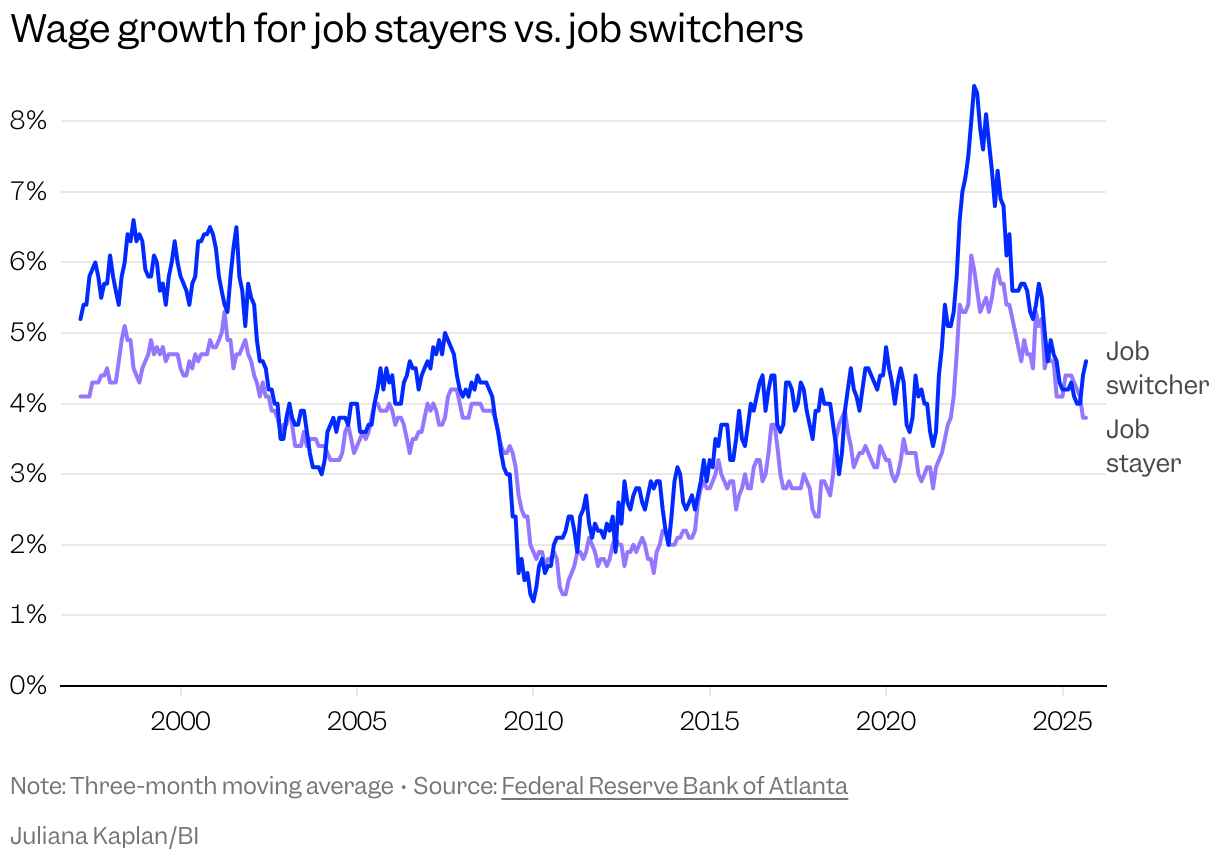
Over the past few years, wage growth for job switchers had far outpaced that of their colleagues holding tight; at the peak of the Great Resignation, job switchers' paychecks were benefiting from major premiums.
But in 2025, the job switcher wage growth came down to earth, and then some. In the back half of the year, job stayers and job switchers have duked it out for who's seeing larger wage growth — a marked contrast to the larger paychecks companies dangled over potential job hoppers just a few years ago.
That's not necessarily great news for job stayers, though. On the whole, wage growth tempered for both groups, meaning less ample raises. And it's another indicator that job market power has slipped back into the hands of employers.
Long-term unemployment reached levels unseen since 2022
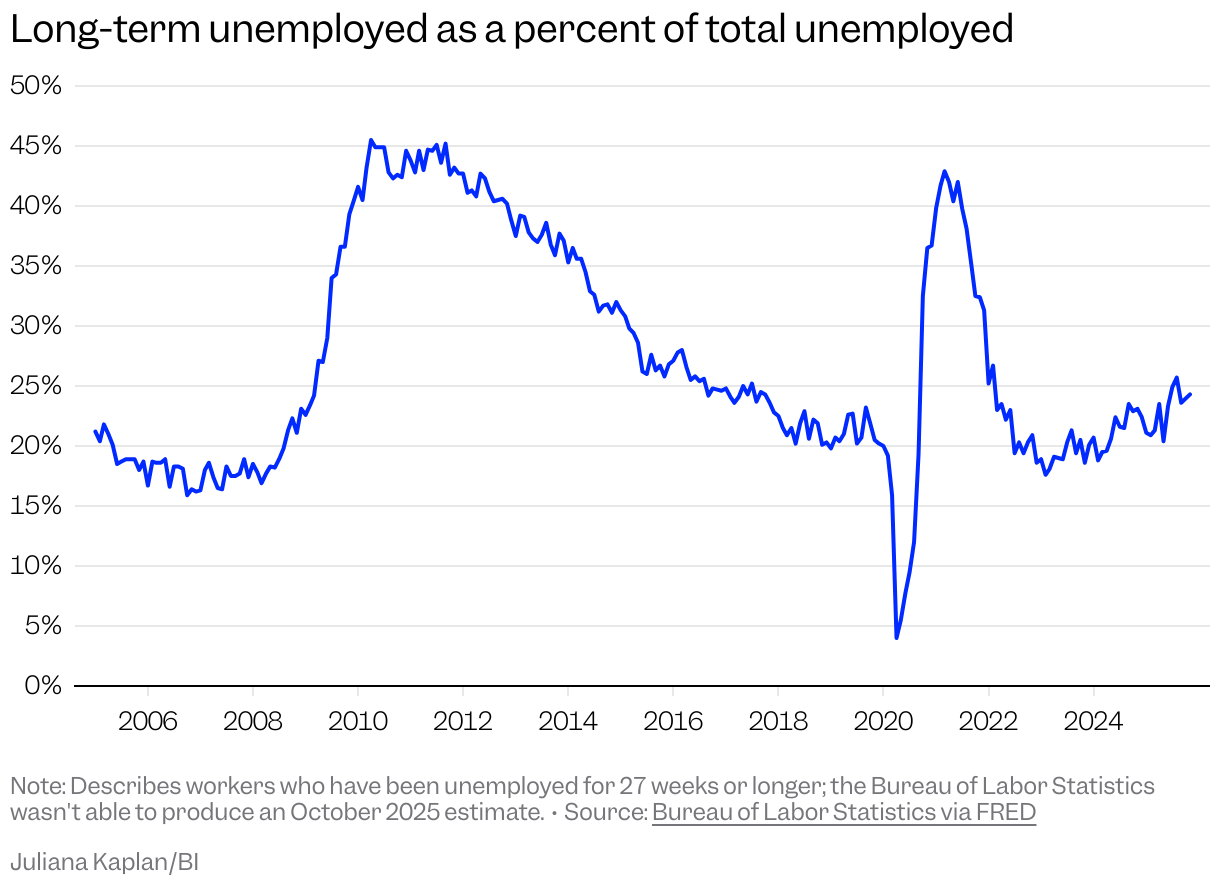
The share of workers who are deemed "long-term unemployed" — meaning they've been out of work for 27 weeks or more — has come to encompass a quarter of all unemployed Americans. That's picked up in the back half of 2025, suggesting that many had spent a solid chunk of the year jobless.
For workers thrust out of their jobs, climbing back into the fold is an ever more daunting task.
Clair Todd, who was laid off two years ago, said constant job rejections can make you feel like you are not good enough.
"On top of that, you have to worry about paying the bills without money coming in," she said. "I don't want to say I've given up, but my search has been extremely discouraging."
She stopped actively looking for a new position a few months ago and instead prioritized building a website development business.
Young adults haven't been this unemployed since the early pandemic
The 2025 job market was brutal for every generation, but Gen Zers are in an especially tough spot. The unemployment rate for 20- to 24-year-olds reached 9.2% in August and September, the highest figure since the recovery from the pandemic recession.
"I was applying and I felt like, 'This is so stupid because I know I'm going to get rejected,' recent grad Bella Babbitt told Business Insider last spring.
For those with a college degree, the prospects have been especially grim. The educated 20-something unemployment rate has consistently surpassed the overall unemployment rate since 2021, and the gap has widened. It's not unusual for young people to be out of work at higher levels than the general population, but a degree has historically boosted young people's chances of landing a job. Young men were more unemployed than young women this year, in part because women tend to dominate one of the few growing sectors of the job market: healthcare.
Business Insider has heard from dozens of Gen Zers this year. Some are pivoting from white-collar fields to more seemingly secure blue-collar work, while others said they've submitted hundreds of applications without any luck. Most felt their traditional paths to success disappeared in 2025: The Trump administration's DOGE initiative slashed opportunities in the federal workforce, AI is snapping up entry-level tasks in fields like tech, and major companies aren't hiring due to economic headwinds.
Workers aren't confident about finding a job if they lost theirs
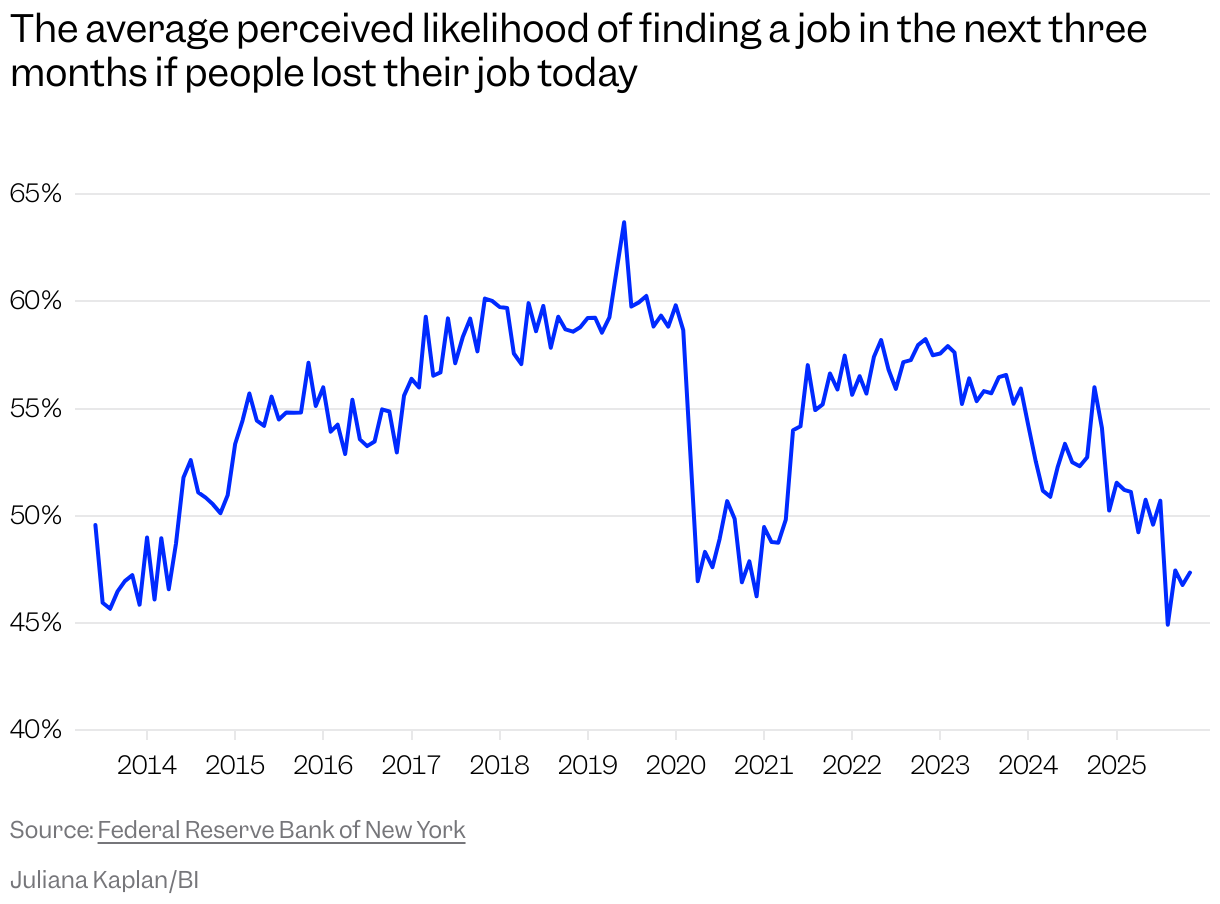
The New York Fed asks people about how likely they think they could find a new job in the next three months if they lost their role today. The average probability fell to its lowest point in August since the survey began in 2013. It's only seen mild recovery since.
Weaker worker sentiment has been paired with fewer job opportunities than a few years ago, stubborn inflation, tariff chaos, and relatively high interest rates.
"I went through months of job searching — about four to five months — and it was really scary, it was really harsh, it was really painful," Mohan, the recent college grad, said. "It took a really huge emotional toll and a big toll on my mental health, too."
Jacob Zinkula contributed reporting for this story.
Dating apps like Tinder, Hinge, Bumble, and Grindr are placing big bets on AI-powered matchmaking.
They are hoping innovations in the space can combat the app fatigue that has stymied growth.
Meanwhile, a new generation of startup apps is emerging, competing with the giants for the internet's singles.
Dating apps' original pitch was to match you with anyone.
"Swipe. Match. Chat. Date." That was Tinder's promise when it launched more than a decade ago, forecasting the endless cycle so many of its users now bemoan.
Now they want to match you with the one.
The giants in the dating space — Match Group's Hinge and Tinder, Grindr, and Bumble — are investing tens of millions into artificial intelligence, hoping to beat each other and the new AI-driven upstarts in the ultimate dating game.
While, technically speaking, AI and machine learning have been used by dating app algorithms for years, these generative AI features take it further.
The result, the companies say, will be meaningful: better matches, fewer swipes. Nothing short of "magical," as Grindr's CEO George Arison put it on a recent earnings call.
"We're entering a platform shift with AI," Match Group CEO Spencer Rascoff said during a Los Angeles Tech Week panel in October. AI is "changing everything" about the company's dating apps, he added.
The space is ripe for change. The big players are struggling. There's frequent churn, the result of "swipe fatigue," and many users are unwilling to shell out for premium features.
Match Group CEO Spencer Rascoff called AI a "platform shift."
Nordin Catic/Getty Images for The Cambridge Union
"It's been a really long time since there's been a new reason — whether technology, platform, brand, whatever — for consumers to be excited about dating," Sam Yagan, cofounder of OkCupid and former CEO of Match Group, told Business Insider.
Match Group's stock is down more than 75% over the past five years. Last month, the company reported quarterly results that missed Wall Street's earnings and revenue estimates. It is struggling to convert users into paying customers, a category that declined 5% last quarter compared to the same period a year ago.
The share price for Bumble, meanwhile, is down more than 50% this year alone. The company laid off 30% of its staff over the summer, and last quarter, the app's paying users fell 18% from the same period last year.
"They've gone through this period over the past few years where users have started to contract, and there's been this question of why," Morgan Stanley analyst Nathan Feather told Business Insider. "Simply, the product doesn't work as well as people expect it to."
Startups are hoping to capitalize on that weakness. Several new apps have raised millions over the past couple of years. Just this month, Hinge founder Justin McLeod stepped down as CEO to found his own AI dating platform.
Robot, robot, make me a match
Cupid, matchmakers, classifieds, dating websites, swiping apps.
No matter how you slice it, they all attempt to solve the same problem: helping you find the perfect match. AI, companies say, will do that better than all of the above.
It makes sense for AI to infiltrate the space, Rick Heitzmann, the cofounder of VC firm FirstMark, which is not invested in any dating companies, told Business Insider. Matchmakers are a type of agent, and anything that can be agentified is a good match for AI, he said.
Whitney Wolfe Herd rejoined Bumble as CEO in March.
Dia Dipasupil/Getty Images
For the biggest players, finding the "better fit" is the ultimate goal of their AI investments.
Hinge is working on improving its match-making algorithm, and Bumble has an AI product scheduled to roll out next year. They are also using AI for profile creation, flirting, and trust and safety — in service of expediting the match-making process.
Tinder is plowing ahead. The app is piloting Chemistry, a matchmaking feature that gives users a "daily drop" of ideal matches based on a dater's camera roll and answers to a series of prompts. The goal is matches driven more by values, less by how hot a photo is — and ultimately fewer of the swipes that used to be at the heart of its branding.
Tinder's Chemistry feature is still in testing, and the look may change.
Tinder
That fewer swipes part is key. Hilary Paine, Tinder's VP of product, told Business Insider that AI-driven matchmaking is a way to stay competitive in the attention economy.
"AI is pushing every consumer app toward personalization," she said. "The more that we can do to get you efficiently to a spark and a connection, a conversation, hopefully a date, that's a better experience for you."
Even Grindr — long considered more of a hookup marketplace than a matchmaker — is trying its hand at AI.
Grindr, which gained a reputation as a place where gay men go to seek short flings with faceless profiles, has added a recommendation feature using AI. There's a "For You" feed with profiles of users who might be a good match, and "A-List," another matching recommendation feed based on profiles with which the user has already chatted.
It's still an open question about whether these AI features will work — and whether they'll be popular. Tinder's Paine said that Chemistry is performing well with Gen Z, the app's key demographic. Grindr's chief product officer AJ Balance said that recommendations are a "very strong early hit."
As Raymond James analyst Andrew Marok put it: "You can't just take a product that's out of favor, put AI on top of it and say, 'OK, now we have a product that's in favor."
Grindr uses AI to power recommendation features like A-List.
Grindr
One longtime Grindr user, Paul Lazo, isn't impressed. The 33-year-old video editor from Philadelphia has been on the app for 11 years and now pays $19.99 a month for the Pro version.
He's found its recommendations lackluster.
"I'm very much into bears and larger men," Lazo told Business Insider. But Lazo said his "For You" page is filled with young, fit men.
The feature is new this year and could still improve. A Grindr spokesperson said the For You product still runs on older machine learning.
Other fish in the sea
Waiting in the wings is a new batch of AI-first dating startups seeking to attract dissatisfied users before Tinder, Hinge, and the like can catch up.
"In the same way that mobile gave birth to Tinder and Bumble, AI could give birth to two multibillion-dollar companies," said Yagan, the cofounder of OkCupid and former CEO of Match Group.
The app Sitch, for example, has raised a total of $9 million since launching in 2024 and charges users $90 for three matches. Its AI is trained on cofounder Nandini Mullaji's experience as a real-life matchmaker; it brings daters a handful of "set-ups" each week and provides an AI matchmaking chatbot.
"We understand people have been burned in the past," Mullaji told Business Insider in April. "We are coming in and saying, 'Hey, we have a business model shift, and we have a total platform shift.'"
There's a new fleet of similar apps pitching AI as a Hail Mary for dating apps. Known, Ditto, and Amata each launched AI-matchmaking apps this year.
Amata users chat about preferences with an AI matchmaker.
Screenshot via Amata
Plus, traditionally non-romantic players are trying their hand.
Facebook has introduced an AI dating assistant that acts like a matchmaker, combing through the platform's rolodex of users to find "someone that I could bring home to my parents" or "a Brooklyn tech bro who would go to EDM concerts with me," product manager Neha Kumar told Business Insider in October.
Some big names are lining up behind Facebook. Amanda Bradford, who founded The League before selling it to Match Group in 2022, put her money on the "dark horse" for the incumbent to best leverage AI.
"They're the only actual 'tech company' of the bunch, and the only one who seriously invests in and has true product, engineering, and AI talent," Bradford said.
Still, it will be an uphill climb for the startups. Dating apps need to reach a critical mass of users to be successful.
"Incumbents have a huge benefit," said Heitzmann, the venture capitalist.
NC13's DevDroid TW 12.7 is seen firing its weapon in this aerial footage. Red annotation by Business Insider.
Screenshot via 3rd Army Corps/Telegram
Troops from Ukraine's 3rd Army Corps said they used a ground robot to fight for 45 days.
The Droid TW 12.7, armed with a .50-caliber machine gun, was remotely operated by the NC13 unit.
The 3rd Army Corps said that Ukrainian troops in the area took no casualties during this time.
A Ukrainian army corps said on Monday that its troops used a remote-controlled vehicle mounted with a machine gun to hold frontline positions for 45 straight days.
"For 1.5 months, the ground drone of the Third Assault Brigade held the position instead of the infantry!" said the Ukrainian 3rd Army Corps in a statement on Telegram.
The platform in question is an uncrewed ground vehicle, or UGV, called the Droid TW 12.7, which is equipped with a .50-caliber machine gun.
It marks one of the first times that Ukrainian troops have said they've used a UGV to replace or assist humans in holding front-line positions — one of the war's most perilous tasks — for an extended period.
The corps published aerial footage of the drone firing its weapon in fields, as well as a short clip, filmed from the drone's mounted camera, of it engaging an unknown target.
Business Insider could not independently verify the location or date of filming for this footage.
The corps said the ground drone was deployed for 45 days to suppress Russian advances on the frontline with machine-gun fire, and that it was controlled by operators from a safe location.
"During the mission, the enemy failed to infiltrate or occupy our position. And the fighters held the lines with zero casualties," the corps said.
The unit that operated the Droid TW 12.7 belonged to NC13, a company within the 3rd Assault Brigade that was launched in September and specifically focuses on UGV warfare.
The Droid TW 12.7 is a remotely operated tracked system equipped with an M2 Browning, developed by the Ukrainian defense technology company DevDroid.
DevDroid says that the ground drone has an operational range of up to 15 miles and is controlled via a radio signal, while also featuring automated navigation powered by artificial intelligence.
It recently drew attention for being deployed in an ambush against a Russian infantry fighting vehicle, where footage filmed from its camera showed the drone pivoting quickly to continue firing on its target.
The achievement announced by the 3rd Army Corps is another sign of the growing use of UGVs in the war. Both Ukrainian and Russian troops have been developing such ground drones to fill dangerous tasks, from minesweeping to ferrying supplies near the front lines.
However, Ukrainian companies and units have also been increasingly experimenting with UGVs that can perform combat missions.
While these still require human pilots, they mark the early stages of robotic systems being used in place of human infantry to fight on the ground.
AI infrastructure like data centers has drawn heavy investment as debate grows over whether valuations are sustainable.
ANDREW CABALLERO-REYNOLDS / AFP via Getty Images
The real AI opportunity goes far beyond chips and data centers, says Diameter Capital's Scott Goodwin.
The credit firm's bets on telecom and satellite companies riding AI's infrastructure buildout have paid off.
But risks are piling up in AI credit, especially in chip finance, warns Goodwin.
The artificial intelligence boom is real — but there's more to the AI trade than chips alone, according to a credit investor.
"This is a super-duper micro cycle that will outlast many investing careers," said Scott Goodwin, the cofounder and managing partner of Diameter Capital Partners, a quote he attributed to his partner Jonathan Lewinsohn.
AI represents what Diameter Capital sees as a long-running, disruptive cycle — but buying the most obvious winners isn't the only way to play it, he said on the "Goldman Sachs Exchanges" podcast published on Friday.
Diameter Capital, which manages approximately $25 billion in assets, has focused on where AI demand could create less obvious bottlenecks — and where those bottlenecks show up in credit markets.
The AI opportunity beyond chips
That view led Diameter to buy the unsecured debt of a midsize telecommunications company in 2023.
Goodwin said the bet was rooted in the idea that as companies move from training AI models to actually using them, demand shifts away from chips alone and toward the networks that carry data.
"It had to leave the data center. How would it leave? It would leave on the commercial fiber, the pipes," he said.
The telco went on to sign more than $10 billion in contracts with hyperscale cloud providers, and the debt has rebounded to face value, Goodwin said.
Diameter Capital also made "a big bet" on a satellite company tied to the wireless spectrum — a wager that later paid off after the company sold spectrum assets and the debt returned to face value.
Goodwin's comments come amid growing debate over whether sky-high AI valuations are sustainable and whether investors are overlooking other opportunities tied to the technology.
Risks and rewards
Goodwin warned that parts of the AI-credit boom may be taking on risk that's hard to price, especially in chip finance.
Some investors, he said, are taking on "residual risk," or the riskiest slice of chip-financing deals — betting on what the hardware might be worth years from now. Cutting-edge firms refresh their technology often, so chips can quickly become outdated for some customers.
"We call up really smart people in Silicon Valley, we call up really smart people at Big Tech companies and ask them what the residual value is on these chips three, four, five, six, seven years forward," he said. "None of them have a clue."
Goodwin said the next phase isn't just about spending on infrastructure — it's about competitive disruption rather than capital expenditure.
"Who are the companies, who are the entities that are going to adopt AI and take a step forward versus their peers? And who are going to be the losers?" he asked.
"That is actually a longer cycle than the capex cycle, so that's really interesting," he said.