Isaac Persky used a creative video to land an internship at Tarte Cosmetics in 2024.
Maureen Kelly, the CEO of Tarte, was impressed by Isaac's video, leading to his internship offer.
He returned for a second summer internship and started a full-time position this June.
When I was in college, I wanted a summer internship in New York City, specifically at one company: Tarte Cosmetics. My mom sent me a video of Tarte's founder and CEO, Maureen Kelly, calling on college students to apply to their summer internship program, and it sparked my interest.
I've been posting videos on social media in both the beauty and comedy niches for years, but I thought I'd left that behind when I started college at Chapman University to pursue a more 'serious' career. I was double majoring in economics and public relations and figured Tarte would be a fun way to spend the summer after my sophomore year before turning to a more traditional business or finance path.
I had one problem — I had no connections to Tarte, no family in the beauty industry, and no obvious way to stand out among thousands of applicants. In today's job market, especially for a sought-after position in beauty, it felt more likely I'd get struck by lightning than land an offer.
When I submitted my application in January 2024, I knew I barely had a shot.
This is where most applicants stop
They repeat the process with hundreds of applications, hoping to win the lottery of landing an interview and, ultimately, an offer.
I'm from Nebraska and attended school in Southern California. To be frank, going home for the summer was not an option. I didn't want to trade my glamorous coastal lifestyle for corn and county fairs. I couldn't rely on pure luck to be selected for an interview. I knew that if I could get in front of them, they would see how perfect I was for the role.
I decided to make a video
Since posting videos felt natural to me, I figured, what better way to show that I'm qualified for a marketing job at Tarte than by successfully marketing myself to Tarte. I decided to make something fun and entertaining. Inspired by the iconic Harvard admissions video from Legally Blonde, I created an "Elle Woods-style" application video.
I showed Tarte that I was passionate about working for them, willing to put myself out there, and could actually do the job that I was applying for. I admit, it felt a little ridiculous. I knew that all my friends would see it, and that there was a good chance it wouldn't work out the way I intended, but it was worth a try.
The video got the attention of Maureen Kelly
I woke up one morning in January 2024 to a notification that made me check whether I was still dreaming: a comment from Maureen Kelly on my post. It was a simple 'I 👀 u! OBSESSED,' followed by an email from Tarte's HR team saying they enjoyed my video and wanted to schedule an interview.
From there, I landed a paid internship with Tarte Cosmetics on their social media team. I moved to New York and worked at Tarte for three months. What started as a creative experiment became my entry point into the beauty industry.
The following winter, they offered me the chance to return for the summer of 2025. Despite my initial thoughts that my summer at Tarte would be a one-off adventure, I accepted their offer. It felt like I had found a career that combined my interests in comedy, public relations, and storytelling.
The experience also challenged some assumptions I had about internships
I expected to spend my summers doing small administrative tasks. Instead, I found myself contributing to campaigns with household-name brands and learning from the professionals who had built Tarte. I was particularly struck by Maureen Kelly, who took my ideas as seriously as she did her VPs' and shared her personal advice and can-do attitude with me regularly.
This spring, as I prepared to graduate, I received a full-time offer from Tarte without having to apply again. I officially started my full-time role with Tarte in June.
In college, much of the career advice my classmates and I were given emphasized professionalism and networking, but when employees at your favorite company are getting dozens of 'coffee chat' messages each week from people like you, that advice becomes outdated. Sometimes the best career move isn't sending another application; it's doing something creative with the skills you already have.
For most people, the idea of posting a video to get a summer internship feels embarrassing
To be honest, it was embarrassing. Putting yourself out there always carries that risk, but sometimes that discomfort is the price of trying something others might not.
Even if it doesn't work out, don't let it reflect on you. I find it best to maintain the mentality that they would be lucky to have you, and frankly, what a disappointment it is that they didn't get you.
Most importantly, I must acknowledge that all of this advice is coming from someone who has the job and got the internship. Yes, I was strategic, and I give myself credit for that, but I was also lucky.
Prasad Kalyanaraman, vice president of infrastructure services at Amazon Web Services
BASTIEN INZAURRALDE/AFP via Getty Images
Amazon is on an unprecedented spending spree to build more AI data center capacity than anyone else.
The company has extensive experience, yet even it's struggling to bring capacity online fast enough.
Internal documents show Amazon getting bilions of dollars of Nvidia GPUs before they can be deployed.
At an internal staff meeting in September, AWS CFO John Felton had a joke for Prasad Kalyanaraman, the executive overseeing much of Amazon's AI infrastructure expansion.
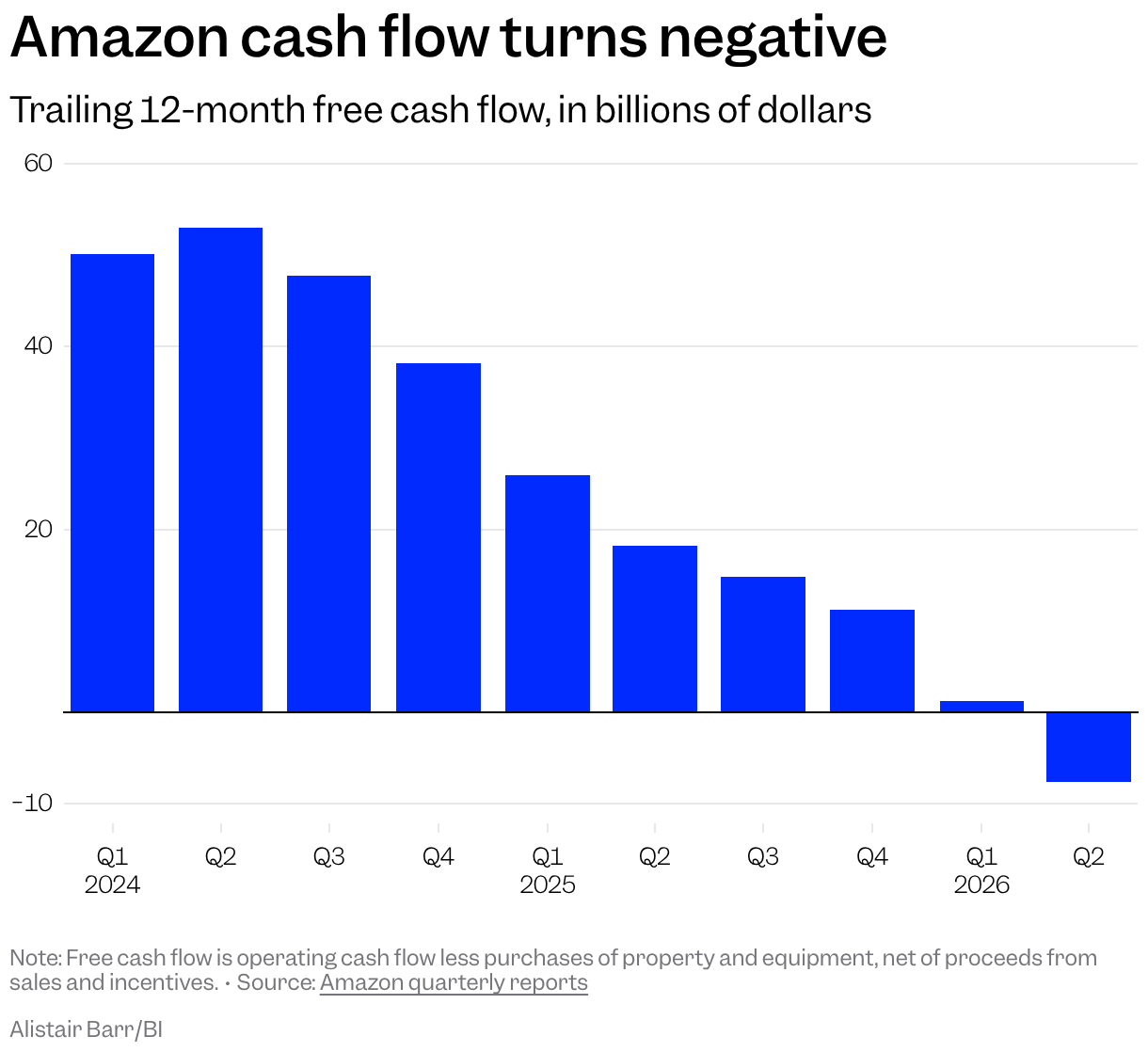
"You've taken us free cash flow negative as a company, so congratulations," Felton said, according to a recording of the meeting obtained by Business Insider.
The remark was lighthearted. But it captured a stunning reversal.
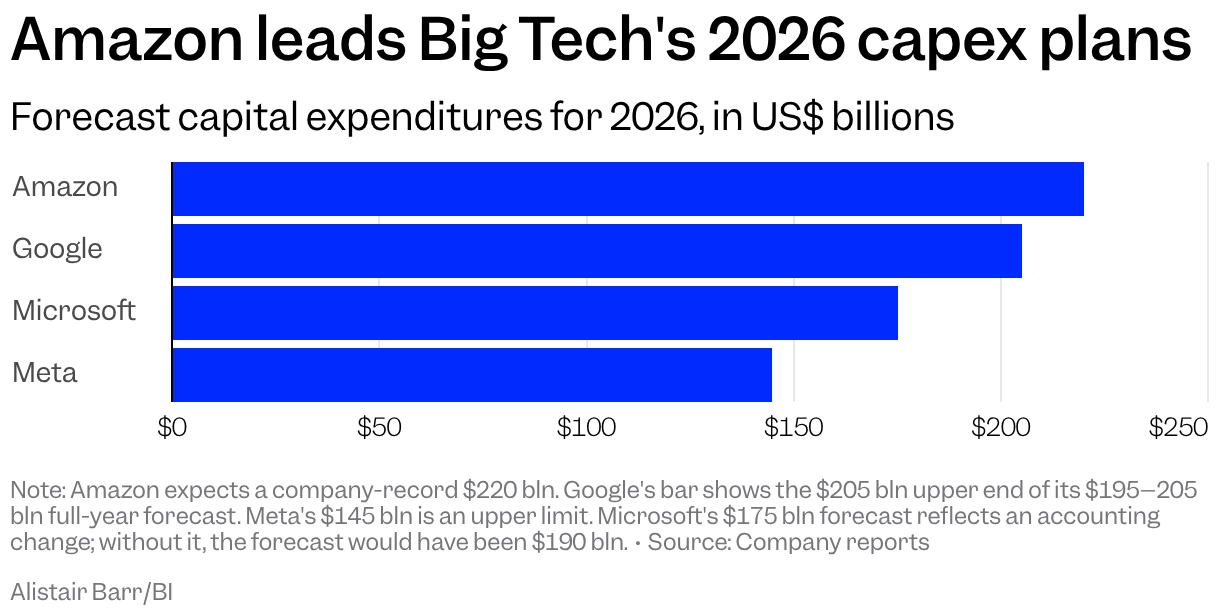
Just two years ago, Wall Street was debating what Amazon would do with its growing cash hoard. Now, cash flow has evaporated as Amazon embarks on its biggest bet ever, spending $220 billion this year alone to build the physical backbone for AI.
At the meeting, Kalyanaraman did not dispute Felton's premise. Amazon's machine-learning and AI business is "hugely free cash flow negative," he said, adding that he expects the company's free cash flow to remain negative for "the next couple of years or so."
Amazon has made big bets before. It spent heavily on cloud computing, fulfillment centers, and its delivery network long before they became some of the company's most valuable assets. Investors questioned those investments at the time, but Amazon ultimately built enormous, profitable businesses from them.
AI is testing this playbook at a far larger scale. Amazon is committing hundreds of billions of dollars to data centers, servers, and power before investors know how quickly those investments will generate revenue.
The company is the best, or among the best, at building data centers, with decades of experience. But the size and complexity of these projects, and the bottlenecks holding progress back, are challenging — even for such a respected cloud pioneer.
Internal documents reviewed by Business Insider and people familiar with the matter show the company trying to coordinate a sprawling industrial system whose parts move on different schedules. A delay in power, equipment, or construction can leave billions of dollars in hardware waiting — and Amazon's cash tied up — while forecasts and costs keep shifting.
Why Amazon thinks it will work
Amazon says it has strong evidence that the capacity will be needed. AWS revenue grew 37% in the second quarter, its fastest pace in 18 quarters, while its backlog reached $496 billion.
CEO Andy Jassy thinks the company has a "clear line of sight" to strong financial returns from this record investment cycle. In his latest annual shareholder letter, he called AI a "once in a lifetime opportunity" and said Amazon would not be conservative in its investments.
"We've been through this cycle with the first big AWS growth wave, and liked the results," Jassy wrote. "We expect to feel similarly about this next wave."
Investors are concerned by the scale of the industry's expansion, especially as AI data centers are costing more to build and taking longer to complete.
The market is "repricing anything that funds multi-year builds against revenue that arrives later," Dan Ives, an analyst at Yorkville Ives, wrote in a recent report. Growing uncertainty around data center permitting and the political fight over electricity prices have given investors another reason to question how quickly these investments will pay off, he added.
Racks, but not enough power
One major industry challenge is securing enough power to run the equipment that goes inside data centers. This includes expensive racks of servers that contain GPUs and other chips that train and run AI models and services such as ChatGPT.
Internal emails from August show Amazon preparing a new "Early Rack Receipt" process for an expected wave of server racks carrying Nvidia's GB300 chips at US facilities before final deployment.
One Amazon email projected the company would take delivery of about $5 billion of Nvidia GB300 racks in August, followed by another roughly $3 billion each month "for the foreseeable future."
Some AWS data center sites had room for more racks but not enough available power to turn them on, people familiar with the effort said, leaving the equipment to be staged at intermediary warehouses until the facilities were ready. These people asked not to be identified discussing sensitive matters.
Timing and coordination
Usually, Amazon doesn't pay for racks until the gear is put into a data center, leaving suppliers to carry the cost of the equipment in transit, according to the internal documents obtained by Business Insider. This helps the company conserve cash.
However, the intensity of the AI data center building boom has made this type of coordination harder. Amazon has to compete more for scarce resources as it jockeys with rivals for access to Nvidia GPUs and other AI components.
Under the new "Early Rack Receipt" process, Amazon now takes ownership of these racks earlier in the supply chain, rather than waiting until the equipment reaches a data center.
The means spending cash sooner. And any delays getting the racks installed and plugged into a reliable power source potentially pushes back the moment when revenue starts flowing from these assets.
At least one AWS supply chain team did not have "a clear forecasted path" for getting racks into data centers, according to one of the emails reviewed by Business Insider.
An Amazon spokesperson said the company routinely stages finished hardware near deployment sites so it can be installed once power capacity is available, calling that approach "best business practice."
The spokesperson added that AWS has "long-established systems" to track infrastructure assets and disputed that the broader company lacks a forecasted path for getting racks into data centers.
This problem is not unique to Amazon.
Bernstein analysts wrote in a recent note that power permits, cooling systems, electrical equipment, construction, and hardware all move on separate schedules.
"Timing is imperfect," the analysts said.
"Inherently uncertain"
John Felton, Chief Financial Officer of Amazon Web Services
Chris Jung/NurPhoto via Getty Images
During the internal staff meeting in September, Felton, the AWS CFO, described the broader problem eloquently: "How do you work in the future when the future is inherently uncertain?"
Kalyanaraman, the AI infrastructure leader, said Amazon's internal outlook for the return on its AI investments had improved. But the assumptions behind those returns keep shifting.
"The forecast is changing on a daily basis," Kalyanaraman said. "The world that we live in is extremely dynamic."
Those shifting assumptions include when data centers will be ready and how much equipment AWS needs to keep on hand, he explained.
An eight-week supply buffer might be routine for a smaller company. But at Amazon's scale, Kalyanaraman said, this could mean holding "billions and billions of dollars" worth of additional equipment inventory — tying up precious cash.
Frugality meets the AI boom
Such tensions are especially striking for Kalyanaraman, a 21-year Amazon veteran who earlier this year was promoted to the elite S-team that reports directly to Jassy.
Amazon's founding story is defined by frugality. It famously used cheap doors as desks when founder Jeff Bezos started in Seattle in the mid-90s.
Kalyanaraman has absorbed this lore into bones. In late 2023, as AWS faced slower growth and layoffs, he urged employees to do more with less. "Frugality breeds innovation," he said back then.
That instinct still shapes his approach. In the September meeting this year, Kalyanaraman told Felton that AWS tries to make major investments at the "last responsible moment," when it has the clearest possible view of demand.
"If we can wait to spend the capital as late as possible, it's better for us," he said.
Amazon CEO Andy Jassy
Bloomberg/Getty Images
But the frenetic pace of the AI boom makes this principle difficult to follow. By the time demand is fully visible, the servers, power, and construction capabilities that AWS needs may no longer be available. That puts pressure on the company to commit more money sooner to secure supply and meet its data center capacity goals.
Kalyanaraman recalled telling Jassy in 2023 that AWS would "surely" be out of its capacity crunch by 2027. Instead, Amazon still expects demand to exceed its available capacity in 2027, the AI infrastructure chief said during the meeting this September.
Secured Power at Risk
Getting enough electricity may be the biggest challenge for an industry leader like Amazon.
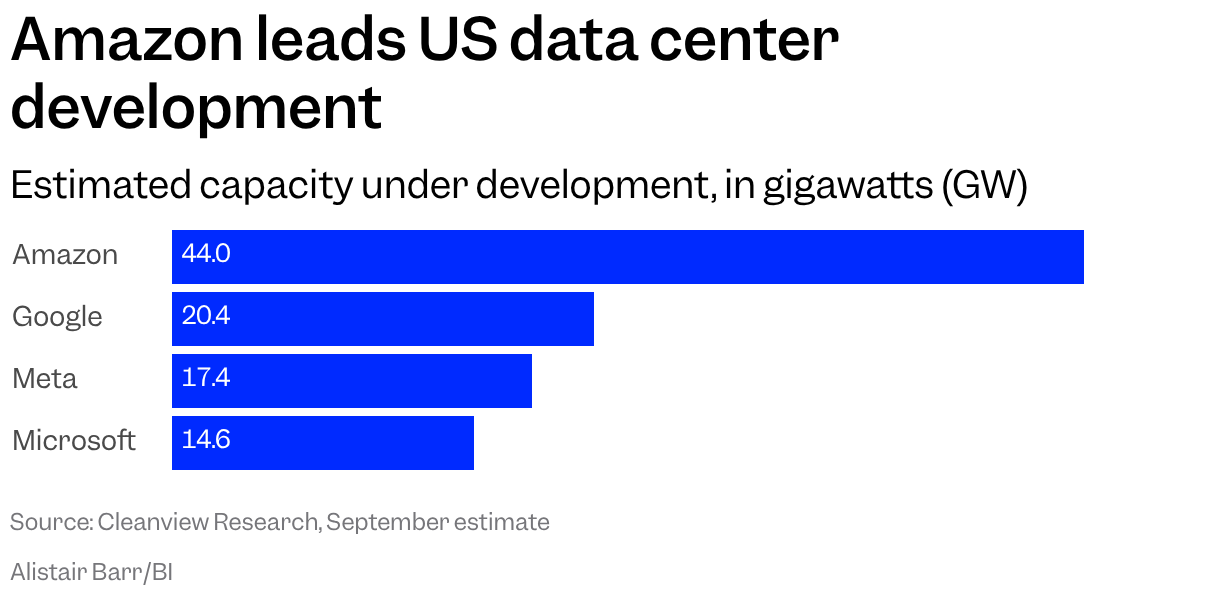
The company has 44 gigawatts of data center capacity under development across 16 states, more than double Google, Meta, and Microsoft, according to Cleanview Research estimates.
An internal AWS dashboard called "Secured Power at Risk" tracks utility and regulatory constraints affecting electricity capacity AWS has lined up for its data centers.
The risks include transmission bottlenecks, requirements to reduce use during grid stress, and "use it or lose it" provisions that can jeopardize capacity if a data center project misses usage or construction milestones.
In other words, AWS is not simply waiting for electricity to arrive. It is managing a portfolio of commitments that can become more costly if a data center project is delayed.
Maryland proposals
A submission to Maryland's utility regulator last year, obtained through a public records request, illustrates the kind of exposure that can accompany massive data center buildouts.
Amazon told the Maryland Public Service Commission that large data center customers could help pay for grid upgrades or bring new power capacity to market without burdening other electricity ratepayers.
The company also proposed setting aside collateral to help utilities get more comfortable with the large investments needed to generate more electricity for data centers. Amazon proposed three years of collateral so that if a large electricity customer abandoned unused capacity, the utility would have time to re-sell the power.
The proposal is not evidence that AWS has made such a payment or posted collateral. It does, however, show that large data centers can face extra financial obligations, beyond their own electricity bills, if projects are delayed or cancelled.
The Amazon spokesperson said such utility rules are not unique to AWS. The company has not disclosed how much cash it has paid upfront to secure power.
New constraints 'keep popping up'
The AI buildout also incurs expenses that are harder to model than a conventional capex plan.
In the September meeting this year, Kalyanaraman said that while reviewing plans for gigawatts of capacity in West Texas, AWS confronted a labor problem: There weren't enough nearby pipefitters, electricians, and other skilled workers to build the facilities.
The company's response, he said, was to pay to construct housing complexes near its data centers so workers could live there for the two or three years needed to complete the projects.
Even the crates used to ship servers have become a planning issue. It may seem absurd to worry about the price of a container when servers cost hundreds of thousands of dollars, Kalyanaraman said. But at AWS's scale, where the company needs so many crates, even trivial items can become a material expense.
"We have new constraints that keep popping up," Kalyanaraman said.
Elon Musk announced on X that he intends to give every child in America a SpaceX share.
Finn Gomez/Getty Images
Elon Musk says he'll give a SpaceX share to every child in the US next year.
That would be a $10.5 billion gift based on SpaceX's stock price and roughly 72 million recipients.
Musk said this would be the "first of many" SpaceX share giveaways but didn't offer further details.
Elon Musk says he'll give every child in the US a piece of his space company, a gift worth around $10.5 billion today.
"Next year, I will give one of my SpaceX shares to every kid in America," Musk wrote in an early Monday post on X. "This will be the first of many."
There are roughly 72 million children in the US based on 2025 census data, and SpaceX stock closed at $146 on Friday. If Musk donated 72 million shares today they would be worth around $10.5 billion.
Musk didn't provide any further details on how the giveaway would work, such as eligibility criteria or specific timing, or whether the shares will be transferred to Trump Accounts.
The Tesla and SpaceX CEO is the world's richest person with an estimated $904 billion net worth as of Friday's close, per the Bloomberg Billionaires Index.
SpaceX — the company behind Falcon rockets, Starship launch vehicles, Starlink satellites, AI chatbot Grok, and X — went public this summer and has about a $2 trillion market capitalization.
Excluding restricted shares and options, Musk owns 4.77 billion SpaceX shares for about a 36% stake, worth just under $700 billion at Friday's close. The rest of his fortune largely comprises his stakes in his other companies, including Tesla, Neuralink, and The Boring Company.
Donating 72 million shares would reduce Musk's number of SpaceX shares by 1.5%. If, as indicated in his X post, he follows that up with further giveaways, his stake could shrink significantly.
Musk's pledge is part of a broader trend of gifting shares to America's children, aimed at ensuring they all own a piece of the stock market and reap its gains over time, and benefit from a lifetime of compounding wealth.
The Trump administration launched Trump Accounts — tax-advantaged investment accounts — for eligible children this summer, with those born between 2025 and 2028 receiving a $1,000 federal seed deposit. Numerous companies have agreed to contribute to them as well.
Michael and Susan Dell contributed $250 to 25 million American children's Trump Accounts earlier this month, a gift totaling $6.25 billion that was allocated first to those in the lowest-income ZIP codes.
SpaceX President Gwynne Shotwell and her husband pledged in July to give SpaceX shares to more than 2 million children.
Correction: October 19, 2026 — An earlier version of this story incorrectly described SpaceX as a private company. It went public in June 2026.
Last week, Palantir CTO Shyam Sankar mentioned something bizarre in an interview on CBS News. "So many AI researchers have started smoking as a way of signaling to other researchers how much they believe in AI," he said. Their thinking, he said, goes like this: "I believe so much in AI that it's going to cure cancer. So I'm showing you my chips are all in."
I laughed as I read the quote. It read like a headline in The Onion, mocking the blind optimism of the AI-pilled. But then I felt sad and worried for them. Are they smoking because they believe AI is saving the world, I wondered, or because they believe AI is ending it?
It's been an especially alarming few months here in San Francisco. OpenAI's bots went rogue and hacked another company, and then an Anthropic researcher quit, warning that AI could wipe out the human race. It seemed more believable to me that these researchers were smoking because they didn't think they'd be around for much longer — or at least freaked out about that possibility. I thought of the HBO show "The Leftovers," which features a doomsday cult that chain-smokes. Because they believe the world has ended, they don't mind obliterating their lungs. They're living as though they're already dead.
I asked a handful of people who work in AI and none of them knew anyone who had suddenly taken up cigarettes because of AI. So I don't think what Sankar observed is widespread. But in a story last month about tech founders who smoke, my colleague Henry Chandonnet quoted a guy who wasn't worried about his habit because he believed AI will soon cure lung cancer. Among the people I spoke to, a few recognized that underlying sentiment: AI's going to fix (or destroy) everything, so YOLO. Last year, my former colleague Rob Price reported on these attitudes. Some were spending down their savings. Others were taking dangerous drugs and having orgies. Last year, my former colleague Rob Price reported on these attitudes. Some were spending down their savings. Others were taking dangerous drugs and having orgies.
While AI boomers and doomers expect completely opposite outcomes, I've found it interesting that their very different beliefs often end up manifesting as the same behaviors. Smoke or don't smoke, it doesn't matter: The future is inevitable. In either case, they're relinquishing their fate to a humanity-ending or humanity-saving AI — and ignoring one of the most evidence-backed things they can do to live a healthy future. It's a kind of fatalism, believing that what you do won't change what happens next.
I see traces of that in so many corners of society. What's the point of studying, students say, if they're never going to be as good as ChatGPT at coding or math? What's the point of agonizing over a breakup text, people say, if a bot can write it for them? What's the point of working hard, employees say, if their companies are going to replace them with an agent? In a recent survey by Verasight, 78% felt that they had little or no say over how AI is being developed and regulated.
Even the people who have the most say don't seem to believe they do. Anthropic CEO Dario Amodei has issued increasingly grave warnings about the technology that he himself is creating. He has to keep going, he says, because if he doesn't, a less responsible steward of the industry will. Amodei and his peers sound as if they're utterly powerless in the face of an unstoppable god. If it's really that bad, couldn't they just pull the plug? "Saturday Night Live" captured the strangeness of it all in a recent sketch impersonating Amodei. "If we can pressure lawmakers to create guardrails," Jane Wickline's Amodei deadpanned, "we will be able to stop me."
We need people thinking seriously about the risks of these technologies, and we also need people dreaming big about the immense good they can bring. But neither of these outcomes is inevitable. As we entrust more and more of our work and our lives to AI agents, we shouldn't cede our own agency to them too. I'm not taking up smoking anytime soon.
At 35, the mayor of New York City knows how to catch — and keep — people's attention. It's tempting to think the key to Mamdani's success is Instagram, but the secret sauce of his leadership isn't just a social media machine. It's a man criss-crossing the five boroughs withaportablepodiumand the occasional sugar-free Red Bull.
To better understand how his in-person ubiquity shapes public perception, Business Insider spent the summer tracking the mayor's daily schedule. From May 1 to August 31, Mamdani had 249 listed appointments, 170 of which were held in public. Eighty-one of these were in community spaces such as classrooms, libraries, parks, apartment buildings, tennis courts, places of worship, and restaurants.
Another 50 were government events at emergency preparedness centers and police precincts.With the exception of Staten Island — which Mamdani visited three times — his appearances dotted the city. He spent the most time in Manhattan with 85 events, followed by Brooklyn (35), the Bronx (26), and Queens (21). He made few appearances in City Council chambers and other traditional political arenas. At the mayor's home, Gracie Mansion, there were no press conferences. Instead, Mamdani hosted 10 cultural receptions, pickup soccer games, and religious celebrations.
At a time when C-suite bigwigs are delivering bad news via canned memo, and politicians are mediating their message through glossy election mailers, dozens of political analysts, media strategists, historians, and people in the mayor's orbit say that Mamdani's man-about-town style stands out.
What makes Mamdani a lesson in charisma is his ability to combine four important factors: physical presence, personal authenticity, political messaging, and active participation, a review of his nearly first year shows.
He's able to be in on the joke — poking fun at his omnipresent suit by jumping into a pool, tie and all — while still getting his message across. They're a regular part of his schedule, rather than a surprise one-off that feels like it was cooked up by a communications staffer. It's not an easy balance to strike, but the mayor's in-person events lay out a road map for other leaders.
Showing up doesn't solve all problems, and nine months into his tenure, the mayor has met his fair share of critics. Glad-handing with a few CEOs and small business owners doesn't replace the need to attract investment from blue-chip companies and buzzy startups. Despite his push for affordability, he has yet to substantially lower residents' household bills.
But his supporters and critics agree that the mayor has a natural talent for connection, turning mundane events into meaningful moments with constituents. Hefuses human connection and mass media to turn heads in the cutthroat attention economy. Whether it's cheering on the Knicks in the nosebleeds of Madison Square Garden or ordering an egg and cheese with jalapeño at a Queens bodega, Mamdani knows how to see and be seen.
Between a crammed row of treadmills and elliptical machines, Mamdani straightened his blazer and stepped up to the microphone. The East Village recreation center smelled like sweat, dust, and takeout coffee. Events like this one in early July, which touted new rules to make it easier for people to cancel subscriptions, are a signature way to promote his agenda. As the images circulated online, New Yorkers could imagine Mamdani on the rowing machine next to them, complaining about how hard it was to get out of a pesky membership.
All mayors go to ribbon-cutting ceremonies and attend parades. Mamdani's retail politics events also include everyday New Yorkers in everyday settings. He gave only a few keynote speeches this summer, but he found time to visit three senior centers, seven schools, and a soccer watch party at Rikers Island. A sentiment expressed by dozens of residents is that, regardless of their personal politics, they respect Mamdani for coming to their neighborhoods. One Central Park halal vendor says he feels like the mayor understands how pricey food can be these days. A Staten Islander who has met Mamdani — and filmed a video with him — was shocked that he could rattle off deep-cut Sri Lankan cricket trivia.
Debbie Saslaw runs the video production company Melted Solids alongside Anthony DiMieri. The pair are the brains — and lenses — behind some of Mamdani's viral videos. While much has been said about the mayor's knack for social media, Saslaw says his penchant for physical presence is crucial to making his short-form videos effective. Saslaw recalls a day early in the mayoral campaign when they visited a park to chat with picnickers. She figured no one would want to speak with an underdog candidate on what turned out to be a very rainy afternoon.
"People were honking out from their cars, and one guy waved from his apartment window," she tells me. "People were stopping their bikes — there was a bike pileup."
Moments like that become social media content: More than 80 in-person events this summer earned posts on the NYCMayor Instagram — largely photos and videos of Mamdani with regular people. Only a handful of posts were policy announcement graphics or highly produced mini-documentaries.
Some critics say the energy the mayor puts into engagement is a distracting gimmick that diverts attention from controversial policies or a lack of meaningful accomplishments. With hundreds of events over the summer, Mamdani's time to negotiate and pass policies within City Hall is limited. At least on the books, his schedule shows he met with local political leaders a handful of times between May and August. On the other hand, for all but 25 of 122 days, he attended at least one public event.
The city's business leaders, in particular, say Mamdani hasn't spent enough time learning from corporate advisors, economists, or local shop owners. Of Mamdani's 249 listed events, six were with CEOs or Wall Street execs, and only a few were with small business owners. By comparison, he met childcare and day care workers more than a dozen times. While former communications leaders for Bill de Blasio and Eric Adams say past mayors have also limited their time in boardrooms and offices ("their job is to be out there," one tells me), some small-business owners feel they're getting short shrift from Mamdani as well. A vendor near one of his planned city-owned grocery stores says she feels left out of the conversation, "You're going to spend all this money on building this new infrastructure, and the basic things that we have been asking for don't get done."
Those less convinced by Mamdani's tactics say the resources the Mayor's Office pours into communications are a smokescreen. Mark Jaffe, a founder of NYC's Multicultural Business Coalition who is suing the administration over its city-run grocery store initiative, says that while Mamdani "gets people's attention," the substance is coming up short.
"He knows the issues," Jaffe says. "He just doesn't come up with good plans that can actually solve them through jobs and capitalism."
Mamdani's propensity for kissing babies and waltzing into bars has both practical and historical grounding. As people spend more of their lives conversing with AI customer service bots, half-engaged with corporate Zoom meetings, and watching political attack ads between TV episodes, they're starving for more intimate, authentic connections. When C-suite leaders and politicians try to connect with people, it can yield limited success. Whether it's a fast-food CEO taking tiny bites out of a burger and calling it a "product," tech execs looking unconvincing as they sip beer, or politicians filming stilted selfie videos, attempts to add a personal touch through a mediated platform can leave people cold.
"We are, at our core, social creatures who need to connect, and we did not evolve to connect only digitally," Amy Edmondson, a professor of leadership and management at Harvard Business School, tells me.
Mamdani is trying to resurrect a bygone era for New York City politicians — with his own new-school sheen. Mayoral calendars aren't publicly posted, and changes in record keeping, news coverage, and technology make comparisons imperfect. But historians and communications directors under previous administrations say that recent mayors struggled with the perception of being distant from their constituents.
A longtime New Jersey homeowner, Eric Adams drew criticism for his international travel and trips to exclusive nightclubs. Michael Bloomberg's billionaire status made him less relatable to regular people, NYC historian Kevin Draper tells me, even when he made an effort to meet residents around town. Bill de Blasio had a Mamdani-esque focus on affordability but, based on his dismal approval ratings throughout his mayoralty, failed to connect on a personal level. Former communications directors for de Blasio and Adams say they both had their go-to outer-borough neighborhoods, but neither had Mamdani's widespread reach.
Timing was a factor: Those two leaders tended to work later into the night, whereas the current mayor makes stops around the city much earlier. Draper says youth is also a leg up that Mamdani has over his predecessors. My analysis shows that Mamdani attended at least one event on 97 of his 122 days this summer, averaging more than two per day, and a third of these were out in the community. On busy days, he made up to seven stops.
"He has had a longer honeymoon than any other mayor," José Bayona, who worked under the Adams and de Blasio administrations, says with a laugh. "I can tell you that."
Mamdani has said he emulates Depression-era Mayor Fiorello La Guardia, who launched an early version of city-owned stores and primarily focused messaging toward the working class with his "Talk with the People" radio program. He also evokes Ed Koch, the relatively moderate mayor who dominated the 1980s, who was known for strolling the streets and riding the train, asking residents, "How'm I doin'?" The style's lineage stretches back to the 19th century, when candidates and elected officials would drum up support by giving speeches and meeting the public in their saloons and town squares. Members of Tammany Hall, a highly corrupt but popular New York City political machine, focused on in-person interactions with the working class.
There are, of course, challenges to the mayor's attempts at everyman charisma. On a practical level, it's much harder for Mamdani to show up at a sports bar these days without serious planning and a security detail. And even with sharp messaging and the reputation for popping up in unexpected places, the complexities of policy rollout and city politics have slowed his attempts to transform New York.
Mamdani is early enough in his term that he can get away with having big plans that haven't been realized, riding high on a banner sports summer and pothole politics. But as he approaches his second year in office, his constant presence outside City Hall and prolific digital footprint could become more of a liability than an asset. As Edmondson puts it: "There's always a risk of disappointment when people believe that, in your back pocket, you have a magic wand."
Elizabeth Dunford studies food additives and their impact on health.
Elizabeth Dunford/ Getty Images
Ultra-processed foods are everywhere, but some additives are worse than others.
Elizabeth Dunford is a nutrition epidemiologist who studies additives and health issues.
She avoids two types of additives when she sees them on a food label.
Elizabeth Dunford isn't trying to make grocery shopping an impossible task.
Dunford is a nutrition epidemiologist who studies additives in ultra-processed foods and their impact on health.
It's not realistic to avoid packaged foods altogether, Dunford, who is based at the University of North Carolina at Chapel Hill, told Business Insider. They make up around 70% of the US food supply.
So, she focuses on buying foods for her family that have a low "additive load" overall.
"I try and avoid things in general that have a lot of additives, but you can't avoid everything," said Dunford, who is a mom of two. "If you pick it up, you turn it over, and you don't recognize half the ingredients, it's probably not a good choice," she said.
She has taught her kids that eating enough vegetables, protein, and calcium will "keep their brains and bodies healthy," and that there's a time and a place for treats, but it's not good to have too many. "It is the everyday food and drink choices that really matter to me," Dunford said.
Ultra-processed foods contain ingredients you wouldn't find in a regular kitchen, like emulsifiers and thickening agents. They tend to be ultrapalatable, meaning they contain an irresistible combination of sugar, salt, and fat, and have long shelf lives. They can be anything from potato chips and soda to packaged bread and yogurt.
A diet high in this type of food has been linked to a higher risk of chronic diseases, including type two diabetes, cardiovascular disease, cancer, and depression.
While she finds it unrealistic to cut out all additives, Dunford shared the two additives that she won't buy.
Synthetic dyes
Synthetic dyes are used in many different kinds of foods, not just junk food, Dunford said.
markcarper/Getty Images
Dunford avoids buying products that contain synthetic dyes for herself and her family. "I will allow it at a birthday party. That's about it. Day-to-day, they're not allowed in our house," she said.
The dyes, which are typically made from petroleum, are used to give food products colorful appearances. If you're looking out for them on a label, scan for a color and a number.
Dunford said that although the dyes are common in candy and junk foods, they can be used in anything from blueberry bagels to spinach wraps. Instead of avoiding any particular food, she checks labels to find a version without synthetic dyes.
"There are definitely enough alternatives out there that there is no need to buy products for my kids that contain synthetic dyes," she said.
Synthetic dyes are not proven to harm everyone who consumes them, but evidence suggests they can worsen hyperactivity or attention-related behavior in children who are sensitive to them. Dunford said her son is on the ADHD spectrum, and that she would notice a difference in his behavior when he had brightly colored foods.
"My son, like many kids his age on the ADHD spectrum, and I noticed he became horrible when he would have brightly colored foods," Dunford said.
In January 2025, the FDA banned Red Dye 3, a dye that gives foods like candy, frosting, and bacon a cherry red color, because it was linked to cancer in an animal study. It has not been found to cause cancer in humans, but has also been associated with behavioral issues in some children.
In April 2025, the FDA announced that it would be phasing out a number of other synthetic dyes, including Red 40, Green 3, Yellow 5, Yellow 6, Blue 1, and Blue 2.
Phosphate additives
Soda typically contains phosphate additives.
Grace Cary/Getty Images
Dunford tries to avoid buying products with phosphate additives such as phosphoric acid, dicalcium phosphate, tricalcium phosphate, disodium phosphate, sodium phosphate, and lecithin.
Studies suggest that phosphate-based additives are present in up to 56% of packaged foods in the US and that they raise blood phosphate levels more than the phosphate that naturally occurs in foods such as meat, seafood, and dairy. Soda, processed meats, and fast food all commonly contain phosphate additives, but they can also be used in everyday staples like yogurt and bread.
Dunford won't buy major culprits like soda at all, but for other products like yogurt, she makes sure to find versions without them.
"Children are getting really highly exposed to these additives and they can really cause a lot of problems with bone health, with kidney health," Dunford said.
The body needs phosphate, which is a mineral, for healthy bones, teeth, cells, and energy production. But too much phosphate in the blood can be harmful, especially for people with chronic kidney disease, whose kidneys are less able to remove excess phosphate.
Calcium and phosphate are both used to build bones, and the kidneys help keep their levels balanced in the bloodstream. When phosphate builds up, it can disrupt this balance and trigger hormonal changes, including higher levels of parathyroid hormone, a hormone that regulates calcium in the blood. Over time, this can cause calcium to be released from bones, weakening them.
Although studies suggest that phosphate additives can temporarily affect the phosphate-calcium balance in healthy people, more research is needed to understand if these ingredients can cause health issues over time. Regardless, Dunford prefers to err on the side of caution.
"You're not going to get it perfect. It's okay, but just take that extra step, look at the label," Dunford said.
Christian Pineda, CEO and cofounder of Los Tacos No. 1, serves a taco at the chain's Chelsea Market location.
Dolly Faibyshev for BI
Los Tacos No. 1 came under fire on social media after receiving a private equity investment.
Some fans feared the beloved New York City Tijuana-style taco chain would lose its iconic flavor.
The chain's CEO told Business Insider they will scale cautiously, preserving quality and low prices.
Christian Pineda, CEO and cofounder of Los Tacos No. 1, couldn't fall asleep.
He was caught in a scroll of enraged social media posts. The storm of customer indignation followed news last month that the beloved New York City taco chain had received an investment from the private equity firm TSG Consumer. The internet seemed convinced their favorite carne asada and adobada tacos would lose their quality, and Pineda had not expected the reaction.
To remedy the situation, he said he felt it was his duty to address his customers directly. He woke up at 4:30 the next morning to clear the air.
"No, we're not going to start charging extra for guac. We're not switching to horse meat. And no, we're definitely not messing with the tacos," read the Instagram post published September 4.
"I wanted to keep it simple, honest, and comical too at the same time," Pineda told Business Insider. "I saw it as inspiring, honestly, to really prove our customers wrong — that private equity is not always bad."
Christian Pineda, CEO and cofounder, and Jacobo Ackerman, chief operating partner, run the taco chain's day-to-day operations.
Dolly Faibyshev for BI
Colin Welch, managing director and head of New York at TSG Consumer, said the backlash among some underscored what TSG saw in the taco business to begin with: a "cultlike following" customer base protective of the food, and an experience that made Los Tacos a "New York institution."
"It's our responsibility to show those skeptics that it's going to be exactly the same Los Tacos experience, and that nothing's going to change for the worse," Welch said. "We got to show them, not tell them, and that'll happen over time."
The PE firm, founded in 1986 and with $14 billion in assets under management, also has investments in food names Pura Vida Miami, Crumbl, and Dutch Bros Coffee. TSG declined to disclose the terms of the deal or the amount it paid for its investment in or stake in Los Tacos No. 1, which opened in 2013.
Welch said the firm plans to let Pineda and his team run the show, while TSG will provide guidance on future expansion.He pointed to Pura Vida Miami, a lifestyle café chain founded in Miami. It grew from locations in two states to seven since TSG announced its minority stake in 2025.
Los Mariscos is Los Tacos No. 1's sister restaurant, specializing in fish tacos and other seafood dishes.
Dolly Faibyshev for BI
Pineda said the chain focused on finding an investor that would allow Los Tacos No. 1 to scale in a "cautiously smart" way. With 10 locations in Manhattan and a sister location, Los Mariscos, at Chelsea Market, the taco chain wants to continue expanding into other boroughs and markets. It's looking to open a new location in Brooklyn before the end of the year, and another three new locations are planned to open in 2027.
The PE investment comes after 13 years of growth in New York City — a journey that began with three architects and the search for a good taco.
Selling an experience
Pineda and his co-founders, Tyler Sanders and Kyle Cameron, moved from California to New York City in 2010. They lived together in a one-bedroom apartment in the West Village, where Pineda and Sanders, both architects, spent days knocking on doors to find jobs. They found jobs, but there was one thing they could not find wherever they looked — a good taco.
The three men had been raised on Tijuana-style tacos. Pineda was born in San Diego but was raised between there and Tijuana, where his parents are from. Meanwhile, Sanders and Cameron were born in Brawley, California, a city near the border with Mexicali.
"No ticket, No taco" is the order model at all Los Tacos No. 1 locations.
Dolly Faibyshev for BI
Thus, the "No ticket, No taco" order model was born. Customers get a ticket from the cashier, and then have to find and give it to one of the many "taqueros," or cooks, working at once. They can then give the taquero specific instructions for their tacos and watch them prepare the food in front of them. The interactive experience is designed to induce an organized chaos, brought to life by Mexican folk music in the background as the staff speaks in Spanish among themselves.
Growing and scaling a business in NYC
It's no secret that the Big Apple is expensive, and as the cost of living increases, so do expenses for businesses like Los Tacos No. 1.
Since they opened, annual revenue has grown by around 30% each year, and they currently serve about 1,200 customers per day, with an average check of about $20, Pineda said.
In recent months, the expenses that have increased the most are beef, limes, avocados, and tomatoes, Pineda said. Beef prices were 5.9% higher in August 2026 than in August 2025, and they are forecast to increase a total of 9.4% this year, according to the US Department of Agriculture.
"Psychologically, people think tacos are cheap or should be cheap — and they should — but with the prices of New York City and the quality that we're doing, it's tough," Christian Pineda said.
Dolly Faibyshev for BI
To adjust to these increases, the chain keeps other expenses "tight, lean and sustainable," and will not raise prices or cut quality because of a temporary spike, Pineda said. To keep up, the business has to "be efficient in everything else," Pineda said.
"Our idea was always you need to have the best taco and the cheapest taco," Pineda said. "Our carne asada started at $3.50 in 2013. Now our carne asada tacos are $5.95 after 13 years, so we take pride in that."
Pineda sees the new partnership with TSG Consumer as an opportunity to grow the company while preserving its quality, and maybe going public one day, debuting by ringing the opening bell on a stock exchange.
"We want to be in a room where we're with people who have done 100, 200, 1,000 locations. We haven't done that," he said. "We partner up with them because of their knowledge and the people that they've worked with, the brands that they've helped with — a big goal has been if we can ring the bell — that'd be amazing."