
Greg Baker/AFP/Getty Images
- South Korea's Kospi has surged 22% from its July low, roaring back into a technical bull market.
- Chip giants Samsung and SK Hynix are powering the rebound after driving much of July's brutal rout.
- Macquarie sees more upside as booming AI demand fuels a memory-chip crunch benefiting the two giants.
South Korean stocks are back in a technical bull market, just two weeks after a brutal selloff.
On Thursday, South Korea's benchmark Kospi closed 4% higher, leaving it 22% above its July 30 closing low and meeting the widely used definition of a technical bull market.
The turnaround has been swift. The Kospi index plunged about 40% from its June 22 peak to its July 30 trough, as a selloff in index heavyweights Samsung Electronics and SK Hynix amplified losses.
On Thursday, Samsung Electronics and SK Hynix closed 5% and 6% higher, respectively, as optimism over AI-driven memory demand lifted chip stocks.
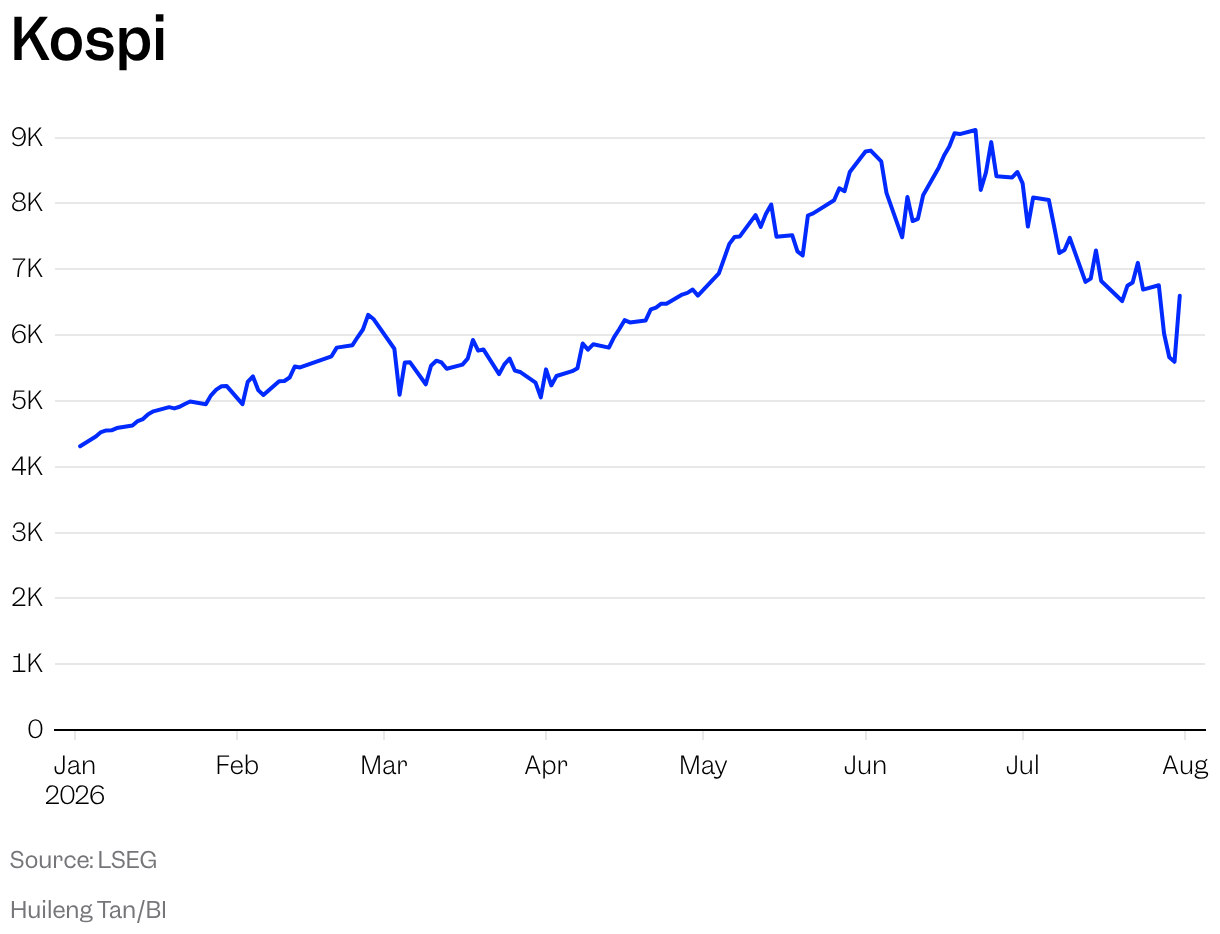
Analysts at Macquarie Capital said July's steep losses — when Kospi plunged 22% — appeared to be driven more by investor positioning and fund flows than a deterioration in fundamentals.
Foreign and institutional selling has stabilized since late July, while margin financing remains at reasonable levels, the bank's analysts wrote in a note on Friday.
"The volatility is over," they wrote.
Being in a technical bull market doesn't mean the Kospi's rally will continue. But August has been calmer so far, with the benchmark index up 3.3% month to date.
Samsung and SK Hynix drove much of July's rout, accounting for 71% of the Kospi's losses. Together, they fell 48%, compared with 26% for the rest of the market, according to Macquarie's analysis.
Macquarie's analysts expect Samsung and SK Hynix to lead the near-term rebound, supported by surging AI-driven demand for memory chips.
"We are facing the worst memory crunch in history and see no signs of supply constraints easing within the next three years," Macquarie said.
Macquarie said AI inference-driven demand is "off the charts," requiring huge amounts of memory even as supply remains constrained and slow to respond.
Macquarie has an year-end target of 8,000 for the Kospi, implying about 17% upside from its current level of 6,813.34.
from Business Insider https://ift.tt/ulM7B9v


No comments:
Post a Comment