
Rawlstock/Getty Images
- Gen Zers are much less likely to have at least one kid than older generations at the same age.
- Not wanting kids, affordability problems, and medical challenges are plausible reasons.
- Having at least three kids is becoming less common across income percentiles, except in the top 1%.
Birth rates in the US have been falling for decades, but there's been an especially large drop in the likelihood of Gen Zers in their 20s having a kid compared with their older peers at the same age.
For 26-year-old Gen Zers, the likelihood of having at least one kid was 26%, down from 47% for millennials, 50% for Gen X, and 46% for boomers at that age. There were also differences between Gen Z and older generations in the probability of wanting another kid.
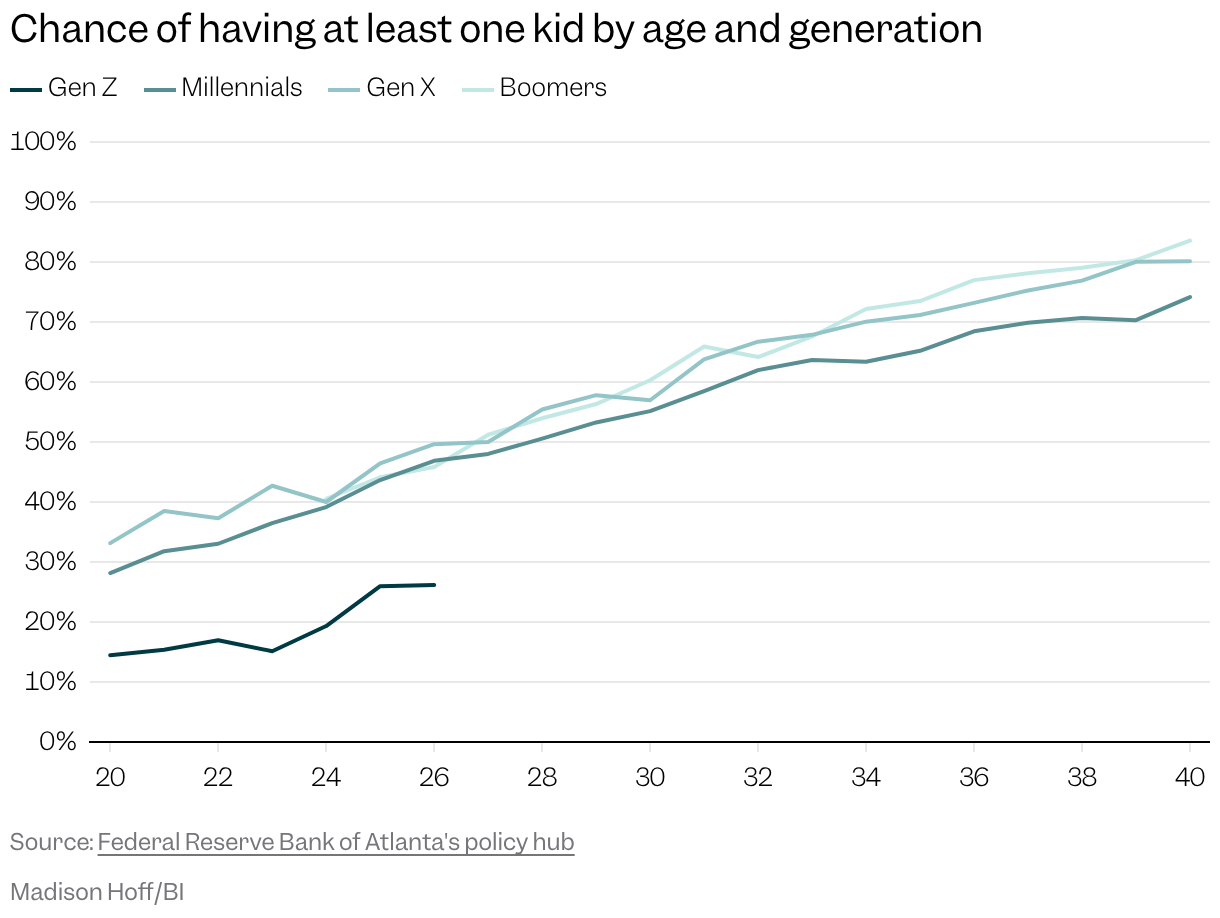
That's based on an analysis by a group of researchers published by the Federal Reserve Bank of Atlanta. Julie Hotchkiss, a research economist at the Atlanta Fed, told Business Insider the analysis controls for education, partnership status, and some health conditions. The analysis uses National Survey of Family Growth data up to 2023.
From affordability challenges to concerns about the future, there are several likely reasons behind the lower probabilities. Hotchkiss said that a lower desire to have kids is one explanation.
Gen Zer Brooklen Farley said in an as-told-to Business Insider essay in 2023 that she decided during college she didn't want to have kids. Farley is worried about issues like the economy and climate crisis.
"Many people call us Zoomers, but honestly, a lot of us are doomers: We feel pessimistic about the future and don't want to subject our children to it," she said.
The research also notes that there's been a rise in medical challenges related to having kids. The researchers looked at impaired fecundity, or trouble becoming pregnant or carrying to term. The average probability of impaired fecundity at 26 was 18% for Gen Z compared to 10% for boomers at that age. The probabilities are higher for older ages — the likelihood for 40-year-old millennials was about 30%, higher than the 26% for Gen Xers at that age.
"If we want to talk about birth rates, we can't just talk about preferences," Hotchkiss said. "It's not just that darned younger generation not wanting, just being selfish and not wanting to have children. There's also really a very real medical issue that needs to be addressed."
Another problem is all the financial costs that come with being a parent. LendingTree found the cost of raising a kid for over 18 years adds up to $303,418 after tax exemptions and credits, or about $17,000 a year.
Affordability issues aren't just a Gen Z problem. Surrounded by a large family growing up, millennial Lizzie Lawson said in a Business Insider essay that she assumed she would also have a large family one day.
"When I was a kid in the early 2000s, my dad was an electrician and sole provider for our growing family of eight," Lawson said in a Business Insider essay, adding that her family got by with the help of coupon cutting and hand-me-downs. "Money was tight, but we also owned a house in a safe suburb, and my parents sent six kids to Catholic school from K-8."
Lawson, a college instructor whose husband is a physical therapist with $100,000 in student loans, said the economy is different from the one she grew up in.
"We can't afford to have one of us stay at home, and there aren't enough coupons in the world to cover the rising cost of day care," she said.
Having large families is rarer than in the past
Michael Konczal, vice president of policy and research at the Economic Security Project, said in his newsletter that across income percentiles, families with at least three kids have become less common since the 90s, except at the top 1%.
"A third kid isn't new for them; what's new is that it has become rarer for everyone else," he said. "Compared with the 1990s, families with three or more kids became less common overall and among the rest of the top 10%. The top 1%'s estimated share barely changed, though the uncertainty is substantial. Maybe all the stresses that made childbearing more difficult over the past 30 years just bounced right off the 1%?"
The US fertility rate has cooled to 1.6 births per woman, below the 2.1 replacement rate, which Hotchkiss said would translate to slower population growth. The Congressional Budget Office projects that just a few years from now, the number of births in the US could fall below the number of deaths, which could have implications in future decades.
"Over time, the negative net contribution of births and deaths increasingly offsets the positive contribution of net immigration, until population growth slows to zero in 2056. The population is projected to shrink thereafter," the CBO said.
from Business Insider https://ift.tt/XmOPNbY


No comments:
Post a Comment